Image
Rural Africa faces interconnected challenges, from climate change adaptation to soil restoration and others, that require more than isolated disciplinary responses. Addressing these complex issues demands research that is both methodologically rigorous and deeply grounded in local realities. Yet too often, research remains technical and fragmented across fields, limiting its capacity to inform holistic, policy-relevant solutions.
In an effort to bridge this divide between statistical rigor and contextual understanding, the University Mohammed VI Polytechnic (UM6P) hosted the Autumn School “Stratégies socio-économiques pour un développement soutenable en Afrique rurale,” an international, interdisciplinary, one-week doctoral training program that combines academic learning, practice workshops, and networking around rural development challenges in Africa. The first edition was held from October 27 to 31, 2025, at UM6P Benguerir campus.
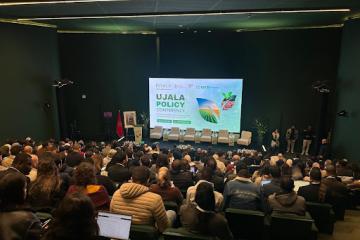
Co-organized by the Graduate School of Economics & Management at Université Paris-Saclay and UM6P, the program brought together more than 25 speakers and 30 PhD students for an intensive week of interdisciplinary exchange focused on rural resilience, climate adaptation, and agricultural transformation. As a partner of the Autumn School, our UM6P-J-PAL Applied Lab for Agriculture (UJALA) led practical sessions on impact evaluation, helping participants design and refine randomized controlled trials through a case-based approach.
This blog draws on the key insights from the Autumn School, and explores UJALA’s contribution to the program, the broader significance of impact evaluation in agricultural programs, and how these lessons can inform future research on rural resilience and sustainable development in Africa.
The Autumn School combined plenaries, technical trainings, and collaborative workshops to connect theory, methods, and real-world policy application. Early sessions emphasized the need to analyze development projects through both statistical reasoning and contextual understanding. Roundtables and interdisciplinary workshops explored public policy challenges in rural regions and systemic approaches to resilience and well-being.
In the following sessions, participants examined how climate change scenarios can be translated into actionable adaptation strategies, engaging with climate modeling, econometric analysis of land-use adaptation, soil restoration as a climate solution, and long-term retrospectives of agricultural systems. Technical sessions also introduced advanced tools for spatial data analysis, evaluation of non-market goods and services, and forward-looking scenario planning.
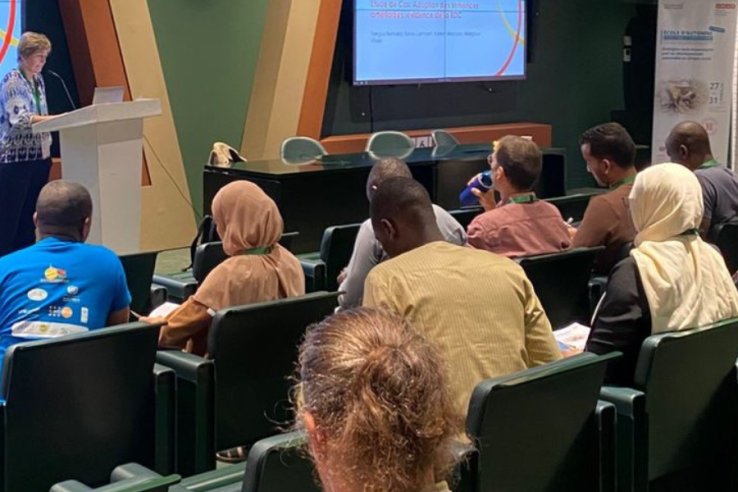
Within this broader framework, UJALA’s contribution centered on measuring the impacts of interventions through rigorous evaluation methods. The randomized evaluation workshop introduced a case study based on “Adoption of Improved Seeds and Deforestation in the Democratic Republic of Congo” by Tanguy Bernard, Sylvie Lambert, Karen Macours, and Margaux Vinez.
Participants were first asked to design an evaluation addressing the same development challenge: small farmers’ access to improved seeds and its implications for agricultural productivity and land use.
Karen Macours’ plenary session then built directly on this exercise. Drawing on the original study, she walked participants through the key components of rigorous evaluation design (i.e., defining the evaluation question, articulating a clear theory of change, identifying data sources, structuring the randomization process, ensuring balance and stratification, and selecting the appropriate unit of randomization). By grounding each concept in the concrete case study and comparing it with participants’ proposed designs, the session made the evaluation design more practical and decision-oriented, rather than purely theoretical.
Throughout the week, doctoral students refined their approaches and reflected on how methodological choices influence both results and policy conclusions, culminating in presentations during a final session. For this closing exercise, groups of participants were tasked with proposing a policy-oriented response to a challenge presented in an assigned case study. The session provided an opportunity for participants to apply what they had learned throughout the week, presenting their analyses and discussing how disciplinary perspectives and methodological tools shaped their proposed solutions.
The value of the Autumn School lay above all in its interdisciplinary design. Participants first worked within their own disciplinary groups before exchanging perspectives with colleagues from other fields. This structured dialogue (i.e., moving from within-discipline reflection to cross-disciplinary exchange) was central to the program. It encouraged researchers to question assumptions, confront trade-offs, and better understand how different analytical approaches interact when applied to complex rural challenges.
A key takeaway was that methods should not be applied in isolation or mechanically. Climate modeling, econometric analysis, systems approaches, and impact evaluation each offer powerful insights, but only when carefully matched to the specific policy question, institutional setting, and local context. Rather than starting with a method, participants were encouraged to start with the problem: What decision needs to be informed? What constraints shape implementation? What contextual factors matter most?
By embedding methodological rigor within interdisciplinary dialogue and contextual reflection, the Autumn School reinforced an essential principle: sustainable rural development requires both technical rigor, contextual understanding, and collaboration across fields.
The Autumn School represents an important step toward strengthening African-led research capacity in resilience, adaptation, and sustainable rural development. By investing in doctoral training and fostering North–South academic collaboration, the program contributes to building a new generation of researchers equipped to navigate complex socio-economic and climate challenges.
Through its partnership in this initiative, UJALA continues to support the integration of rigorous impact evaluation within interdisciplinary efforts aimed at transforming agricultural systems in Africa.
Interested in finding out more about UJALA and collaborating with us? Visit our web page to learn more and get in touch with the team.