

Researcher-Led Evaluations: UJALA’s push for rigorous agricultural evidence
How has this policy lab model evolved?
The UM6P-J-PAL Applied Lab for Agriculture (UJALA) is built on a simple but powerful premise: Evidence is most useful when generated in partnership with those implementing programs on the ground. This is particularly true in small-scale agriculture in low- and middle-income countries, where private companies and service providers play a central role in delivering inputs, advisory services, and market linkages.
UJALA was originally set up with the goal of enabling independent evaluations of programs implemented by OCP Nutricrops. UJALA operates within large-scale, real-world systems where programs shift constantly in response to market dynamics. This setting allows research to both inform and evolve alongside implementation, strengthening the link between evidence generation and its translation into practice.
This collaboration also reflects a broader lesson across J-PAL’s work: Partnerships with private sector actors are critical to generating relevant evidence and scaling solutions that improve outcomes for small-scale farmers.
At the same time, this model can be complemented by approaches that leverage the broader pool of ideas emerging across the agricultural research community. Researchers often bring fresh perspectives and solutions that can be valuable for OCP Nutricrops, particularly those that fall outside current operational portfolios or explore new types of partnerships and delivery models. And, given that OCP Nutricrops operates in a context where programs are continuously adapted and refined, and has demonstrated openness to testing new approaches, there is an opportunity to expand the range of interventions and evaluation designs considered.
Expanding the model: Introducing Researcher-Led Evaluations
Building on this foundation, UJALA is launching a new research track: Researcher-Led Evaluations. This track is designed to support innovative, policy-relevant research in partnership with implementers outside of the OCP Nutricrops network.
UJALA’s existing model is centred on embedded evaluations that assess OCP Nutricrops’ programs designed for small-scale farmers to improve their productivity, profitability, food security, and environmental sustainability. In this model, interventions are developed and implemented by OCP Nutricrops, and evaluations are embedded within these ongoing operations to generate evidence under real-world conditions.
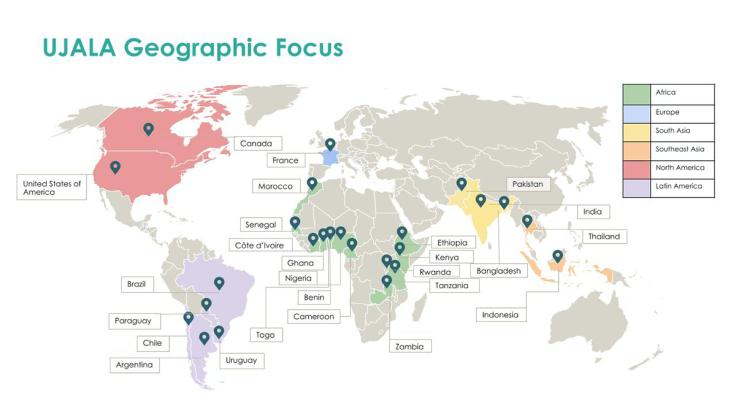
Researcher-Led Evaluations differ in that research teams take the lead in identifying the intervention, designing the evaluation, and partnering with an implementing organization other than OCP Nutricrops. While expanding the range of interventions and partnerships that can be studied, all Researcher-Led Evaluations must align with UJALA’s research agenda and take place in geographies where OCP Nutricrops operates or plans to operate (see map below). In particular, proposals are expected to address one or more of the following priority areas:
- Subsidy schemes to improve food security
- Reducing the reliance of low-income households on imported food
- Overcoming farmers’ constraints to technology adoption
- Improving access to input and output markets
- Fertilizer customization and small-scale farmer outcomes
To support research across different stages of development, from early-stage pilots to validation, adaptation, and long-term impact, and to generate cumulative evidence on what works, for whom, and under what conditions, UJALA offers a range of funding opportunities under this track.
Researcher-Led Evaluations are implemented through a dedicated Request for Proposals (RFP) process, beginning with a required Letter of Intent (LOI) and followed by an invitation to submit a full proposal. Unlike embedded evaluations, where timelines are largely driven by the agricultural calendar and the implementation schedule of OCP Nutricrops programs, Researcher-Led Evaluations follow defined application cycles with clear submission deadlines, allowing for a more structured and competitive selection of projects. The Spring round of LOIs is due on April 30th, 2026.
For more details on the Researcher-Led Evaluations track, including program design, eligibility, application timeline, and submission process, please visit the UJALA Researcher-Led Evaluations page.
Please feel free to contact the UJALA team directly at [email protected]