


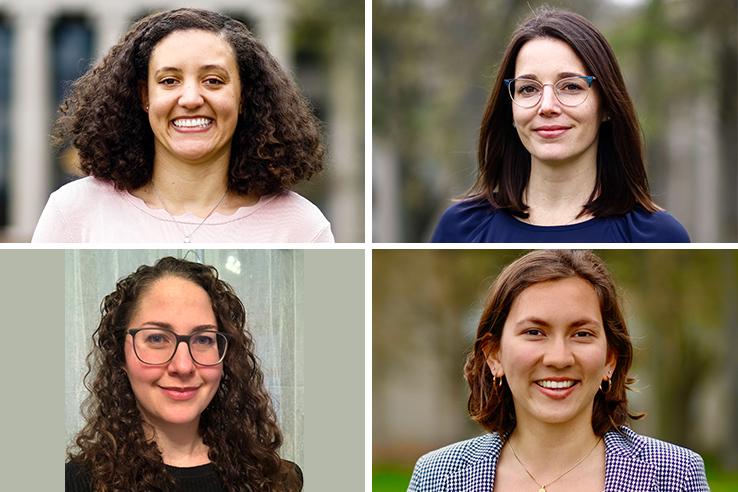
J-PAL North America Staff Spotlight: Homelessness & Housing Stability Team
Bottom row, left to right: Laina Sonterblum, Caitlyn Ark
In the fourth installment of our Staff Spotlight series, we feature three J-PAL North America staff members who have supported our work to expand the evidence base on strategies to reduce and prevent homelessness and encourage long-term housing stability. These team members offer a window into their policy and research roles by sharing about workplace culture and favorite projects.
Amanda Lee
Senior Research Manager Amanda Lee leads our Research Management Support (RMS) and evaluation incubators while supporting the homelessness and housing stability team. Learn about the projects she’s currently working on and hear her insight into the research team at J-PAL North America.
What drew you to J-PAL North America?
I’m definitely happy when my work can make a positive contribution to the world, so the mission really drew me to the organization. J-PAL has a commitment to reducing poverty, which is complemented by a commitment to using evidence—we aim to produce rigorous evidence on programs or policies that impact people’s lives.
Tell me about what you’re working on right now.
I’m managing our Bay Area Evaluation Incubator, which provides training and technical support to direct service providers to design randomized evaluations. This evaluation incubator is unique from previous ones because we’re running multiple projects that are geographically and topically focused. The direct service providers are in California and hope to evaluate the impact of cash transfers on homelessness and housing stability. The evaluation process can last for years, so everything is still in early stages, but we have some promising projects at this point. It’s been cool to see the excitement around the possibility of designing and running these evaluations, both from the partners and from the researchers.
Do you have a favorite project?
One of my favorite projects is AMP Up Boston. It’s a collaboration between Co-Scientific Director Dr. Lawrence Katz; Economic Mobility Pathways (EMPath), the organization providing project services; and the Boston Housing Authority to evaluate a new version of a comprehensive economic mobility coaching program. I’ve been involved in multiple phases of the project—from thinking about design and study protocols, to the IRB submission process, to participant recruitment, to hearing from participants. It’s a local project and it’s nice to feel like I’m having an impact in my own backyard, so to speak.
What might people find surprising about the research team?
Those of us on the research team—whether research associates or research managers—all shape our roles to play to our strengths. We don’t all have to be experts at absolutely every facet of the job. It might depend on the overall balance of the team, but at J-PAL, it’s very possible to bring your strengths to the role and complement the strengths of others on the team.
What interests do you have outside of work?
I sing in a couple of choruses. I’ve been singing in both for over ten years and it is really a lot of fun. One group performs classical works and we often perform with an orchestra. The other is called the Kuumba Singers of Harvard College. The group is mostly undergrads but it’s open to everybody, including non-students and students from other schools. We sing music of the African diaspora, including spirituals, gospel, African folk songs, and contemporary music.
Bridget Mercier
Policy and Training Manager Bridget Mercier leads our housing and homelessness stability team and manages our training team to build the capacity of researchers and practitioners to generate and apply evidence.
What did you do before coming to J-PAL North America?
I went to the University of New Hampshire for undergrad, and after graduating, I knew I wanted to get into the nonprofit space and work in service of others. I grew up in New Hampshire, so I also wanted to explore a new location! I decided to join AmeriCorps VISTA and did two years of service in Los Angeles. My experience as a VISTA Leader for the Los Angeles Unified School District motivated me to get my graduate degree in public administration and public policy and have a broader impact.
After my master's program, I worked for the New York City Department of Education. It was a wonderful way to apply what I had learned in my early career and in graduate school to another educational context.
What do you like most about J-PAL North America?
First and foremost, the staff! I've really enjoyed getting to know my colleagues—everybody's super smart, thoughtful, and supportive.
In addition to being passionate about our mission, it’s nice to work for an organization that is so intentional about the policies and processes we have in place to move our important work forward.
What current projects excite you most?
I'm really excited about the open Housing Stability Evaluation Incubator, where we are looking to identify service providers and other organizations who are interested in assessing the impact of homelessness prevention and reduction programs. This is a great opportunity to provide support directly to organizations to help them design and develop randomized evaluations of their programs.
More broadly, our goal of building a base of rigorous evidence on effective strategies that address homelessness and promote housing stability is incredibly important. Homelessness is one of the most severe manifestations and outcomes of poverty. Given the urgency and importance of providing stable housing to those in need, I’m humbled to have the opportunity to work in this space.
What is your proudest moment here?
Supporting this year’s Evaluating Social Programs course was one of my proudest accomplishments. It was really rewarding to put on a course that helps many different stakeholders get a better understanding of impact evaluation. I was also able to serve as a teaching assistant (TA), working with a small group of participants (many of whom were focused on housing) to further support their learning. I really liked getting to know my TA group members and appreciated all their questions and the way they engaged deeply with the course content.
What is on your travel bucket list?
Two countries that are definitely on my bucket list are Portugal and Greece. I’ve had family members and friends who have gone to both and had the best time, so I’d love to be able to take trips there.
Laina Sonterblum
Laina Sonterblum is a senior policy associate at J-PAL North America, where she supports our work in homelessness and housing stability and education. Read how she incorporates a social work lens into her current policy role.
What drew you to J-PAL North America originally?
I was very drawn to the organization’s mission of building and leveraging evidence to reduce poverty. On top of that, the policy position seemed very dynamic, with the ability to wear a lot of different hats and provide input in a variety of areas, and that was really exciting to me.
How does your current role relate to your professional background?
My background is in social work and I’m a licensed social worker. I think the mission of J-PAL North America and the mission of social work are fairly well aligned; part of the mission of social work is to enhance well-being and help people meet their basic needs, and there’s a particular focus on ending poverty. The two missions complement each other well. Social justice is also one of the core values of social work, and I try to bring that to the table by blending previous direct-practice experience with my current role of looking at policy and poverty alleviation on a more macro and systemic level.
Do you have a favorite work project?
I’ve enjoyed providing technical assistance to organizations in the Bay Area and building their capacity to design randomized evaluations of cash transfer programs. I like collaborating with stakeholders who are on the ground implementing programs and creating policies.
What does your workspace look like?
It is somewhat chaotic and disorganized, but I know where everything is. It’s kind of funny—I love to be organized in my work, but my physical spaces rarely reflect that. I have stuff all around me and it kind of stresses me out, but I also kind of like it.
What hobbies or interests do you have outside of work?
I love every kind of TV—ranging from reality TV like the Bachelor, to Marvel/Star Wars/DC shows, to murder mysteries, and everything in between. You name it, I will watch it. I also love cooking and baking, particularly baking bread. I have found bread to be one of my favorite stress reduction techniques. You need to let it rest, rise, and proof—that’s a very calming time. Then you knead it, which is good for getting out aggression. You have to let it rise a second time, and I’m usually very productive for that hour while I wait. Finally, you get to eat bread, which is another excellent stress reduction strategy.
Caitlyn Ark
Caitlyn Ark is a former policy and research co-op who supported work in homelessness and housing stability; environment, energy, and climate change; and health care delivery. Read about her experiences as a student and co-op.
How did the co-op role relate to your studies?
I’m a fourth-year undergraduate at Northeastern University, which has a co-op program where students are able to work full-time for six months. In my co-op search, I looked for a job at the intersection of health and policy. I am a biology major and have two minors: mathematics and human services. My quantitative background from mathematics and biology applies itself well to the kind of analysis and experimental design that J-PAL conducts. As the context of social work in the United States is crucial to understand before attempting to mitigate social issues, the classes I’ve taken in social change and human services at Northeastern have given me an important framework to apply to my work at J-PAL.
What was it like to be a co-op?
The co-op/internship program at J-PAL is very flexible. Engaging with different programmatic areas has been really rewarding and introduced me to new areas of the policy and research landscape. J-PAL draws upon different perspectives—clinicians, direct service providers, researchers who develop evaluations, state and local governments, and others in the policy world. I think it’s critical to have a diverse range of perspectives at the table. I’ve enjoyed seeing the research process from start to end—from working with external partners to design randomized evaluations, to implementing evaluations ethically, to tracking outcomes, to disseminating results. It’s been eye-opening to see how people affect change.
What did you enjoy most about J-PAL North America?
Something that sets J-PAL North America apart is the people and culture. Everyone is passionate about helping others. The workplace is collaborative, and at every step of management, there are people who care about the work but also care about you, which is not something you find in all workplaces. I’m very mission-driven, and having evidence-based policy at the forefront of everything J-PAL does is one of the things I like the most about the organization. I think evidence-based policy is so important and it’s essential to be driving that type of work.
If you could meet anyone, who would it be and why?
Grant Imahara from MythBusters was so dynamic, funny, engaging, and full of wisdom. Seeing his excitement about science got me engaged with science and experimental design. His work on the show was a valuable representation of Asian Americans in the science world, and it was complemented by his storytelling skills. It’s important to encourage creativity in science. I want to say that we would be friends—which is another reason I want to meet him—but it would also just be cool to meet a role model.
This post is the fourth in a series highlighting staff at J-PAL North America. Previous posts shared about teams working on heath care, communications and fundraising, and state and local innovation. To learn more about our staff and their accomplishments, follow J-PAL North America on LinkedIn.

Cash transfers are an increasingly popular form of support, but there is a need for further evaluation in the context of homelessness reduction and prevention in the United States. J-PAL is committed to expanding this research base through our ongoing partnerships.
Homelessness in the United States is a pressing issue that requires increased research on effective strategies to address it and encourage long-term housing stability. The Bay Area Evaluation (BAE) Incubator supports Bay Area service providers with implementing and evaluating cash transfer programs to assess their impact on homelessness and housing stability. In part one of our BAE Incubator partner series, we explore existing evidence on cash transfers and highlight the need for further evaluation in the context of homelessness reduction and prevention in the United States. Subsequent blog posts showcase the experiences of BAE partners, such as Compass Family Services, Abode Services, and Hamilton Families.
Homelessness in the United States
Nearly 600,000 people in the United States experience homelessness on a given night, according to 2020 data from the Department of Housing and Urban Development, the highest measured since 2013. The Covid-19 pandemic has greatly impacted the way people experience homelessness and housing instability by further stretching the resources of many individuals and families.
Structural discrimination and systemic factors place certain groups at higher risk of experiencing homelessness. Black people and other communities of color, members of the LGBTQ community, people with severe mental illness, survivors of domestic violence, veterans, and other marginalized communities are disproportionately affected by homelessness and housing instability. Housing instability can take many—often uncounted—forms, including living with friends, switching between different forms of temporary housing, or struggling with eviction.
Due to the complexity and variety of ways people experience homelessness, there are many different approaches that aim to tackle this issue. While rigorous evidence has pointed to several promising solutions, additional research is needed to identify and strengthen ways to help people maintain safe and stable housing. With the US federal budget totalling around $7.2 billion annually to prevent homelessness and housing instability, it is critical to evaluate promising programs and examine evidence when allocating funds.
The promise of cash transfers
Traditional methods of support for those experiencing or at risk of homelessness have come in the form of rental assistance, transitional housing, and emergency services such as shelters. In the past few decades, the Housing First approach—which prioritizes immediate housing without preconditions—has become a popular model of assistance, in part due to evidence highlighting its effectiveness compared to traditional shelter-based approaches.
Recently there has been increasing interest in cash transfers as a method to reduce homelessness. Cash transfers often come in two forms: conditional or unconditional. Conditional cash transfers provide monetary assistance on the condition that recipients make certain investments, often in education and health. Unconditional cash transfers provide money to people directly to spend in the way recipients consider most appropriate. This unconditionality not only removes paternalistic oversight that can come with other programming, but also returns autonomy and decision-making ability to the recipient.
Cash transfers have typically been studied in low- and middle-income countries. Although they have demonstrated encouraging outcomes like increasing economic and psychological well-being, physical health, and household purchasing power, there is less evidence of their impact in high-income contexts.
In the past few years, several ongoing pilot studies have emerged that seek to address this gap in knowledge by evaluating cash transfer programs in high-income countries such as the United States. The evidence in this context indicates that cash transfer programs have promising effects, especially in relation to financial stability, health, employment, and wellbeing. More recently, the J-PAL funded Baby’s First Years study showed that unconditional cash gifts to low-income mothers resulted in changes in their infants’ brain activity.
Limited evidence on cash transfers to address homelessness in the United States
Although initial studies of cash transfers show promising results for financial stability and health, only a few studies have assessed their impact on homelessness and housing stability specifically.
Results from two quasi-experimental evaluations in England and the United States illustrate that providing financial assistance to individuals experiencing or at risk of homelessness is associated with greater moves into permanent housing and lower rates of shelter entry. A randomized evaluation in Canada found that a one-time cash transfer to individuals experiencing homelessness led to them moving into stable housing faster and spending fewer days unsheltered.
Additionally, there are a few ongoing randomized evaluations on cash transfers and homelessness taking place in cities across the United States that will further contribute to the evidence base once completed.
Despite preliminary evidence in the field, evaluations with larger sample sizes, varied payment methods and cadences, diverse populations (e.g., adults, youth, and families), and different contexts are still needed to build up a rigorous evidence base that can inform policy decisions.
Generating new evidence on cash transfers and homelessness in the Bay Area
In order to expand the causal evidence base on the impact of cash transfers on homelessness, J-PAL North America is partnering with several homeless service providers in the California Bay Area to bolster their knowledge and capacity to design and implement randomized evaluations of cash transfer programs. The California Bay Area has the third largest population of people experiencing homelessness of any metropolitan area in the United States and this number has continued to increase over the last several years. These partnerships are an opportunity to explore whether cash transfers, paired with existing services, can combat homelessness in a setting that urgently requires comprehensive responses.
J-PAL North America is dedicated to advancing high-quality research and identifying effective strategies to reduce and prevent homelessness and encourage long-term housing stability in the United States. Our homelessness and housing stability team partners with organizations to raise policy-relevant research questions; strengthens organizational capacity to design and implement randomized evaluations; and generates, synthesizes, and utilizes evidence on innovative programs. Organizations and researchers interested in using rigorous impact evaluations to answer policy questions related to cash transfers or other housing-focused programs can read more about our work, subscribe to our Homelessness Reduction and Prevention Initiative newsletter, or contact Bridget Mercier, J-PAL North America’s policy and training manager, for more information.
In the third part of an ongoing Staff Spotlight series, we showcase three J-PAL North America team members who have staffed our State and Local Innovation Initiative.
In the third part of an ongoing Staff Spotlight series, we showcase three J-PAL North America team members who have staffed our State and Local Innovation Initiative, which builds capacity for state and local governments to generate evidence about programs and policies that alleviate poverty through randomized evaluations. These staff and alumni speak about experiences that led them to J-PAL, discuss their academic backgrounds, and share favorite aspects of their roles.
Maria Arzumanov
Maria (Masha) Arzumanov is a policy associate at J-PAL North America. She helps equip US state and local leaders with rigorous evidence to address social problems in their communities, as well as supporting our work in crime and violence prevention and the Environment, Energy, and Climate Change team.
How did you first learn about J-PAL North America?
I heard about J-PAL while earning an MSc at the London School of Economics in the Department of Government. We’d covered J-PAL studies in my classes, and my thesis advisor recommended J-PAL when I was looking for positions after grad school. The application and interview process felt competitive but extremely unbiased, which I appreciated.
What aspect of your role do you enjoy the most?
I enjoy working closely with J-PAL affiliated researchers, like our co-chair for the State and Local Innovation Initiative, Bruce Sacerdote. I actually cited his work in my master’s dissertation (thanks, Bruce!). With my dissertation, I primarily worked independently; I had a thesis advisor, but I alone was responsible for thinking through my research design. Now I support the Request for Proposals process, and I’m able to see how our co-chairs consider research design and identify feasible projects in order to award funding.
Can you share more about your dissertation?
My master’s dissertation focused on how Congressional stockholding impacts the way votes are cast in the House of Representatives. In the study, I employed a Differences in Differences design and exploited the timing of the stock market crash in 2008 to compare voting habits of stockholding and non-stockholding representatives before and after the crash. J-PAL has funded randomized evaluations on political economy and voting, and I’m really interested in potential misalignment between government policies and public demand. In my eyes, J-PAL seeks to reconcile this misalignment by trying to inform policy with what communities need.
How has J-PAL North America helped you in your career goals?
Working at J-PAL has made me more cognizant of how to use evidence in policy, and how so many contemporary policies could be improved by leaning on economics research. I also think there are increasingly more opportunities for federal, state, and local governments to use evidence in their decision-making—the funding provided by the American Rescue Plan is a recent example. In the future, I’m keen to pursue research that fills gaps in our understanding of what policies work.
What’s something you’ve always wanted to do, but haven’t yet?
I like hiking quite a bit, and I’ve wanted to climb Mount Kilimanjaro for a long time. I think my goal would be to climb it and bring a little speaker so I can listen to “Africa” by Toto as the sun rises at the top—I think that would be ideal.
Mera Cronbaugh
Policy Associate Mera Cronbaugh works with US state and local governments to develop rigorous evidence to inform policy and program decisions. Read how her interest in economics and financial services led her to J-PAL North America, and discover her advice for prospective candidates.
What drew you to J-PAL North America?
I grew up in Russia, a country with a very different economic history from the United States, and was drawn to study economics in college. I appreciated that it could be used to understand high-level systems with real impact on communities. Economics was very abstract, however, and so along with economics and Russian, I began studying consumer and family financial services.
During an internship at a financial planning start-up and my time as a peer financial coach at The Ohio State University, it became clear that it wasn’t just lack of awareness or individual-level access that served as barriers to financial inclusion. I witnessed how these services were inaccessible to much of the population in ways that were difficult for individual organizations to address. I was drawn back to economics as a discipline that had the tools to both understand and address these systemic barriers. During my senior year, I learned about the exciting work J-PAL does to translate evidence and data into action to promote community wellbeing and reduce poverty. I started out as an intern after graduation and transitioned into a Policy Associate role in January.
What aspect of your role do you enjoy the most?
I love working on our State and Local Innovation Initiative. I especially appreciate learning about what state and local government agencies across the country are doing to support their communities. I’ve enjoyed actively collaborating with governments to review existing evidence on social programs. Recently, I’ve also supported the design of new evaluations to assess promising solutions to pressing policy challenges.
Do you have advice for prospective J-PAL North America candidates?
J-PAL staff care deeply about the work we do. At J-PAL, your experiences, interests, and passions are valued. I encourage a prospective candidate to share their interests and experiences during the hiring process.
What’s something you’ve always wanted to do, but haven’t yet?
A life goal I have is to climb Mount Elbrus (or in Balkar, Mingi Tau [Минги тау]). It’s the tallest mountain in Europe, located in the Caucasus Mountains in southern Russia and is, in my humble opinion, one of the most beautiful places in the world.
Yiping Li
Former Senior Policy Associate Yiping Li led our work in crime and violence prevention and coordinated partnerships with state and local governments. Read how her life experiences, psychology background, and interest in the legal system led her to J-PAL.
What drew you to J-PAL North America?
I was drawn to J-PAL North America because of my interest in domestic poverty alleviation. I grew up in a low-income neighborhood in Chicago. I remember filling out SNAP applications for my immigrant neighbors as an 11-year-old because they didn’t know where to turn to for help. I remember being excited to work in my local library through One Summer Chicago, a summer youth employment program, after spending previous summers indoors because of lack of available opportunities. Because of my personal experience, I know the potential impact J-PAL’s work can have on people living in poverty, because they are my community. I don’t have to imagine who can benefit from our work; it’s my community that could benefit when we get things right. I’m very glad to be in a position to grapple with these issues and hopefully change things for the better.
Tell me about your educational background.
I was a developmental psychology major and was interested in the research process: how to use experiments to answer questions and use data to back up claims. That made it easier to transition from psychology to economics, even though I only took one economics class. Outside of academics, during all four years of college, I volunteered at a student-run organization that provided free legal information to those navigating through the Massachusetts small claims court system. There, I was shocked that the legal system would make it so difficult for the people it is meant to serve.
When I started leading the crime and violence prevention work at J-PAL, I spent a lot of time thinking about the roles of institutions and policies on an individual’s interaction with the legal system, rather than seeing it as an individual decision. Are there obstacles leading them to criminal activity? Or is there something about their environment that is increasing their risk of interacting with the criminal legal system? How can we work on addressing those factors instead of just focusing on the individual?
What aspect of your role did you enjoy the most?
There are many state and government leaders who have the interests of their constituents at heart and want to use evidence to guide their decisions, but they have capacity constraints. I enjoyed helping leaders to think through strategies and navigate obstacles with their policies and programs.
What is your hidden talent?
I started learning Chinese calligraphy at six years old. When I was nine, my work was included in a published selection of calligraphy. I have a Level 8 certification out of 9 levels. One day, I hope to receive the Level 9 certification, but we will see how it goes.
This post is the third in a series highlighting staff at J-PAL North America. The first post features our health team and the second post showcases our communications and fundraising team. To learn more about our staff and their accomplishments, follow J-PAL North America on LinkedIn.
This Staff Spotlight highlights four J-PAL North America team members who work together to evaluate promising programs aimed at making health care in the United States more efficient, effective, and equitable.
In the first post of an ongoing Staff Spotlight series, we highlight four J-PAL North America team members who support Co-Scientific Director Amy Finkelstein and staff the Health Care Delivery Initiative to evaluate promising programs aimed at making health care in the United States more efficient, effective, and equitable. These staff share about their paths to J-PAL, give insight into their roles, and speak about valuable lessons learned.
Jesse Gubb
Jesse Gubb is a research manager at J-PAL North America, where he supports Co-Scientific Director Amy Finkelstein’s randomized evaluations and develops resources to improve research quality. Learn more about how his academic background led him to J-PAL.
What is your educational background, and how did you come to J-PAL North America?
I have an academic research background, which reflects my interest in research and belief in evidence-based decisions. I focused on political science in undergrad and in my PhD. One thing grad school taught me was I didn’t want to be an independent researcher working in isolation. I wanted to do something on the ground, with a team, and have direct policy relevance. J-PAL was a place where I could do that.
What has been your favorite project at J-PAL North America?
The healthcare hotspotting project, which I worked on when I first arrived, remains my favorite. I showed up when the actual research was complete, so I was able to quarterback the last part—managing the publication and dissemination process. It was challenging because we found a null result for a popular program. That meant considering the interests of our implementing partner while trying to share the results of the study and make a point about the value of randomized evaluations, all while dealing with the unfamiliar world of medical journal publishing and media embargoes. Ultimately, we were able to make a big impact while maintaining nuance. Two years later, people continue to reach out about the study, often with an interest in evaluating their own similar interventions.
What is unique about your role?
I feel like both people within and outside academic research don’t often think that research needs management. It’s not a role I was aware of before coming here. But it’s super important to keep a project moving forward. I coordinate with researchers to make sure everyone is on the same page, and I work with partners to make academic analysis plans feasible on the ground. I even play “pretend lawyer” in trying to get institutions to sign data use agreements or secure IRB approval. There’s a lot of negotiating to make sure a project gets completed. I’m often putting out fires that no one knows about and solving problems before they arise, and that’s very satisfying to me.
If you could witness any historical event, what would you want to see?
We don’t pay enough attention to the 1800s in the US, especially Reconstruction. We miss that era in history class; it’s not part of our American mythology. It was an era where we attempted to construct a pluralistic society and multiracial democracy, which saw a lot of progress but ultimately led to failure. It would be interesting to see that period and understand how it’s instructive to the current time and place. It’s important in this role too, as someone trying to understand policy and poverty alleviation in the US, to consider similar efforts in other periods and learn from them.
Cordelia Kwon
Cordelia Kwon is a policy associate at J-PAL North America, where she supports the Health Care Delivery Initiative, writes and disseminates key policy messages, and encourages the development of randomized evaluations. Learn how her background in global health and qualitative research informs her work.
What is your favorite part about working at J-PAL North America?
I have two favorite things. The first is the people and community. I have some of the most intelligent and supportive coworkers I could hope for. There is great mentorship in the office but also an amazing support system outside of work, which has been so helpful because I moved to a new city for this position.
The second is the mission of reducing poverty by ensuring that policy is informed by scientific evidence. Academic research can be hard to digest, so I love working on the communications team to reach people across platforms and share research results in an accessible way—whether through a tweet, a blog, or an op-ed.
What is your educational background, and how does it relate to your current role?
In undergrad, I studied anthropology and public health, with a minor in Middle Eastern studies. I always knew that I wanted to work in public health but was still figuring out how I wanted to do that. Initially, I was interested in humanitarian work and health systems for migrants and refugees. I learned a lot about global health systems while studying abroad in Abu Dhabi, Australia, Ghana, and Europe, and thought I would go into global health work.
But when Covid-19 happened, there was increased visibility of the Black Lives Matter movement as well as a rise in hate crimes against Asian Americans—which is very relevant to my own community. Those events made me want to focus on domestic issues, which led me to J-PAL North America.
Even though I studied global health, my previous experience still applies because we can learn from other countries about what works. My background in qualitative research also comes up a lot in staff conversation, as some other members of our policy team don’t have a background in economics. We can have open conversations to constructively critique the work we do and look at our studies from different perspectives.
What valuable career lessons have you learned so far?
If you care about a job, you can do the job. It’s important to be passionate and eager to learn—I come from a qualitative background and had to study randomized evaluations before my interview, but I learned!
I wasn’t fully confident during the application and interview process because I kept thinking: “I’m not an economist; I don’t have my master’s; I don’t have the same experience as the other staff.” Now I know there are so many staff members here to support me as I learn new things.
Instead of feeling uncomfortable because you don’t know something, be open to exploring a new field. It’s easy to want to be the smartest person in the room, but if you’re willing to learn, you have more opportunities for growth and change.
Hannah Reuter
Hannah Reuter is a policy manager at J-PAL North America, where she oversees the Health Care Delivery Initiative. Discover how she came to work in evidence-based policy and her favorite parts about working at J-PAL.
What is your professional and educational background?
I graduated from University of Massachusetts, Amherst where I studied political science. I served as an AmeriCorps member as my first job out of undergrad. A large part of my service was focused on food security for the local community. While I really loved working in direct service, I was frustrated because there always seemed to be systemic issues that I couldn’t fix at the direct service level.
So I decided to go back to graduate school at NYU Wagner for my Master’s in Public Administration. I was then introduced to the world of evidence-based policy through my first job post-grad school, where I worked to connect individual researchers and with state, local, and federal policymakers. Then three years ago I came to J-PAL, where I now lead our Health Care Delivery Initiative.
How does your role at J-PAL North America relate to your background?
I don’t think I’d be here if I hadn’t gone to the particular grad program I attended. For one, it was there that I was exposed to Poor Economics and the work of J-PAL. My graduate work also opened my eyes to a different way to think about policymaking, beyond the party politics that we see on the news or that I was exposed to as an undergrad. Policymaking is about building consensus, and while evidence isn’t the only tool to build consensus, it can be a really compelling one.
What aspects of your role do you enjoy the most?
I’ve really enjoyed working with policymakers on custom trainings. Policymakers will come to us and express interest in evidence but don’t know where to start. Those trainings open an opportunity to problem-solve collaboratively with a non-research audience. While we can’t solve every barrier to evaluation in a short session, I’m proud of the work we do to explain why evaluation is important, how it can be used in their work, what the limitations are, and the viable ways to work around those limitations.
More generally, I love that J-PAL convenes a group of researchers who are trying to make their work useful and relevant to a community beyond other researchers. Research for research’s sake is great, but I think it’s important that it gets used and doesn’t remain behind a paywall.
If you could live in one other era of history, when would it be?
I would love to go back to France in the 1400s and follow Joan of Arc around. There is such a mythology around her and it’s hard to disentangle her Saint story from her story as a real, living woman. She convinced really powerful men to do things that didn’t make any sense, and I’m fascinated by that.
Lisa Turley Smith
Lisa Turley Smith is a research associate at J-PAL North America, where she supports Amy Finkelstein’s research portfolio. A certified “J-PAL Groupie,” find out how Lisa found J-PAL and her favorite parts of her role.
How did you first learn about J-PAL North America?
I first learned about J-PAL during my sophomore year of undergrad from one of my economics professors. I was interested in more practical applications of economics, and she recommended I look at J-PAL. After looking at the website, J-PAL just seemed right in line with my thinking about how we should use evidence and quantitative research to tackle development and poverty alleviation. The next semester, I read Poor Economics by Abhijit Banerjee and Esther Duflo. It was my favorite book—I’ve probably read it three times since. So I had heard about J-PAL very early on and it became one of my goals to work at J-PAL one day. I was very excited when I got this position at the North America office. At orientation, I became known as the “J-PAL Groupie” among the staff.
What aspect of your role do you enjoy the most?
I knew that in my career I wanted to make an impact somehow. Prior to coming here, I worked in direct service. I’ve worked at an immigration firm and I also tutored at a high school with a high immigrant population. That work was really gratifying, but it was also really exhausting. At the end of the day, I knew I couldn’t change the systemic issues they were facing. I realized I wasn’t personally suited for direct service.
In this role, I love working with data, no matter the topic. But being able to tell a story with the data and answer big questions makes me feel that I can still make an impact without burning myself out.
What valuable career lessons have you learned so far?
One thing that I’ve really taken in is that it’s really important to get perspectives from people who have very different life experiences at each step of the research process. People will interpret results so differently depending on their life experience, and that’s really important to acknowledge.
The other lesson I find important is that you can rely on the people you work with. If there’s a coding problem or if there’s something that isn’t coming out right, it’s always better to get input from someone else. The expertise of your co-workers is one of your greatest resources, especially here at J-PAL North America.
What does your work-from-home set-up look like?
It changes all the time. I usually work in our spare room, and that works pretty well, but it’s also where my partner works. If we ever have meetings, I move downstairs to the living room and work at the folding table there. And if we don’t have childcare on a given day and my toddler is napping, I need to work on the other side of the apartment. I’ve really just had to make any space work!
This post is the first in a series highlighting staff at J-PAL North America. Other installments feature our communications and fundraising team and state and local team. To learn more about our staff and their accomplishments, follow J-PAL North America on LinkedIn.