

Remedial Education to Address Learning Gaps in Secondary Schools in India


Many students in secondary schools in low- and middle-income countries are significantly behind grade level, raising concerns about how rigid curriculum affects learning outcomes. To address this, researchers conducted a randomized evaluation to test the impact of an in-school remedial education program on student learning in Odisha, India. Both the standard and a version that allowed teacher flexibility improved student test scores without reducing grade- level mastery or affecting the likelihood of passing exams.
Policy issue
Public-sector organizations often face a fundamental trade-off: whether to allow workers discretion to adapt services to local needs or enforce rigid, standardized rules to ensure uniform delivery. Education systems face a similar tension. Low learning levels among secondary school students are a persistent challenge in many low- and middle-income countries. Public schools often follow a standardized curriculum that assumes students are performing at grade level, even when many are years behind. Despite this gap, teachers are expected to deliver grade-level content on a fixed schedule, often enforced by high-stakes exams.
While teaching students at their level has shown promise in primary education, there is limited evidence on its effectiveness in secondary schools, where learning gaps are wider and classrooms more mixed in ability. Policymakers also worry that giving teachers flexibility could lead to poor teaching or reduced effort. This evaluation addresses a key question: Can remedial education help secondary students catch up without harming those already at grade level, and could giving teachers more flexibility help to amplify these gains?
Context of the evaluation
In India, many students enter secondary school far behind grade level. Grades 9 and 10 are a critical bridge to higher education but are associated with high dropout rates, especially among girls. Students often lack the foundational skills needed to understand advanced material or succeed on the high-stakes Class 10 board exams.
In the Indian state of Odisha, about one-third of the population lives below the national poverty line. Nearly half of its secondary students fail to meet basic international benchmarks in math, though the top 5 percent outperform peers in other low-income countries, highlighting stark learning disparities. This study focused on 300 government secondary schools in two largely rural districts, Jajpur and Dhenkanal. Among those in the study, about 40 percent belonged to Scheduled Castes or Scheduled Tribes (disadvantaged groups in India), and 15 percent had parents who could not read or write. At the start of the program, the average Class 9 student was 4–5 grade levels behind in English, math, and the local language Odia, and nearly half tested below Class 3 competency.
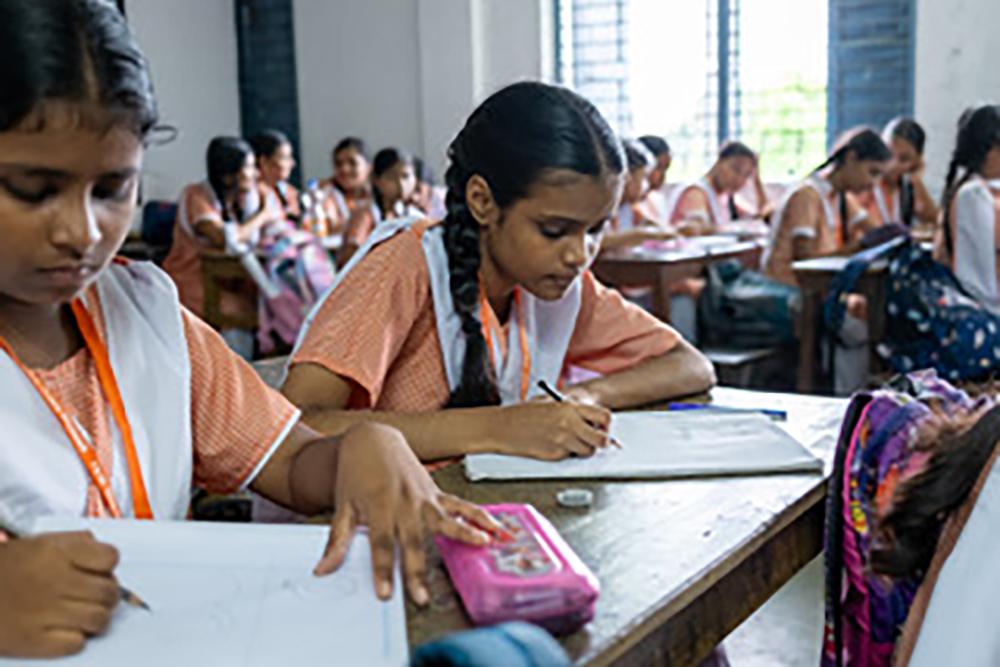
The Utkarsh (“Excellence”) program, developed by Transform Schools, People for Action, and the Kusuma Trust UK, and implemented with the Odisha Department of School and Mass Education, aims to help Class 9 students strengthen foundational skills and prepare for board exams by leveraging existing teachers and class time. It combines remedial and grade-level instruction across three phases: 18 days of basic skill building (Foundation Camp), 45 days to reinforce and apply these skills (Supported Learning Phase), and 6 days of grade-level preparation (Consolidation Camp).
Details of the intervention
Researchers partnered with Transform Schools, People for Action (PFA), and the Odisha Department of School and Mass Education to conduct a randomized evaluation to measure the impact of two variations of Utkarsh. Researchers randomly assigned 300 government secondary schools in the Jaipur and Dhenkanal districts to one of three groups:
- Standard group (100 schools). These schools received the full version of Utkarsh. Teachers were trained in a one-week session and provided with teaching and learning materials, including daily topic outlines and student worksheets, organized into class- specific phases covering concepts from Classes 3–8. They were instructed to implement topics and lesson plans according to a pre-specified schedule. Lessons were not fully scripted, and all instruction occurred during the regular school day using existing teachers and infrastructure.
- Flexible group (100 schools). These schools received the same Utkarsh training and materials as the standard group, but teachers were given the guidance that they had the flexibility to adapt topics and/or timelines according to the needs of their students.
- Comparison group (100 schools). These schools did not receive the Utkarsh program and continued with the regular curriculum and teaching.
Before the program began, researchers administered tests in Odia, math, and English to understand students’ initial skills. To understand how the program was being implemented in practice, they made unannounced classroom visits during the intervention, when schools were expected to be carrying out FC or SLP. About four months after the program began, researchers administered surveys and standardized tests in Odia, math, English, and science to measure learning outcomes. Because regular Class 10 exams were canceled due to COVID-19, they later collected administrative data on Board Marks, based on a weighted average of their teacher- assigned Class 9 (40 percent) and Class 10 (60 percent) scores, and conducted a follow-up phone survey to track students’ schooling and employment outcomes.
Results and policy lessons
Both the structured and flexible versions of the Utkarsh remedial education program improved student learning in similar amounts relative to the comparison group, without crowding out grade- level skills, and were cost-effective.
Short-term learning gains. Students in both Utkarsh groups scored an average of 0.11 standard deviations higher in Odia, English, mathematics, and science at the end of the school year relative to the comparison group’s learning progress of 0.19 standard deviations in the same period. In practical terms, this roughly translates to 60 percent of a typical year of learning, meaning students learned in one term what the comparison group would normally achieve in a little over one and a half terms. The likelihood of achieving Class 3 or Class 5 competency rose by 3–8 percentage points, depending upon subject, relative to the comparison group. However, there were no differences in full Class 9 mastery between the program and comparison groups. Researchers noted this was unsurprising because the program’s four-month timeframe was too short for students who were 4–5 grades behind to catch up fully, and importantly, students already at or near grade level did not fall behind, indicating the program did not harm higher-performing students.
Longer-term outcomes. Students in the intervention groups did not pass the exams at higher rates, as pass rates were already extremely high—over 99 percent in both program and comparison schools. However, students in the Standard Utkarsh arm received slightly lower average Board Marks, a pattern researchers interpret as consistent with teachers’ more realistic grading after better understanding students’ true learning levels through the program’s leveling exams and exposure to remedial content. The effect on Board Marks for the Flexible group was about half as large, and the evidence did not clearly rule out chance as an explanation. Two years after the program, researchers found no measurable differences in school enrolment or employment outcomes between students in the program and comparison groups.
Teacher engagement and program delivery. Researchers found no evidence that flexibility reduced teacher effort or resulted in neglect of duties. Even without explicit flexibility, many teachers adjusted lesson pacing and content to match student needs: nearly 77 percent of comparison group teachers and 78 percent of Standard Utkarsh teachers reported they could adjust content if students struggled, and this rose to about 84 percent in the Flexible arm. Only 82 percent of Standard Utkarsh teachers and 73 percent of Flexible Utkarsh teachers stayed within one week of the official timetable. While teachers in the flexible group made slightly more deviations from the prescribed schedule, they largely continued delivering remedial material. Teachers in intervention schools also developed more accurate perceptions of their students’ abilities by the end of the program, reducing their estimates of student’s literacy and numeracy by 5–11 percentage points.
Cost-effectiveness. At a 200-school scale, the program cost approximately US$11.64 per student, with both versions equally cost-effective. This translates to a gain of 0.95 SD in overall test scores per $100 spent. This places Utkarsh among the most cost-effective secondary school interventions documented in South Asia, comparable to Mindspark, which increased learning outcomes by 0.93 SD per $100 at a 50-school scale and the eLearn program which increased test scores by 1.4 SD per $100 at a 200-school scale.
In structured education systems, improving service delivery may require adjusting rules and giving teachers more freedom to respond to local needs. While there are often concerns about disrupting established routines, researchers found that teachers were able to successfully adapt to a new, more effective classroom approach that benefited both them and their students.
Use of Results: The Utkarsh program has been scaled up both across the original state (Odisha, population 40 million) and also in new states (Karnataka, population 60 million; Chhattisgarh, 30 million; Haryana, 25 million; and Himachal Pradesh, 7.5 million). As of 2026, it has reached more than 12.8 million students. The government of Odisha is also considering expanding the model to Grades 6-8 starting in 2026-27. As a direct outcome, state governments have collectively allocated approximately US$10 million (≈INR 90 crore) to scale and sustain program models informed by the Utkarsh evaluation.
Drawing on this evidence, the state governments of West Bengal, Telangana, Tamil Nadu, and Tripura have applied the Utkarsh framework to pilot implementations of remedial education programs, adapting the model to state‑specific policy priorities. Discussions to support implementation are also underway with the state governments of Jharkhand, Madhya Pradesh, Maharashtra, and Rajasthan.
Beg, Sabrin A., Anne E. Fitzpatrick, Jason T. Kerwin, Adrienne Lucas, and Khandker Wahedur Rahman. “When Given Discretion Teachers Did Not Shirk: Evidence from Remedial Education in Secondary Schools.” Working paper, December 2024.