

Digital Credit to Support Farmers’ Input use and Productivity in Ghana
- Farmers
- Earnings and income
- Household finance
- Savings/deposits
- Credit
- Digital and mobile
- Savings
- Monetary incentives
- Non-monetary incentives
- Vouchers



Traditional credit providers like banks and microfinance institutions are often wary of extending credit to small-scale farmers, fearful that they will inherit the risks inherent to farming. With limited access to formal credit, many farmers must rely on costly, informal loans. Researchers conducted a randomized evaluation of a phone-based digital finance program that offered farmers agricultural inputs on credit. The program increased farmers’ spending on farm inputs, yet it did not lead to higher crop output, sales, or profits on average. Researchers point to implementation challenges in the timely delivery of loans as a reason for the limited impact on farmers’ yields.
Policy issue
Small-scale farmers often have limited cash at planting because they have already spent income from the previous harvest and have limited access to affordable loans. Therefore, they often invest less than they would like, limiting their productivity or, they or turn to expensive informal borrowing.These challenges reflect broader financial market imperfections. On one side, farmers lack credit histories and collateral, which discourages formal lenders. On the other side, limited access to timely credit prevents farmers from fully benefiting when it’s most needed at planting, constraining their productivity and income.
Digital tools may offer a possible solution, by lowering the cost and effort of lending and borrowing, yet research on digital credit is nascent. Digital platforms can reduce the need for paperwork, travel, and in-person screening, making it easier for lenders to reach farmers and for farmers to apply for loans.
Context of the evaluation
Agriculture plays a central role in Ghana, employing about 52 percent of the workforce, and is dominated by small-scale agriculture, with most farms under 5 hectares. Despite high mobile phone ownership, reaching at least 84 percent of the population, only about 40 percent of adults hold a bank account. This gap makes it difficult for traditional lenders to serve farmers but also points to the potential of digital financial services.
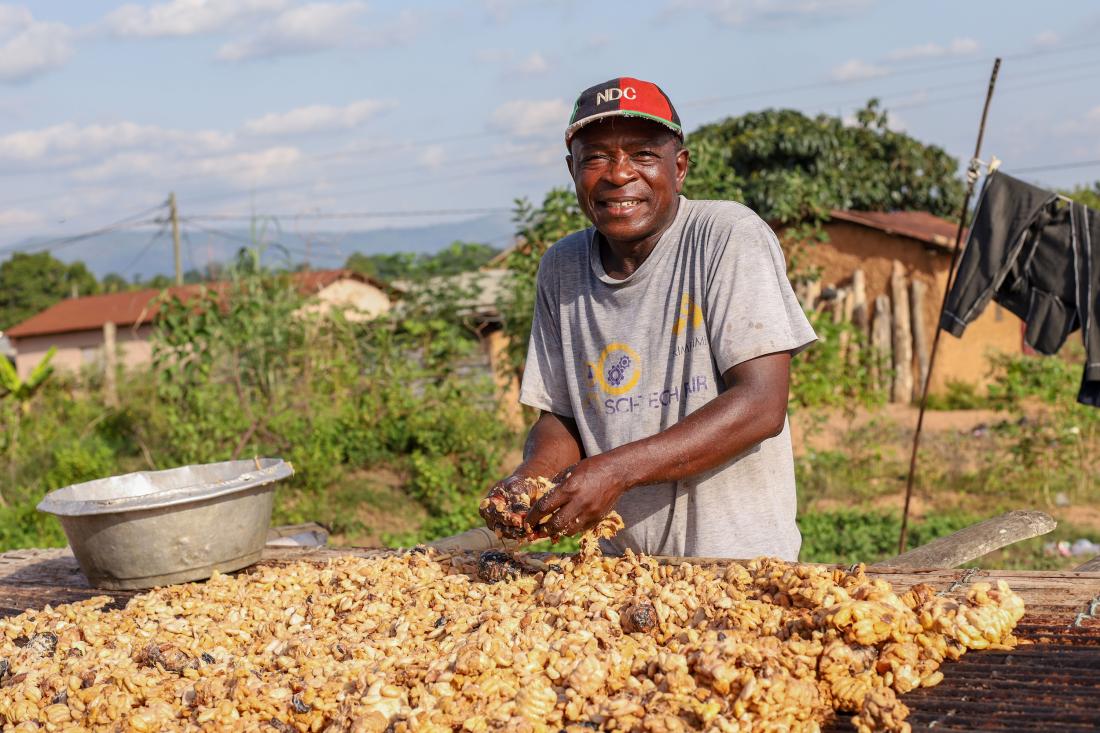
Farmers in this study were from the Ashanti region, a major cocoa-producing area in southern Ghana. Most farmers were men, with women making up about one-third of the sample. About half of households also operated a non-farm business alongside agriculture. Average farm profits were around 2,500 Ghanaian cedis (approximately US$535) but earnings varied widely. Access to formal credit was limited: Only 11 percent of farmers in the study reported borrowing from a formal financial institution in the previous year, while about 21 percent borrowed from informal sources.
Details of the intervention
Researchers partnered with Farmerline Limited, a social enterprise, to evaluate the impact of its Mergdata Digital Finance Module, a phone-based digital finance program that facilitates rapid credit rating and loan provision in the form of agricultural inputs rather than cash, including fertilizers, herbicides, or insecticides. Researchers randomly assigned 1,372 farmers who had applied for and been deemed eligible for credit to one of two groups:
- Digital credit group (917 farmers): Farmers were offered agricultural inputs on credit through Farmerline up to about 350 Ghanaian cedis (approximately US$75 in 2018). Farmers began repayment three months after receiving the inputs and had up to six months to repay the loan at an interest rate of about 4 percent per month. The repayment schedule was designed to align with the agricultural cycle so that farmers could repay after harvest.
- Comparison group (455 farmers): Farmers were not offered loans but could continue to use Farmerline’s other services (e.g., weather forecasts, market price information, and farming advice through the Mergdata platform).
The program aimed to deliver inputs within 30 days of the loan application, before the optimal planting period. In practice, only about 25 percent of borrowers received their loans within this timeframe, while roughly 75 percent received them later than planned. Moreover, only 59 percent of farmers assigned to the digital credit group ultimately received a loan, while about 17 percent of farmers in the comparison group also received loans due to operational errors in the distribution process.
To measure the impact of the program, researchers conducted follow-up surveys in mid-2020 and collected data on agricultural investments, crop production, sales, profits, land use decisions, borrowing behavior, health, and well-being.
Results and policy lessons
Digital credit enabled farmers to increase their agricultural investment, but it did not improve their agricultural output or profits on average. Delays in loan delivery limited the overall impact of the intervention.
Farm input expenditures: Farmers offered digital credit increased their expenditure on farm inputs by about 11 percent relative to farmers in the comparison group. The largest increase occurred for hired machinery, which was not an input directly offered on credit. This indicates that farmers also increased spending on complementary farm inputs. However, these effects were driven entirely by men as women spent less on farm inputs.
Agricultural production and profits: Despite increasing their farm investment, farmers offered credit did not increase their crop production, sales, or farm profits. Researchers explained the delays in loan delivery prevented farmers from applying inputs at the optimal planting time and limiting productivity. Farmers who received loans within the intended 30-day period, compared to those who received them late, increased their expenditure on fertilizer and saw higher crop production and sales. Their profits though did not increase. This highlights the importance of timely credit aligned with the planting cycle to enable productive investment.
Land use decisions: Farmers offered credit increased the amount of land used for mixed cropping, suggesting that relaxing credit constraints may have encouraged diversification in farming practices. However, they did not change the amount of land used for a single-crop cultivation.
Non-farm activity: Male farmers offered a loan were 10 percent less likely to operate a non-farm business relative to the comparison group. However, female farmers made more non-farm business income, largely through increased activity in existing enterprises. This demonstrates that women farmers did not fully use the farm inputs they received or potentially gave them to their husbands.
Health and well-being: Farmers who received credit placed themselves higher on a self-reported social ladder measuring perceived economic status compared to those who didn’t. They reported no differences in food security or psychological distress.
Overall, the results suggest that digital credit programs can help farmers make productive investments, but credit alone may not increase agricultural productivity. Credit timing is key: Inputs must arrive before the planting period for farmers to use them effectively. Even then, credit may not be a sufficient tool to help farmers increase productivity and profits.