

From training to impact: Strengthening foundational learning in Ghana
This is the second blog post in a series highlighting how UNICEF and J-PAL are working together to strengthen evidence use in education. The first blog post reflected on insights from global experts working to adapt and scale evidence-based education programs. This post builds on the first by exploring the on-the-ground experiences of two education practitioners in Ghana who are putting those ideas into action.
We first met Agnes and Fati through the 2024 J-PAL/UNICEF Learning Academy, a training that paired J-PAL’s Evaluating Social Programs online course with virtual group discussion sessions. Designed for education practitioners and government partners, the Learning Academy aimed to build skills for using evidence to strengthen foundational literacy and numeracy programs. Over the course of four weeks, participants had the opportunity to learn from one another’s experiences and apply course concepts to their own work.
Agnes Arthur is an education specialist with UNICEF Ghana, and Fati Issifu, a former teacher and first runner-up of the 2022 Ghana teacher prize, works at the nonprofit Promoting Equality in African Schools. Both women were interested in participating in the Learning Academy cohort to better understand how to evaluate the impact of the programs they work on.
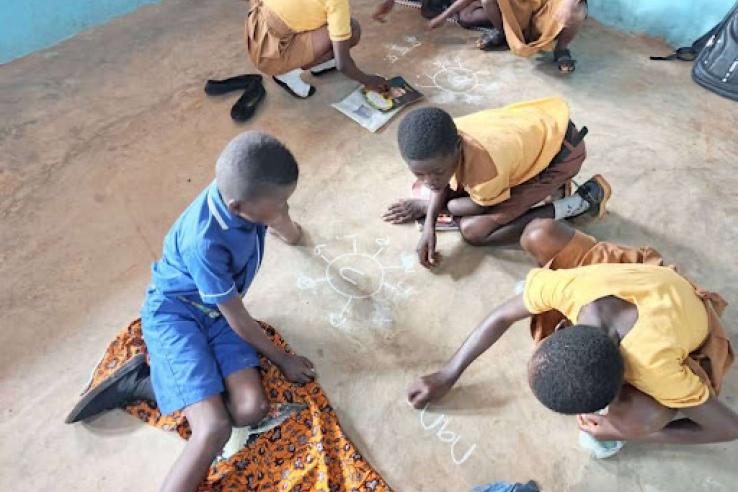
Coincidentally, they both worked on the implementation and scaling of the Differentiated Learning Plus (DL+) program throughout schools in Ghana. Inspired by the Teaching at the Right Level approach, the DL+ program is based on the concept of differentiated learning, a teaching model that tailors instruction to the individual needs of students.
We sat down with Agnes and Fati to learn about their work using evidence to transform classrooms and scale effective approaches across Ghana.
Challenges and opportunities for evaluation and evidence
In Ghana, more children are enrolled in school than ever before—yet nearly 80 percent leave primary school without the basic reading and math skills they need to succeed.
The learning crisis has prompted growing interest in how education programs are designed and whether they are making a difference. One of the major challenges to answering those questions, Agnes explained, is that new learning models are often introduced without a clear plan for evaluating their impact: “But this is changing [...], we are transforming the situation,” she noted.
At UNICEF, her team—partnering closely with the government—has worked to refine the concepts behind differentiated learning. To help educators apply this approach effectively, they are promoting a locally developed dashboard that delivers real-time data and insights on students’ progress.
“Most of our work is co-creating. We are bringing government officials together to design education programs collaboratively. This way, they get to understand and appreciate that you need to accompany such interventions with evidence, so that when you take them to scale, you can make an informed decision.”
— Agnes Arthur, Education Specialist, UNICEF Ghana
Fati, who worked as a trainer during the implementation of the DL+ program, shared that many school leaders and educators may not have the proper training to interpret and apply evidence. This can make it difficult to shift long-standing practices. “Teachers on the ground are used to a certain way of doing things,” she explained, such as only conducting learning assessments at the end of the school year.
But for differentiated learning to be successful, students’ knowledge should be assessed prior to instruction so that they can be grouped by learning levels. Making the shift from assessing learning at the end of the school year to leveraging assessment to inform instruction requires not only stronger systems, but also support and training for educators to engage with and apply insights from the data they now have access to.
From insights to impact
The Learning Academy built on the work Agnes and Fati were already doing—offering space to reflect, new tools to strengthen their approach, and a chance to connect evaluation concepts with day-to-day program decisions.
Both Fati and Agnes emphasized the value they found from deepening their knowledge around building a program theory of change. For Fati, it shifted how she thinks about evaluation from a one-time event at the end of the program to an ongoing process that is embedded in program design. “Building a theory of change is actually very difficult, but once you get it right, whatever you are doing becomes very easy,” shared Agnes.
Inspired by what she learned during the training, Fati worked with her team to introduce unannounced visits to teachers implementing the DL+ program in their classrooms. “To our surprise, we realized that some of them were not following the program we asked them to. They were not meeting the fidelity of the program.”
When improved monitoring revealed gaps in implementation, Fati’s team drew on emerging evidence to guide their next steps. A recent evaluation in Ghana found that in-person refresher trainings significantly improved teachers’ implementation of the differentiated learning approach, while digital modules had little impact due to low engagement.
Based on this research, her team organized a two-day refresher training for teachers to reinforce the core components of the program and clarify expectations. “It’s picked up—we are now improving and the program is going very, very effectively,” Fati said.
Fati’s experience shows how even small changes that are grounded in evidence can improve program implementation and strengthen the link between instructional design and classroom practice.
Building a culture of evidence use
For both Fati and Agnes, rigorous evidence is crucial to their work—and they note that its use to inform program design is increasing across Ghana. They agree that evidence allows policymakers to tailor scarce resources to regions and sectors that really need them. “It also builds credibility with stakeholders and funders,” shared Fati, who secured funding to set up a nonprofit to implement the differentiated learning approach in hard-to-reach schools in the country.
Agnes is now gearing up for an endline evaluation of the DL+ program to see whether improving access to real-time, classroom-level data has led to measurable gains in student learning outcomes. When asked about advice she might share with colleagues who are looking to incorporate evidence into their work, she suggests that finding ways to embed evaluation throughout implementation is critical to understanding which aspects of a program should be scaled and which can be dropped. Fati echoes the importance of focusing on evaluation: “Start small, pilot, and use data to adapt before scaling.”
“In Ghana, where we have some regions and districts with serious learning gaps, it is very important to us to know what works. I believe that to guess and to continue guessing, especially within the African education system, is very dangerous.”
– Fati Issifu, School Improvement Officer, Promoting Equality in African Schools
Fati and Agnes’ experience reflect a broader shift taking root in Ghana’s education system—one that puts data, evaluation, and inclusive pedagogy at the center of education reform. Their stories underscore how building the capacity of educators and fostering close collaboration between practitioners, policymakers, and researchers across the education system can ensure that data and evidence lead to meaningful improvements in how children learn.
FLN Academy 3.0 is a collaboration between UNICEF and J-PAL that supports UNICEF regional and country offices and local stakeholders in applying evidence-based solutions to advance foundational literacy and numeracy.
This is the first blog in a series exploring how UNICEF and J-PAL are working together to strengthen evidence use in education. In this post, we highlight insights from global experts on scaling proven education interventions. The second blog turns to the local level—spotlighting how two education leaders in Ghana are applying these ideas in practice to improve student learning through data and evaluation.
To ensure that children in school learn to read for meaning and apply basic math, bringing together the best of both worlds—practical insights from those who work on the ground and synthesis of rigorous research from academic experts—is imperative.
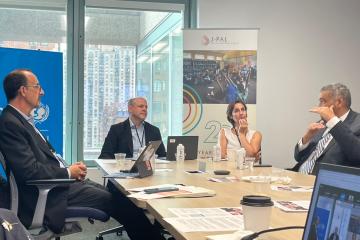
This was the key message from Pia Britto, UNICEF’s Global Director of Education and Adolescent Development, at the launch of the Foundational Literacy and Numeracy (FLN) Academy 3.0 in September 2024. The event featured panelists Benjamin Piper (Program Director of Global Education, Gates Foundation) and Luis Benveniste (Global Director of Education, World Bank), who shared insights from their extensive careers in getting research-backed educational programs to work at scale.
FLN Academy 3.0 is a collaboration between UNICEF and J-PAL that supports UNICEF regional and country offices and local stakeholders in applying evidence-based solutions to advance foundational literacy and numeracy. Through this partnership, we bring together practitioners, policymakers, and researchers to exchange knowledge on what has worked to improve children’s learning.
These experts come together around problems of practice they all face in improving children’s basic reading and math skills, which form the foundations of all learning. We aim to work alongside local UNICEF offices and their partners to strengthen the global response to the learning crisis through the adoption and scaling of proven interventions.
“The philanthropic interest on foundational literacy and numeracy is relatively new but quite exciting, and I think it’s incumbent on us to think about how we can apply these programs at scale to reach more children.”
—Benjamin Piper, Global Education Program Director, Gates Foundation
The launch of FLN Academy 3.0 marked the beginning of a series of webinars on interventions for improving foundational learning outcomes that are recommended by the Global Education Evidence Advisory Panel in its 2023 “Smart Buys” report. Since last fall, we have hosted two webinars spotlighting Teaching at the Right Level and structured pedagogy. Both webinars offered attendees the opportunity to update their knowledge of evidence-based programs and engage with practitioners about implementation and scaling issues.
FLN Evidence: Teaching at the Right Level
Given the research-backed consensus on the effectiveness of Teaching at the Right Level and other tailored instruction models for accelerating FLN learning, session moderator John Floretta (Global Deputy Executive Director of J-PAL) focused his presentation on a story that not many people may have heard: TaRL’s successful adaptation from India to Zambia through a rigorous process of piloting and government-led scale-up. With the support of UNICEF and other partners, Zambia’s Catch-Up program has helped students make large gains in learning. Panelists Rukmini Banerji (CEO, Pratham Education Foundation), Titus Syengo (Executive Director, TaRL Africa), who has been working with 16 Africa countries to implement TARL, and Katharina Wuppinger (Chief Education, UNICEF Zambia Country Office) shared their unique perspectives as stakeholders at different phases in TaRL’s journey from piloting and evaluation to adaptation and scale-up.
“We learned in the process that it’s really the middle of the system that has to be the people that become the champions. If they feel the progress—if they feel that children are making progress—then many things will become easier.”
—Rukmini Banerji, CEO, Pratham Education Foundation
FLN Evidence: Structured Pedagogy
Isaac Mbiti (University of Virginia; co-scientific director, J-PAL Africa) presented evidence on structured pedagogy—the coordinated package of detailed teacher guides, student textbooks, and continuous teacher support—to show its cost-effectiveness in increasing student learning in different countries. He focused on two cases in Kenya and India, where structured pedagogy helped reduce inequality among students and sustain learning gains. Benjamin Piper, Permie Isaac (Head of Content and Training, Funda Wande), and Anustup Nayak (Project Director, Classroom Instruction and Practice, Central Square Foundation) had a lively discussion that spotlighted how essential it is for the success of implementing structured pedagogy to integrate efforts at every level of the education system.
“One of our key lessons is producing a product with the system rather than for the system. ‘For the system’ looks like: going away, designing a program, and then imposing it on teachers and schools. What we advocate for is collaboration right from the get-go and engaging stakeholders at every step. This ensures that whatever is being designed talks to the needs of the teachers in the system. This creates ownership, and ownership leads to better chances of implementation.”
–Permie Isaac, Head of Content and Training, Funda Wande
The upcoming webinars, scheduled throughout 2025, will focus on parental engagement interventions, educational technology, and applying generalizable research insights to a new context. For information on how to attend the webinars, contact [email protected]. You may watch recordings of all webinars at the FLN Hub.
This is the seventh post of J-PAL’s 20 for 20: Partner Voices blog series, where we showcase stories of results and impact with our partners to celebrate our twentieth anniversary. Read on to learn how J-PAL Middle East and North Africa’s (MENA) partnership with UNICEF Egypt helps bring greater use of evidence on policies that impact Egypt’s children and their families.
At UNICEF Egypt, we use evidence to drive change and show us how far we have come in making children happier and safer—and how many are left behind.
This year, I am personally delighted to celebrate four years of partnership with the Abdul Latif Jameel Poverty Action Lab Middle East and North Africa (J-PAL MENA). I have seen this partnership start and grow over the years. It brought together over 500 people from Egypt’s government, development organizations, civil society organizations and J-PAL affiliated researchers.
Throughout the past years, stakeholders have come together to discuss pertinent policy issues affecting children and adolescents in Egypt and to explore possible policy solutions. Seven seminars and briefs on thematic areas that are key to children in the country were developed, including youth unemployment, education systems, shock responsive social assistance, gender and social norms, fertility and family planning, early childhood development, and climate change.
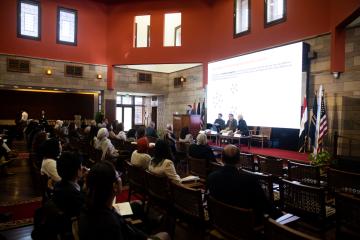
During each seminar, policymakers highlight a particular development priority in Egypt. J-PAL affiliated researchers frame the priority from a global perspective and offer evidence-informed insights for improving policy and program design. In dialogue, the panel of policymakers, UNICEF, development partners and J-PAL affiliated researchers ground the evidence in the Egyptian context.
The value of researchers working with policymakers for greater impact
Over the past years, there has been a noticeable shift by the government of Egypt toward more evidence-based decision- and policymaking. This comes amid the economic reform the country has been undergoing and the need to understand the impact of such changes on the lives of children and their families. Thus, availing timely research that informs and optimizes policymaking can have a significant impact on the lives of vulnerable children and young people. This is strengthened through the use of platforms to exchange knowledge and information and the creation of spaces to have open and constructive discussions.
By collaborating with policymakers, researchers can ensure that their research questions are relevant, feasible, and aligned with the policy agenda and priorities. When researchers are in alignment with policymakers, this increases the chances of their findings being communicated and adopted in decision-making and enhances the overall policy relevance, impact, and quality of the research itself.
Bridging research and policy plays a pivotal role in directing the future of investments for children
UNICEF and J-PAL MENA have established a strategic partnership to discuss pertinent policy issues to promote evidence-based policymaking and foster a culture of learning and innovation in the country.
Following the success of the Global Evidence for Egypt seminar series, the partnership grew to contribute to the launch of the Egypt Impact Lab under the leadership of the Ministry of Planning and Economic Development, J-PAL MENA, along with strategic partners.
This new phase of the partnership between UNICEF and J-PAL MENA aims to:
- Facilitate dialogue and exchange between Egyptian policymakers and J-PAL affiliates on key policy issues that affect children and youth in Egypt, such as education, health, nutrition, social protection, and gender equality.
- Strengthen the capacity and confidence of government staff, civil society organizations, and development partners to design, implement, and evaluate effective and scalable interventions for children and youth using rigorous methods.
- Support the generation and dissemination of high-quality evidence on the impact of development programs and policies in Egypt and facilitating the use of this evidence in policy and practice.
- Support the Egypt Impact Lab, a national platform for impact evaluation that is managed by the Ministry of Planning and Economic Development in Egypt, and which aims to generate and disseminate high-quality evidence on what works and what does not work for development in Egypt.
This new phase of the partnership between UNICEF and J-PAL MENA shows how our relationship is dynamic and continues to evolve and adapt to the changing needs and priorities of the country.
I see, over the upcoming period, continued work on organizing more seminars on emerging and relevant policy issues that affect children and adolescents in Egypt and inviting more policymakers and practitioners to join the dialogue and exchange with J-PAL affiliated researchers and experts. This is along with delivering more customized learning activities for government staff, academics, CSOs, and development partners. But it is also important to communicate and share the results as much as it is important to generate evidence. J-PAL MENA, with UNICEF and other partners, can play a key role in bringing more partners from different sectors to create opportunities for collaboration and contribute to greater evidence-based policymaking to improve outcomes for children and their families in Egypt.
Want to learn more?
If you are interested in getting involved or learning more about the partnership, you can visit the Global Evidence for Egypt page on UNICEF Egypt or J-PAL to check out previous seminar briefs and recordings.