SASWA Partnership: Rwanda’s Ministry of Health
Integrating subsidies for water treatment into Rwanda’s maternal and child health services
A program to improve child health
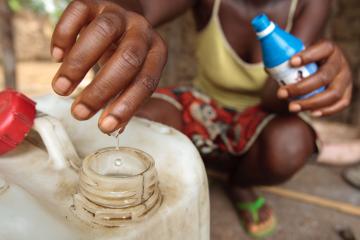
Access to safe drinking water is fundamental to a child’s health and survival, and yet for many families it is still out of reach. To help address this, Rwanda’s Ministry of Health, with the technical support of J‑PAL Africa, has launched a pilot program that will provide free, easy-to-use chlorine water treatment to households through maternal and child health (MCH) services. By using routine health visits, similar to how other preventive health products like bed nets are given for free, the program aims to make safe drinking water reliable and accessible for households with young children.
J-PAL Africa supports governments in piloting and scaling evidence-based approaches to expanding access to safe water through its Scaling Access to Safe Water in Africa (SASWA) portfolio.
What the pilot will test and why it matters
The core question is simple: can existing health services in Rwanda effectively deliver free chlorine-based water treatments, and if so, what would it take to implement this across the country?
A growing body of evidence suggests household water treatment can lower child mortality by roughly 25 percent, and the cost for delivering water treatments is estimated to be as low as about 3,000 Rwandan Francs (approximately $2.06) per child. However, in Rwanda, few households use these household water treatments, often due to cost, misinformation about water safety and access barriers. One rigorously tested and effective delivery mechanism involves using a voucher system to (a) inform households about safe drinking water practices during routine maternal and child health visits and (b) distribute free bottles of dilute chlorine solution for home use on a monthly basis. If this approach proves feasible and operationally viable at scale in Rwanda, it would be a highly cost-effective public health program, particularly for rural communities.
How the rollout is planned in Rwanda
The pilot will run in two phases to ensure the approach is practical and adaptable. The first phase involves five health centers in three districts over three months to identify early challenges, track uptake of the program, and refine procedures. The second phase will expand to between fifteen and 25 health centers over a year, with careful monitoring of supply, uptake, behavior, and water quality. Depending on the learnings from these two phases, there might be a potential third piloting phase before scaling the program nationally.
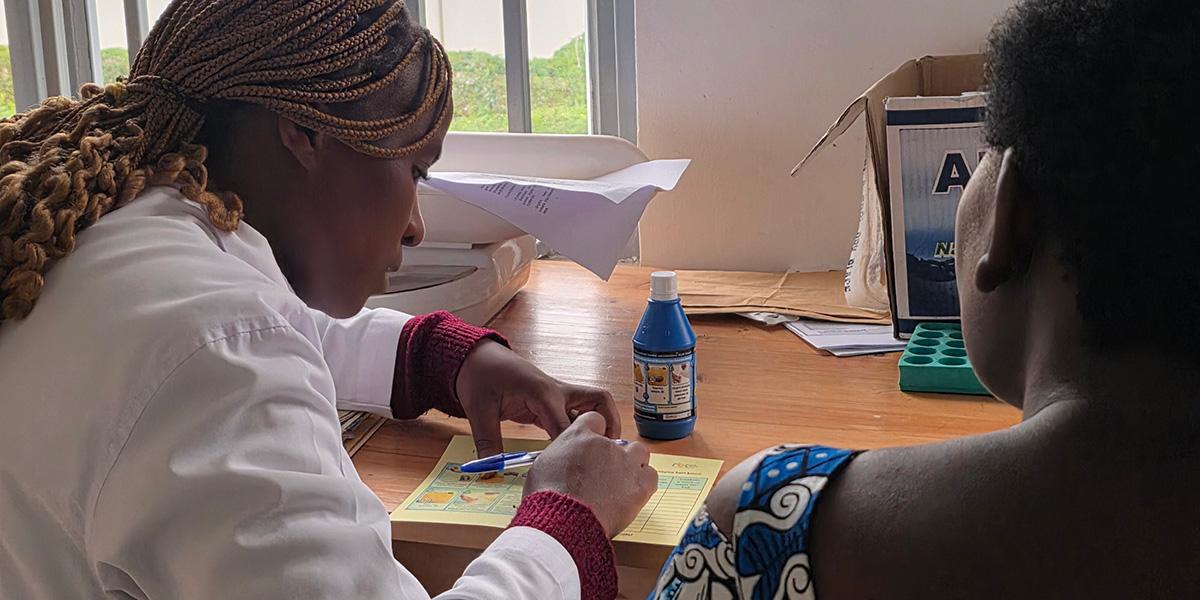
During routine antenatal care and vaccination visits, health care workers distribute voucher cards that households can redeem monthly for bottles of dilute chlorine solution (called ‘Sur’Eau’). The beneficiary households have the option of primarily redeeming from the Community Health Workers (CHW), but also at the nearest health centre and health post. Each bottle typically lasts about one month, depending on household size, with larger households receiving additional bottles. CHWs are expected to play a central role in teaching families how to use the chlorine, answering questions during routine household visits, and encouraging enrollment at local health centers and health posts.
Enrollment, tracking, and supply management
Enrollment happens at health centers and second-generation health posts when expectant mothers visit for antenatal and postnatal care or when caregivers bring children under five years old in for vaccinations. Each beneficiary household receives a renewable twelve-slot redemption card that also has simple illustrations with clear, practical guidance for treating drinking water. Health staff and CHWs maintain tracking forms that record beneficiaries’ identification and redemption months so distribution can be monitored across redemption points. In turn, health centers are asked to forecast chlorine demand using antenatal and vaccination visit attendance. The product manufacturer, Society for Family Health, distributes chlorine supply to CHWs monthly according to actual redemption rates. To make sure distance to the health center is not a barrier for redemption and to ensure the water treatments are constantly available at the community level, CHWs collect supplies during their weekly meetings at facilities.
Monitoring, research, and learning
Redemption records will help monitor how often beneficiaries redeem chlorine across different redemption points. Researchers will conduct household surveys to gather insights from both users and non-users of the water treatments. Researchers will then measure residual chlorine levels and the presence of E. coli in stored drinking water to estimate impacts on water quality.
Looking ahead
Rwanda’s pilot is the first of several country-led efforts to accelerate access to clean water through a voucher model. However, other countries, including Guinea, Togo, and Madagascar, are also planning to set up pilots with technical assistance from SASWA. Lessons from Rwanda on operational design, uptake, and integration into health services, will help inform these upcoming pilots.And insights from Guinea, Togo, and Madagascar will feed back into refining the model as additional countries start considering adopting and adapting it. This ongoing exchange of learning across the portfolio is central to SASWA’s strategy and will help expand the program to other countries in sub-Saharan Africa.
For more information about this pilot, please reach out to:
Bonnyface Ndung'u, Policy Manager, J-PAL Africa
Nana Teillard, Senior Policy Manager, J-PAL Africa