J-PAL J-PAL
The Abdul Latif Jameel Poverty Action Lab
  • About
    • Overview
    • People
    • Strengthening Our Work
    • Code of Conduct
    • Initiatives
    • Events
    • Blog
    • News
    • Press Room
  • Offices
    • Overview
    • Global
    • Africa
    • Europe
    • Latin America and the Caribbean
    • Middle East and North Africa
    • North America
    • South Asia
    • Southeast Asia
  • Sectors
    • Overview
    • Agriculture
    • Crime, Violence, and Conflict
    • Education
    • Environment, Energy, and Climate Change
    • Finance
    • Firms
    • Gender
    • Health
    • Labor Markets
    • Political Economy and Governance
    • Social Protection
  • Evaluations
  • Research Resources
    • About Us
    • Our Work
    • Join ASPIRE
    • Newsroom
  • Policy Insights
  • Evidence to Policy
    • Pathways and Case Studies
    • The Evidence Effect
  • Blog
  • Careers
  • Courses
  • For Affiliates
  • Support J-PAL

Utility menu

  • Blog
  • Careers
  • Courses
  • For Affiliates
  • Support J-PAL

Quick links

  • Evaluations
  • Research Resources
  • Policy Insights
  • Evidence to Policy
    • Pathways and Case Studies
    • The Evidence Effect
  • About

    The Abdul Latif Jameel Poverty Action Lab (J-PAL) is a global research center working to reduce poverty by ensuring that policy is informed by scientific evidence. Anchored by a network of more than 1,100 researchers at universities around the world, J-PAL conducts randomized impact evaluations to answer critical questions in the fight against poverty.

    • Overview

      The Abdul Latif Jameel Poverty Action Lab (J-PAL) is a global research center working to reduce poverty by ensuring that policy is informed by scientific evidence. Anchored by a network of more than 1,100 researchers at universities around the world, J-PAL conducts randomized impact evaluations to answer critical questions in the fight against poverty.

      • Affiliated Professors

        Our affiliated professors are based at over 130 universities and conduct randomized evaluations around the world to design, evaluate, and improve programs and policies aimed at reducing poverty. They set their own research agendas, raise funds to support their evaluations, and work with J-PAL staff on research, policy outreach, and training.

      • Invited Researchers
      • J-PAL Scholars
      • Board
        Our Board of Directors, which is composed of J-PAL affiliated professors and senior management, provides overall strategic guidance to J-PAL, our sector programs, and regional offices.
      • Staff
    • Strengthening Our Work

      Our research, policy, and training work is fundamentally better when it is informed by a broad range of perspectives.

    • Code of Conduct
    • Initiatives
      J-PAL initiatives concentrate funding and other resources around priority topics for which rigorous policy-relevant research is urgently needed.
    • Events
      We host events around the world and online to share results and policy lessons from randomized evaluations, to build new partnerships between researchers and practitioners, and to train organizations on how to design and conduct randomized evaluations, and use evidence from impact evaluations.
    • Blog
      News, ideas, and analysis from J-PAL staff and affiliated professors.
    • News
      Browse news articles about J-PAL and our affiliated professors, read our press releases and monthly global and research newsletters, and connect with us for media inquiries.
    • Press Room
      Based at leading universities around the world, our experts are economists who use randomized evaluations to answer critical questions in the fight against poverty. Connect with us for all media inquiries and we'll help you find the right person to shed insight on your story.
  • Offices
    J-PAL is based at MIT in Cambridge, MA and has seven regional offices at leading universities in Africa, Europe, Latin America and the Caribbean, Middle East and North Africa, North America, South Asia, and Southeast Asia.
    • Overview
      J-PAL is based at MIT in Cambridge, MA and has seven regional offices at leading universities in Africa, Europe, Latin America and the Caribbean, Middle East and North Africa, North America, South Asia, and Southeast Asia.
    • Global
      Our global office is based at the Department of Economics at the Massachusetts Institute of Technology. It serves as the head office for our network of seven independent regional offices.
    • Africa
    • Europe
    • Latin America and the Caribbean
    • Middle East and North Africa
      J-PAL MENA is based at the American University in Cairo, Egypt.
    • North America
    • South Asia
    • Southeast Asia
  • Sectors
    Led by affiliated professors, J-PAL sectors guide our research and policy work by conducting literature reviews; by managing research initiatives that promote the rigorous evaluation of innovative interventions by affiliates; and by summarizing findings and lessons from randomized evaluations and producing cost-effectiveness analyses to help inform relevant policy debates.
    • Overview
      Led by affiliated professors, J-PAL sectors guide our research and policy work by conducting literature reviews; by managing research initiatives that promote the rigorous evaluation of innovative interventions by affiliates; and by summarizing findings and lessons from randomized evaluations and producing cost-effectiveness analyses to help inform relevant policy debates.
    • Agriculture
      How can we encourage small farmers to adopt proven agricultural practices and improve their yields and profitability?
    • Crime, Violence, and Conflict
      What are the causes and consequences of crime, violence, and conflict and how can policy responses improve outcomes for those affected?
    • Education
      How can students receive high-quality schooling that will help them, their families, and their communities truly realize the promise of education?
    • Environment, Energy, and Climate Change
      How can we increase access to energy, reduce pollution, and mitigate and build resilience to climate change?
    • Finance
      How can financial products and services be more affordable, appropriate, and accessible to underserved households and businesses?
    • Firms
      How do policies affecting private sector firms impact productivity gaps between higher-income and lower-income countries? How do firms’ own policies impact economic growth and worker welfare?
    • Gender
      How can we reduce gender inequality and ensure that social programs are sensitive to existing gender dynamics?
    • Health
      How can we increase access to and delivery of quality health care services and effectively promote healthy behaviors?
    • Labor Markets
      How can we help people find and keep work, particularly young people entering the workforce?
    • Political Economy and Governance
      What are the causes and consequences of poor governance and how can policy improve public service delivery?
    • Social Protection
      How can we identify effective policies and programs in low- and middle-income countries that provide financial assistance to low-income families, insuring against shocks and breaking poverty traps?
Displaying 1711 - 1725 of 8339
Healthcare provider meets with patient.
Update
J-PAL Updates

May 2020 North America Newsletter

J-PAL North America's May newsletter highlights Amy Finkelstein's new NEJM Perspective piece on improving health care delivery through randomized evaluations, J-PAL North America's new COVID-19 Evidence Portal, and the Evaluating Social Programs online webinar series.
Young people working at a food bank.
Update
J-PAL Updates

June 2020 North America Newsletter

J-PAL North America's June newsletter highlights a New York Times op-ed by affiliated researchers Sara Heller and Judd Kessler on the importance of restoring summer jobs in New York, COVID-19 guidelines for education funders, and evidence-based strategies to support small businesses.
Tutor works with student.
Update
J-PAL Updates

July 2020 North America Newsletter

J-PAL North America's July newsletter highlights a new policy insight on increasing community college graduation rates with comprehensive support programs, the launch of the Economics Transformation Project, and a new research resource on collecting electronic signatures.
Parent gets child ready for school.
Update
J-PAL Updates

August 2020 North America Newsletter

J-PAL North America's August newsletter highlights a new blog post on how research can help combat the COVID-19 education crisis, our education technology evidence review, and an interview with affiliated researcher Sarah Cohodes.
Page
Landing page

Board Members

Hand providing thumbprint for biometric identification card
Update
J-PAL Updates

December 2020 Newsletter

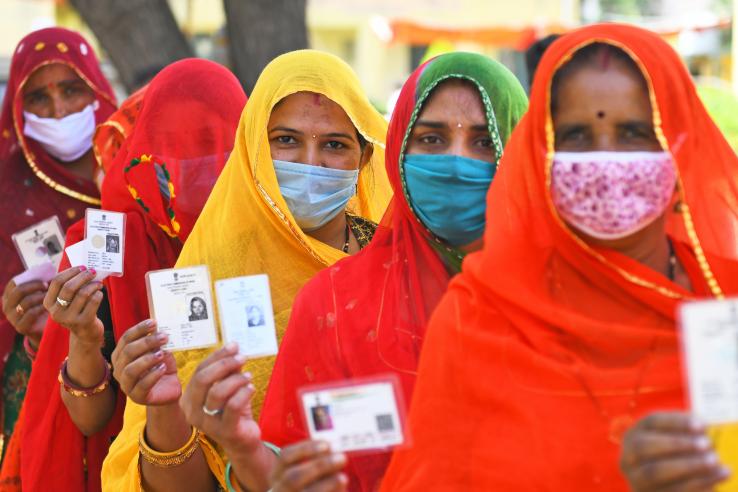
The December 2020 Newsletter highlights a new J-PAL Africa blog series that explores key policy and research questions on different digital identification and payments systems.
People in a queue for a vaccination drive.
Blog

Strengthening social assistance and health response to COVID-19 in India

The COVID-19 pandemic has expanded the proportion of the population in low- and middle-income countries that require social assistance from governments to deal with economic and health vulnerabilities. Can social assistance schemes be better designed so that they reach those who need support the...
Three children smiling
Project

Learning from Home During the Pandemic: The Experiences of Parents and Teachers

As a response to the outbreak of COVID-19, Jakarta’s provincial government stopped all in-person classroom learning in schools. The quick transition from normal schooling to learning from home raises questions about the readiness of teachers, parents, and students in carrying out the teaching and...
A view of the Boston common, city hall, and distant skyscrapers
Blog

Promoting upward mobility in partnership with state and local governments: A blueprint for future evaluations

This blog post is the final piece in a series on how state and local governments in the United States can promote upward mobility in their communities. It is part of J-PAL North America’s work to develop a learning agenda that summarizes the core research priorities from state and local governments...
A man and woman look at their mobile phones
Blog

Leveraging the digital revolution: Can governments utilize big data to help decision-making?

Using evidence to make policy decisions can be a challenge when the information one needs is not credible, easily accessible, or interpretable. However, this difficulty can be overcome with the use of a high-frequency monitoring system. As governments and organizations move towards more digitized...
Person

Abhilasha Purwar

Abhilasha is currently working on a project which seeks to design, implement and evaluate Pilot Emissions Trading Schemes (ETS) for particulate matter in 1000 industrial units in the states of Maharashtra, Gujarat and Tamil Nadu. Her interests lie at the intersection of science and engineering...
Person

A.R. Selva Swetha

As Capacity Building Manager at CLEAR/J-PAL South Asia, Swetha, as part of the IDEA Initiative, manages training, resource development and advisory activities for various state governments, central agencies and other data providers, towards making their administrative data accessible and research...
Page
Landing page

Catalog of Administrative Data Sets

Two men sitting down listening to a facilitator of the UBL program
Blog

Preventing intimate partner violence by engaging men: Evidence from Unite for Better Life in Ethiopia

A growing body of evidence suggests that gender inequality, especially social norms that endorse violence against women, is one of the main drivers of IPV. What programs can effectively build more gender equitable attitudes and behaviors, and do these behaviors translate into reductions in violence...
Person

Diego Verdugo

Diego Verdugo joined J-PAL in January 2013 and is a Senior Research Manager. He is currently working on the evaluation of the program Chile Sano, which measures the impact of a dental treatment on labor market outcomes of economically vulnerable people.

Pagination

  • First page « First
  • Previous page ‹
  • …
  • Page 113
  • Page 114
  • Current page 115
  • Page 116
  • Page 117
  • …
  • Next page ›
  • Last page Last »
J-PAL

J-PAL

400 Main Street

E19-201

Cambridge, MA 02142

USA

Contact

+1 617 324 6566

[email protected]


Press Room

Stay Informed

Receive our newsletters

Subscribe


Privacy Policy

Accessibility

MIT