J-PAL J-PAL
The Abdul Latif Jameel Poverty Action Lab
  • About
    • Overview
    • People
      • Affiliated Professors
      • Invited Researchers
      • J-PAL Scholars
      • Board
      • Staff
    • Strengthening Our Work
    • Code of Conduct
    • Initiatives
    • Events
    • Blog
    • News
    • Press Room
  • Offices
    • Overview
    • Global
    • Africa
      • About
      • Policy
      • Research
      • Training
    • Europe
      • About
      • Research
      • Policy
      • Training
    • Latin America and the Caribbean
      • About
      • Research
      • Policy
      • Training
      • Cross-Cutting Projects
    • Middle East and North Africa
      • About
      • Research
      • Policy
      • Training
    • North America
      • About
      • Research
      • Policy
      • Training
    • South Asia
      • About
      • Research
      • Policy
      • Training
    • Southeast Asia
      • About
      • Research
      • Policy
  • Sectors
    • Overview
    • Agriculture
    • Crime, Violence, and Conflict
    • Education
    • Environment, Energy, and Climate Change
    • Finance
    • Firms
    • Gender
    • Health
    • Labor Markets
    • Political Economy and Governance
    • Social Protection
  • Evaluations
  • Research Resources
    • About Us
    • Our Work
    • Join ASPIRE
    • Newsroom
  • Policy Insights
  • Evidence to Policy
    • Pathways and Case Studies
    • The Evidence Effect
  • Blog
  • Careers
  • Courses
  • For Affiliates
  • Support J-PAL

Utility menu

  • Blog
  • Careers
  • Courses
  • For Affiliates
  • Support J-PAL

Quick links

  • Evaluations
  • Research Resources
  • Policy Insights
  • Evidence to Policy
    • Pathways and Case Studies
    • The Evidence Effect
  • About

    The Abdul Latif Jameel Poverty Action Lab (J-PAL) is a global research center working to reduce poverty by ensuring that policy is informed by scientific evidence. Anchored by a network of more than 1,100 researchers at universities around the world, J-PAL conducts randomized impact evaluations to answer critical questions in the fight against poverty.

    • Overview

      The Abdul Latif Jameel Poverty Action Lab (J-PAL) is a global research center working to reduce poverty by ensuring that policy is informed by scientific evidence. Anchored by a network of more than 1,100 researchers at universities around the world, J-PAL conducts randomized impact evaluations to answer critical questions in the fight against poverty.

      • Affiliated Professors

        Our affiliated professors are based at over 130 universities and conduct randomized evaluations around the world to design, evaluate, and improve programs and policies aimed at reducing poverty. They set their own research agendas, raise funds to support their evaluations, and work with J-PAL staff on research, policy outreach, and training.

      • Invited Researchers
      • J-PAL Scholars
      • Board
        Our Board of Directors, which is composed of J-PAL affiliated professors and senior management, provides overall strategic guidance to J-PAL, our sector programs, and regional offices.
      • Staff
    • Strengthening Our Work

      Our research, policy, and training work is fundamentally better when it is informed by a broad range of perspectives.

    • Code of Conduct
    • Initiatives
      J-PAL initiatives concentrate funding and other resources around priority topics for which rigorous policy-relevant research is urgently needed.
    • Events
      We host events around the world and online to share results and policy lessons from randomized evaluations, to build new partnerships between researchers and practitioners, and to train organizations on how to design and conduct randomized evaluations, and use evidence from impact evaluations.
    • Blog
      News, ideas, and analysis from J-PAL staff and affiliated professors.
    • News
      Browse news articles about J-PAL and our affiliated professors, read our press releases and monthly global and research newsletters, and connect with us for media inquiries.
    • Press Room
      Based at leading universities around the world, our experts are economists who use randomized evaluations to answer critical questions in the fight against poverty. Connect with us for all media inquiries and we'll help you find the right person to shed insight on your story.
  • Offices
    J-PAL is based at MIT in Cambridge, MA and has seven regional offices at leading universities in Africa, Europe, Latin America and the Caribbean, Middle East and North Africa, North America, South Asia, and Southeast Asia.
    • Overview
      J-PAL is based at MIT in Cambridge, MA and has seven regional offices at leading universities in Africa, Europe, Latin America and the Caribbean, Middle East and North Africa, North America, South Asia, and Southeast Asia.
    • Global
      Our global office is based at the Department of Economics at the Massachusetts Institute of Technology. It serves as the head office for our network of seven independent regional offices.
    • Africa
    • Europe
    • Latin America and the Caribbean
    • Middle East and North Africa
    • North America
    • South Asia
    • Southeast Asia
  • Sectors
    Led by affiliated professors, J-PAL sectors guide our research and policy work by conducting literature reviews; by managing research initiatives that promote the rigorous evaluation of innovative interventions by affiliates; and by summarizing findings and lessons from randomized evaluations and producing cost-effectiveness analyses to help inform relevant policy debates.
    • Overview
      Led by affiliated professors, J-PAL sectors guide our research and policy work by conducting literature reviews; by managing research initiatives that promote the rigorous evaluation of innovative interventions by affiliates; and by summarizing findings and lessons from randomized evaluations and producing cost-effectiveness analyses to help inform relevant policy debates.
    • Agriculture
      How can we encourage small farmers to adopt proven agricultural practices and improve their yields and profitability?
    • Crime, Violence, and Conflict
      What are the causes and consequences of crime, violence, and conflict and how can policy responses improve outcomes for those affected?
    • Education
      How can students receive high-quality schooling that will help them, their families, and their communities truly realize the promise of education?
    • Environment, Energy, and Climate Change
      How can we increase access to energy, reduce pollution, and mitigate and build resilience to climate change?
    • Finance
      How can financial products and services be more affordable, appropriate, and accessible to underserved households and businesses?
    • Firms
      How do policies affecting private sector firms impact productivity gaps between higher-income and lower-income countries? How do firms’ own policies impact economic growth and worker welfare?
    • Gender
      How can we reduce gender inequality and ensure that social programs are sensitive to existing gender dynamics?
    • Health
      How can we increase access to and delivery of quality health care services and effectively promote healthy behaviors?
    • Labor Markets
      How can we help people find and keep work, particularly young people entering the workforce?
    • Political Economy and Governance
      What are the causes and consequences of poor governance and how can policy improve public service delivery?
    • Social Protection
      How can we identify effective policies and programs in low- and middle-income countries that provide financial assistance to low-income families, insuring against shocks and breaking poverty traps?
Displaying 661 - 675 of 1291
Open Laptop with hands
Evaluation

Climate Action Outreach by Democrats in an Online Network in the USA

Researchers conducted a randomized evaluation to study if Democratic climate advocates recruit others for climate advocacy and whether they reach out across party lines to increase bi-partisan support. While Democrats were motivated to mobilize others to email Congress on climate action, they were more likely to do so when they believed their efforts would influence like-minded, Democratic-leaning individuals.
Students working at a Mindspark center in Delhi.
Evaluation

Disrupting Education? Evidence on Technology-Aided Instruction in India

Researchers evaluated a computer-based adaptive learning platform (Mindspark) for secondary school students in urban India to measure the impact of customized learning technology on student test scores. The program increased test scores across all groups of students and was cost-effective compared to traditional schooling models.
Workers and supervisors on garment factory shop floor in Bangladesh
Evaluation

A Safer Monitoring Tool to Help Workers Report Harassment in Bangladesh

Researchers evaluated how different ways of asking questions in surveys affect workers’ likelihood of reporting harassment at a firm in Bangladesh. A survey technique that gave people plausible deniability led to workers reporting more abuses, allowing the firm to access more accurate data on the extent of harassment at its workplace.
Female African American doctor speaks to patient
Evaluation

Reducing Administrative Burden for Postpartum Individuals Accessing Primary Care in the United States

Researchers evaluated the impact of auto-scheduling appointments with targeted messages and nudge reminders on primary care engagement within four months after delivery for postpartum individuals with diabetes, hypertension, mental illness, or obesity in the United States. Individuals who received this intervention were substantially more likely to have a primary care visit than those who did not, highlighting the potential of low-cost interventions to improve the transition of ongoing care needs after pregnancy to primary care clinicians.
Man in glasses looks at paper records
Evaluation

Property Tax Experiment in Punjab, Pakistan: Testing the Role of Wages, Incentives and Audit on Tax Inspectors' Behavior

Researchers conducted a two-year randomized evaluation of incentive schemes for tax officials in Punjab, Pakistan that found performance pay significantly increased tax revenues without harming taxpayer satisfaction.
Angled view of community members deliberating on electoral strategies in Benin
Evaluation

Reducing Corruption Among Local Politicians in Benin

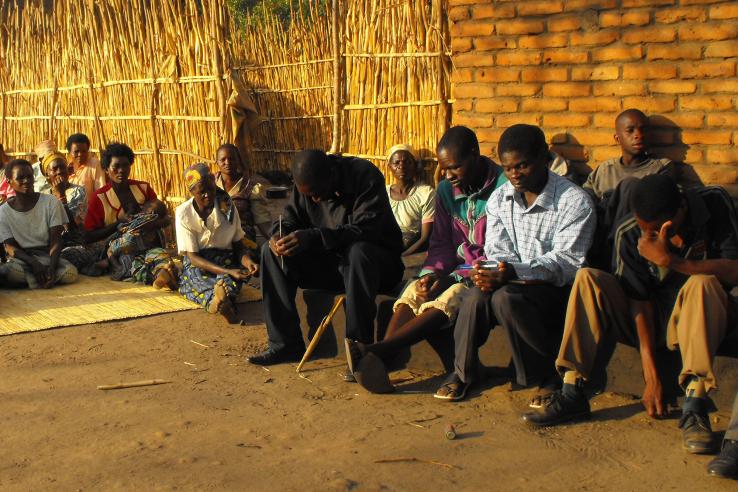
Many governments have devolved some political and economic authority to local entities, hoping to achieve more accountable and effective governance at the local level. Yet political corruption often hinders effective delivery of local services like water, sanitation, or primary education. Increasing monitoring of elected officials’ actions and reporting on those actions to a wider audience of citizens is one possible way to decrease incidences of corruption among local officials.
Domestic workers wearing surgical masks attend a training in Kenya.
Evaluation

Mask Up! Testing strategies to increase mask use in Kenya

Although conflicting recommendations have been issued, recent evidence suggests that face masks may significantly reduce the spread of SARS-CoV-2. However, questions remain on how to effectively promote mask adoption. Research are conducting a randomized evaluation to evaluate the impact of free mask distribution combined with educational interventions on mask adoption in Kenya.
A student smiles as he uses a computer tablet to practice reading in a classroom.
Evaluation

The Impact of Teaching Teachers to Use Computer Assisted Learning on Student Math Performance in the United States

Researchers conducted two randomized evaluations to test the impact of coaching teachers on integrating CAL in their elementary and middle school mathematics instruction in two large, diverse school districts in the United States. The intervention led to improved math performance in one evaluation and mixed results in the other, with test-score gains observed in classrooms with higher weekly CAL practice time.
Nurses catering to a child
Evaluation

Digital Monitoring and Health Service Provision in Sierra Leone

In many countries, rural populations access social services through decentralized systems that hire community-based workers with high monitoring needs, leaving little time for supervisors to perform other essential functions. Researchers are evaluating the impact of a phone-based e-monitoring app and organizational structure on frontline worker performance and service delivery in Sierra Leone.
Man in denim shirt sits at a laptop and has a phone up to his ear.
Evaluation

The Impact of Outreach and Assistance from Navigators on Medicaid Renewals in the United States

Researchers assessed the impact of outreach on Medicaid retention; outreach messages provided a reminder to renew as well as information about how to obtain free one-on-one assistance with renewal processes from health insurance navigators. Outreach using pre-recorded calls prevented denials due to procedural reasons and increased Medicaid renewal rates by 1.0 percentage point across the full study population, by 4.0 percentage points for Tribal members, 2.1 percentage points for children, and 1.9 percentage points for people with chronic conditions.
Women working in a sewing factory
Evaluation

The Impact of Mask Distribution and Promotion on Mask Uptake and Covid-19 in Bangladesh

Researchers partnered with Innovations for Poverty Action and Bangladeshi policymakers to test various strategies to increase mask-wearing and assess the impact of community mask wearing on SARS-CoV-2 infection rates. They found that a four-part intervention tripled mask usage and increased physical distancing. Further, this increase in mask-wearing reduced symptomatic SARS-CoV-2 infections. When surgical masks were employed, 1 in 3 symptomatic infections were avoided for individuals 60+ years old—the age group that faces the highest risk of death following infection. This was the first large-scale randomized evaluation to demonstrate the effectiveness of masks in a real-world setting.
Three school children sitting at a table looking at one tablet.
Evaluation

Improving Student Learning through Classroom Technology Adoption in Pakistan

Researchers partnered with the Government of Pakistan to conduct two parallel randomized evaluations to test the impact of providing supplemental teaching materials on the quality of student learning and teachers’ effectiveness. Overall, the eLearn Classroom intervention improved student achievement and students’ attendance for grade 8 students. Conversely, providing grade 6 students with individual eLearn Tablets worsened their test scores.
egyptian woman standing in her shop
Evaluation

Impact of Loans and Grants on Microenterprise Growth in Egypt

In partnership with three microfinance institutions (MFIs), researchers conducted a randomized evaluation to measure the impact of providing loans, cash grants, or in-kind grants on microentrepreneurs’ business decisions, outcomes, and overall welfare. All three types of capital assistance led to increases in business and economic outcomes, especially for women. Impacts were concentrated among the best-performing recipients of each type of assistance, and researchers found that observable characteristics were the same among those top-performers across all three groups. This suggests that personal characteristics are more important than the type of assistance in predicting the effectiveness of capital assistance.
A man and a woman unload crates of vegetables off a truck
Evaluation

Graduating the Ultra-Poor in Egypt

Following a series of evaluations of the Graduation approach in 15 other countries, researchers are now evaluating the impact of the Graduation approach on the livelihoods of the ultra-poor in Upper Egypt.
Person works on laptop with Philippine currency and bank card
Evaluation

Sensitivity to Interest Rates and Account Ownership Requirements for a Commitment Savings Account in the Philippines

Researchers worked with First Valley Bank in the Philippines to evaluate the impact of varying the interest rate and account ownership requirements on demand for commitment savings accounts. While savings account take-up was 23 percent, neither the interest rates nor the ownership requirements affected individuals’ demand for accounts.

Pagination

  • First page « First
  • Previous page ‹
  • …
  • Page 43
  • Page 44
  • Current page 45
  • Page 46
  • Page 47
  • …
  • Next page ›
  • Last page Last »
J-PAL

J-PAL

400 Main Street

E19-201

Cambridge, MA 02142

USA

Contact

+1 617 324 6566

[email protected]


Press Room

Stay Informed

Receive our newsletters

Subscribe


Privacy Policy

Accessibility

MIT