

Displaying 1291 - 1305 of 1309

Evaluation
The Impact of an Online Entrepreneurial Mindset Training for Youth in Ecuador
Recent studies have shown that a psychology-based entrepreneurial mindset training can have promising effects on business outcomes. In Ecuador, researchers are evaluating whether these skills can be taught at scale and online by testing the effects of an entrepreneurial mindset training program on youth education and employment outcomes. They are also investigating if and how the effects change when the program is paired with mentoring.

Evaluation
Preventing Youth Violence and Dropout in the United States
In the United States, researchers evaluated the impact of a cognitive behavioral therapy (CBT) program designed to teach high-risk male students in secondary schools to regulate harmful, automatic behaviors. Results demonstrated that the program led to a significant drop in arrests per student, especially for violent crimes, and increased school engagement and high school graduation rates.

Evaluation
Helping Students Change their Mindsets in Norway
Researchers evaluated the impact of a low-cost computer-based intervention providing information about the brain’s potential to change and grow on students’ beliefs in their abilities to learn and their subsequent effort in school. Results showed that providing this information improved students’ perseverance and academic performance, driven largely by impacts among the lowest achieving students.

Evaluation
Reducing Administrative Burden for Postpartum Individuals Accessing Primary Care in the United States
Researchers evaluated the impact of auto-scheduling appointments with targeted messages and nudge reminders on primary care engagement within four months after delivery for postpartum individuals with diabetes, hypertension, mental illness, or obesity in the United States. Individuals who received this intervention were substantially more likely to have a primary care visit than those who did not, highlighting the potential of low-cost interventions to improve the transition of ongoing care needs after pregnancy to primary care clinicians.

Evaluation
Early Childhood Development at Scale through Home Health Visits
Researchers in Bangladesh conducted a randomized evaluation to test the impact of integrating light-touch ECD support into an existing national child health program on early childhood development outcomes. Children who received the ECD support showed improvements in cognitive, language, and physical development, and their older siblings benefited, too.
Evaluation
Long-run and Intergenerational Impacts of Child Health Gains from Deworming in Kenya
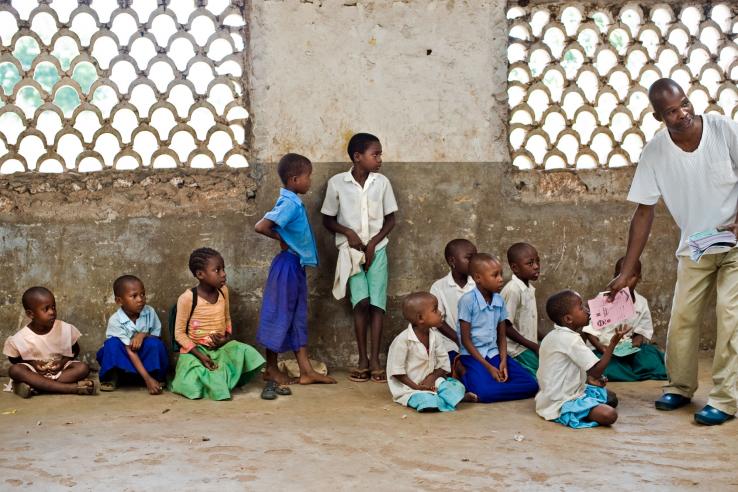
Researchers conducted long-term follow-ups a mass school-based deworming program in western Kenya, which had substantially improved health and school participation of treated children, as well as of untreated children in treatment schools and children in neighboring schools in the short-term. Approximately ten years after treatment, researchers found that the program increased women’s educational attainment and men’s labor supply, with accompanying shifts in occupation choice. Twenty years after treatment, earnings, spending, and time spent working outside of agriculture had improved.
Evaluation
Promoting Agricultural Technology Adoption in Rwanda
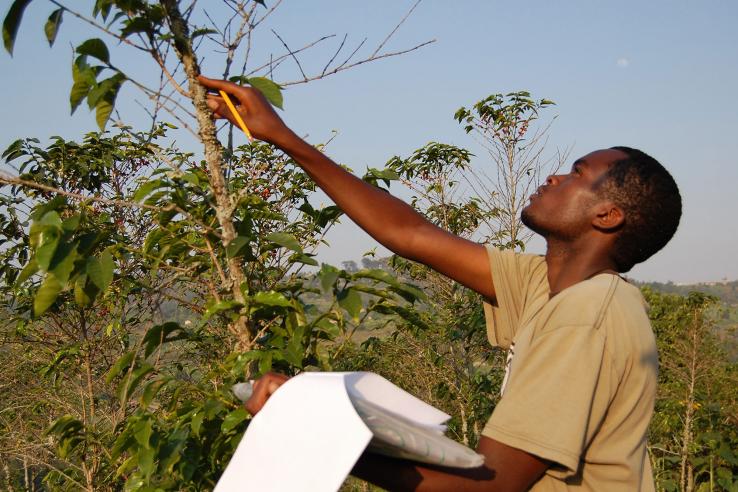
In Rwanda, researchers worked with TechnoServe to evaluate the impact of an agronomy training program on farmers’ knowledge and use of best practices in coffee-growing. Preliminary results suggest that the trainings helped some farmers improve their coffee-growing practices, but that the practices more likely to be adopted were those that required less effort on the part of the farmers. Future analysis will examine whether and how these practices spread through farmers’ social networks.

Evaluation
Strengthening Implementation of Computer-assisted Learning (CAL) to Improve Student Math Outcomes in India
Researchers partnered with the Uttar Pradesh Department of Social Welfare and Khan Academy to conduct a randomized evaluation testing the impact of dedicated on-the-ground implementation personnel on middle school students’ use of the Khan Academy platform and their mathematics learning in India. Students in schools that received dedicated support staff used the Khan Academy platform more and scored higher on mathematics assessments than students in schools without such support.

Evaluation
Scaling Personalized Adaptive Learning (PAL) for Math and Language in India
Researchers conducted a randomized evaluation to test the impact of a personalized adaptive learning software integrated into public school schedules on student learning outcomes in Rajasthan, India. After 18 months, students in schools that received the intervention scored higher in math and Hindi relative to students in comparison schools.

Evaluation
Digital Delivery of Humanitarian Aid to Improve Food Security of Women in Afghanistan
Researchers evaluated a program delivering digital aid payments on food security and mental well-being for vulnerable female-headed households in Afghanistan. Digital payments led to improved food security and mental well-being for beneficiaries. Digital delivery of aid was also cost-effective and transparent, showing no evidence of diversion to the de facto Afghan authorities.
Evaluation
Strengthening Village Courts in Rural Bangladesh
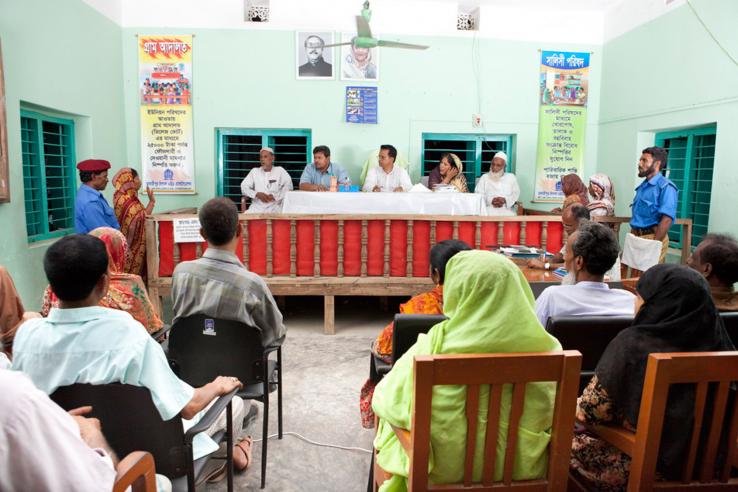
The government of Bangladesh is trying to strengthen local justice systems in rural areas by establishing close-to-home, low-cost village courts that would deal with minor, non-criminal cases. Innovations for Poverty Action is working with researchers to evaluate the impact of a program to improve the village court system on access to and quality of justice for marginalized people, as well as socioeconomic and welfare outcomes.

Evaluation
Graduating the Ultra-Poor in Egypt
Following a series of evaluations of the Graduation approach in 15 other countries, researchers are now evaluating the impact of the Graduation approach on the livelihoods of the ultra-poor in Upper Egypt.

Evaluation
Are Rainwater Harvesting Techniques Profitable for Small-Scale Farmers? The Adoption and Impact of RWH Techniques in Niger
In Niger, researchers conducted a randomized evaluation to test the impact of providing training and conditional or unconditional cash transfers on farmers’ adoption and use of an environmental technology, their resulting land use, agricultural production and profitability, and labor allocation. Providing farmers with training led to a substantially higher probability of adopting the technology, while the conditional or unconditional cash transfers had no additional effect on farmers’ decision to adopt.

Evaluation
The Impact of an Emissions Trading Scheme on Economic Growth and Air Quality in India
In India, researchers evaluated the impact of the first emissions trading scheme for particulate matter on air quality, industry compliance costs, and industry profits. Compliance with the market was high, and participating firms substantially reduced their particulate matter emissions without large increases in abatement costs, suggesting that the emissions trading scheme was a cost-effective pollution reduction strategy