J-PAL J-PAL
The Abdul Latif Jameel Poverty Action Lab
  • About
    • Overview
    • People
      • Affiliated Professors
      • Invited Researchers
      • J-PAL Scholars
      • Board
      • Leadership
      • Staff
    • Strengthening Our Work
    • Code of Conduct
    • Initiatives
    • Events
    • Blog
    • News
    • Press Room
  • Offices
    • Overview
    • Global
    • Africa
    • Europe
    • Latin America and the Caribbean
      • Growing Futures
    • Middle East and North Africa
    • North America
    • South Asia
    • Southeast Asia
  • Sectors
    • Overview
    • Agriculture
    • Crime, Violence, and Conflict
    • Education
    • Environment, Energy, and Climate Change
    • Finance
    • Firms
    • Gender
    • Health
    • Labor Markets
    • Political Economy and Governance
    • Social Protection
  • Evaluations
  • Research Resources
    • About Us
    • Our Work
    • Join ASPIRE
    • Newsroom
  • Policy Insights
  • Evidence to Policy
    • Pathways and Case Studies
    • The Evidence Effect
  • Blog
  • Careers
  • Courses
  • For Affiliates
  • Support J-PAL

Utility menu

  • Blog
  • Careers
  • Courses
  • For Affiliates
  • Support J-PAL

Quick links

  • Evaluations
  • Research Resources
  • Policy Insights
  • Evidence to Policy
    • Pathways and Case Studies
    • The Evidence Effect
  • About

    The Abdul Latif Jameel Poverty Action Lab (J-PAL) is a global research center working to reduce poverty by ensuring that policy is informed by scientific evidence. Anchored by a network of more than 1,100 researchers at universities around the world, J-PAL conducts randomized impact evaluations to answer critical questions in the fight against poverty.

    • Overview

      The Abdul Latif Jameel Poverty Action Lab (J-PAL) is a global research center working to reduce poverty by ensuring that policy is informed by scientific evidence. Anchored by a network of more than 1,100 researchers at universities around the world, J-PAL conducts randomized impact evaluations to answer critical questions in the fight against poverty.

      • Affiliated Professors

        Our affiliated professors are based at over 130 universities and conduct randomized evaluations around the world to design, evaluate, and improve programs and policies aimed at reducing poverty. They set their own research agendas, raise funds to support their evaluations, and work with J-PAL staff on research, policy outreach, and training.

      • Invited Researchers
      • J-PAL Scholars
      • Board
        Our Board of Directors, which is composed of J-PAL affiliated professors and senior management, provides overall strategic guidance to J-PAL, our sector programs, and regional offices.
      • Leadership
      • Staff
    • Strengthening Our Work

      Our research, policy, and training work is fundamentally better when it is informed by a broad range of perspectives.

    • Code of Conduct
    • Initiatives
      J-PAL initiatives concentrate funding and other resources around priority topics for which rigorous policy-relevant research is urgently needed.
    • Events
      We host events around the world and online to share results and policy lessons from randomized evaluations, to build new partnerships between researchers and practitioners, and to train organizations on how to design and conduct randomized evaluations, and use evidence from impact evaluations.
    • Blog
      News, ideas, and analysis from J-PAL staff and affiliated professors.
    • News
      Browse news articles about J-PAL and our affiliated professors, read our press releases and monthly global and research newsletters, and connect with us for media inquiries.
    • Press Room
      Based at leading universities around the world, our experts are economists who use randomized evaluations to answer critical questions in the fight against poverty. Connect with us for all media inquiries and we'll help you find the right person to shed insight on your story.
  • Offices
    J-PAL is based at MIT in Cambridge, MA and has seven regional offices at leading universities in Africa, Europe, Latin America and the Caribbean, Middle East and North Africa, North America, South Asia, and Southeast Asia.
    • Overview
      J-PAL is based at MIT in Cambridge, MA and has seven regional offices at leading universities in Africa, Europe, Latin America and the Caribbean, Middle East and North Africa, North America, South Asia, and Southeast Asia.
    • Global
      Our global office is based at the Department of Economics at the Massachusetts Institute of Technology. It serves as the head office for our network of seven independent regional offices.
    • Africa
    • Europe
    • Latin America and the Caribbean
    • Middle East and North Africa
    • North America
    • South Asia
    • Southeast Asia
  • Sectors
    Led by affiliated professors, J-PAL sectors guide our research and policy work by conducting literature reviews; by managing research initiatives that promote the rigorous evaluation of innovative interventions by affiliates; and by summarizing findings and lessons from randomized evaluations and producing cost-effectiveness analyses to help inform relevant policy debates.
    • Overview
      Led by affiliated professors, J-PAL sectors guide our research and policy work by conducting literature reviews; by managing research initiatives that promote the rigorous evaluation of innovative interventions by affiliates; and by summarizing findings and lessons from randomized evaluations and producing cost-effectiveness analyses to help inform relevant policy debates.
    • Agriculture
      How can we encourage small farmers to adopt proven agricultural practices and improve their yields and profitability?
    • Crime, Violence, and Conflict
      What are the causes and consequences of crime, violence, and conflict and how can policy responses improve outcomes for those affected?
    • Education
      How can students receive high-quality schooling that will help them, their families, and their communities truly realize the promise of education?
    • Environment, Energy, and Climate Change
      How can we increase access to energy, reduce pollution, and mitigate and build resilience to climate change?
    • Finance
      How can financial products and services be more affordable, appropriate, and accessible to underserved households and businesses?
    • Firms
      How do policies affecting private sector firms impact productivity gaps between higher-income and lower-income countries? How do firms’ own policies impact economic growth and worker welfare?
    • Gender
      How can we reduce gender inequality and ensure that social programs are sensitive to existing gender dynamics?
    • Health
      How can we increase access to and delivery of quality health care services and effectively promote healthy behaviors?
    • Labor Markets
      How can we help people find and keep work, particularly young people entering the workforce?
    • Political Economy and Governance
      What are the causes and consequences of poor governance and how can policy improve public service delivery?
    • Social Protection
      How can we identify effective policies and programs in low- and middle-income countries that provide financial assistance to low-income families, insuring against shocks and breaking poverty traps?
Displaying 3391 - 3405 of 7150
Evaluation

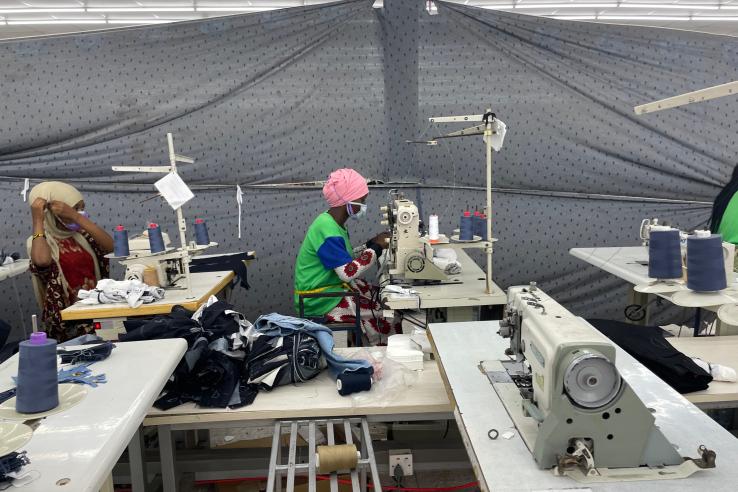
Encouraging Paid Sick Leave among Female Garment Workers in Bangladesh

Manufacturing jobs can improve women’s economic empowerment, but health issues or caretaking often drive women out of the labor force. In partnership with a large garment Banladeshi manufactory firm, researchers are conducting a randomized evaluation to test the impact of text messages about paid sick leave on workers' health and job satisfaction.
Pakistani woman applying for a job online through the Job Talaash platform
Evaluation

Follow-Up Phone Calls to Reduce the Costs of Job Search among Job Seekers in Pakistan

Researchers conducted a randomized evaluation to test the impact of reducing the psychological costs of job applications, such as the tendency to postpone applications because completing a task today seems more burdensome than tomorrow, on job application rates and interviews in Lahore, Pakistan. The intervention, which involved follow-up calls inviting job seekers to apply for jobs, increased the number of job applications and interviews. The benefits of applying to jobs were similar after the increase in applications, suggesting that psychological costs play an important role in job search behavior.
Students in a school in India
Evaluation

The Impact of Targeted Teaching on Secondary School Learning Outcomes in India

Researchers evaluated a secondary school readiness program, Utkarsh, that provided targeted instruction to students in Odisha, India.
Page
Landing page

Board Members

Hand providing thumbprint for biometric identification card
Update
J-PAL Updates

December 2020 Newsletter

The December 2020 Newsletter highlights a new J-PAL Africa blog series that explores key policy and research questions on different digital identification and payments systems.
People in a queue for a vaccination drive.
Blog

Strengthening social assistance and health response to COVID-19 in India

The COVID-19 pandemic has expanded the proportion of the population in low- and middle-income countries that require social assistance from governments to deal with economic and health vulnerabilities. Can social assistance schemes be better designed so that they reach those who need support the...
Three children smiling
Project

Learning from Home During the Pandemic: The Experiences of Parents and Teachers

As a response to the outbreak of COVID-19, Jakarta’s provincial government stopped all in-person classroom learning in schools. The quick transition from normal schooling to learning from home raises questions about the readiness of teachers, parents, and students in carrying out the teaching and...
A view of the Boston common, city hall, and distant skyscrapers
Blog

Promoting upward mobility in partnership with state and local governments: A blueprint for future evaluations

This blog post is the final piece in a series on how state and local governments in the United States can promote upward mobility in their communities. It is part of J-PAL North America’s work to develop a learning agenda that summarizes the core research priorities from state and local governments...
Evaluation

The Impact of Community Policing on Citizens' Response to COVID-19

Researchers are conducting phone surveys to understand the effects of a community policing intervention on citizens' trust in the state and how that affects their willingness to comply with COVID-19 related measures in Uganda.
Evaluation

The Impact of a WhatsApp-based Intervention on Financial Resiliency and Intimate Partner Violence in Colombia

Researchers are evaluating the effectiveness of an interactive WhatsApp-based couples communication, financial education, and COVID-19 information program in promoting low-income households' financial resiliency and reducing IPV rates in Colombia. Research is ongoing; results forthcoming.
man wearing surgical mask using cell phone
Evaluation

The Impact of a Text-based Campaign on Intimate Partner Violence in Peru

In partnership with the Ministry of Women and Vulnerable Populations of Peru, researchers are evaluating a text-based campaign designed to help men regulate their emotions and reduce perpetration of IPV during the Covid-19 pandemic.
Young students do schoolwork in a classroom in Puerto Rico
Evaluation

Principal Training to Improve Student Achievement in Puerto Rico

Researchers are evaluating the impact of changes in school management practices on student outcomes over time by introducing a large-scale principal training program for school directors in Puerto Rico and testing different strategies to sustain improved management practices after the program.
A man and woman look at their mobile phones
Blog

Leveraging the digital revolution: Can governments utilize big data to help decision-making?

Using evidence to make policy decisions can be a challenge when the information one needs is not credible, easily accessible, or interpretable. However, this difficulty can be overcome with the use of a high-frequency monitoring system. As governments and organizations move towards more digitized...
Person

Craig McIntosh

Craig McIntosh is a Professor of Economics in the School of Global Policy and Strategy at the University of California, San Diego. He is a development economist whose work focuses on the evaluation of programs intended to contribute to the financial livelihoods of poor households. He has worked on...
Person

Leonard Wantchekon

Leonard Wantchekon is the James Madison Professor of Political Economy and Professor of Politics and International Affairs at Princeton University, as well as Associated Faculty in Economics. His research is broadly focused on Political Economy and development economics particularly in Africa, and...

Pagination

  • First page « First
  • Previous page ‹
  • …
  • Page 225
  • Page 226
  • Current page 227
  • Page 228
  • Page 229
  • …
  • Next page ›
  • Last page Last »
J-PAL

J-PAL

400 Main Street

E19-201

Cambridge, MA 02142

USA

Contact

+1 617 324 6566

[email protected]


Press Room

Stay Informed

Receive our newsletters

Subscribe


Privacy Policy

Accessibility

MIT