






The Abdul Latif Jameel Poverty Action Lab (J-PAL) is a global research center working to reduce poverty by ensuring that policy is informed by scientific evidence. Anchored by a network of more than 1,100 researchers at universities around the world, J-PAL conducts randomized impact evaluations to answer critical questions in the fight against poverty.
Our affiliated professors are based at over 130 universities and conduct randomized evaluations around the world to design, evaluate, and improve programs and policies aimed at reducing poverty. They set their own research agendas, raise funds to support their evaluations, and work with J-PAL staff on research, policy outreach, and training.
Our Board of Directors, which is composed of J-PAL affiliated professors and senior management, provides overall strategic guidance to J-PAL, our sector programs, and regional offices.
We host events around the world and online to share results and policy lessons from randomized evaluations, to build new partnerships between researchers and practitioners, and to train organizations on how to design and conduct randomized evaluations, and use evidence from impact evaluations.
Browse news articles about J-PAL and our affiliated professors, read our press releases and monthly global and research newsletters, and connect with us for media inquiries.
Based at leading universities around the world, our experts are economists who use randomized evaluations to answer critical questions in the fight against poverty. Connect with us for all media inquiries and we'll help you find the right person to shed insight on your story.
J-PAL is based at MIT in Cambridge, MA and has seven regional offices at leading universities in Africa, Europe, Latin America and the Caribbean, Middle East and North Africa, North America, South Asia, and Southeast Asia.
Our global office is based at the Department of Economics at the Massachusetts Institute of Technology. It serves as the head office for our network of seven independent regional offices.
Led by affiliated professors, J-PAL sectors guide our research and policy work by conducting literature reviews; by managing research initiatives that promote the rigorous evaluation of innovative interventions by affiliates; and by summarizing findings and lessons from randomized evaluations and producing cost-effectiveness analyses to help inform relevant policy debates.
How do policies affecting private sector firms impact productivity gaps between higher-income and lower-income countries? How do firms’ own policies impact economic growth and worker welfare?
How can we identify effective policies and programs in low- and middle-income countries that provide financial assistance to low-income families, insuring against shocks and breaking poverty traps?
J-PAL North America's Social Policy Research Initiative (SPRI), formerly known as the General Research Initiative, supports randomized impact evaluations of innovative social programs and policies that can provide insights for learning which policies work best and why.
J-PAL North America provides strategic and customized Research Management Support (RMS) to researchers in the J-PAL network to navigate early-stage complexities in the design and implementation of randomized evaluations.
This literature review, developed by researchers in the J-PAL network, is a comprehensive resource that synthesizes the results of 161 rigorous evaluations of climate actions conducted in high-income countries after 2000. The review categorizes climate actions into five main areas: Energy...
Join J-PAL North America, researchers in the J-PAL network, and climate leaders from Orlando, Florida, for a conversation on the role and promise of rigorous evaluation in informing effective, accessible climate solutions.
J-PAL North America's February newsletter features a new affiliate spotlight on Jacob Wallace and new research results in influenza vaccination take up. We also highlight an upcoming Climate Action webinar and recently published Climate Action Evidence Review.
Credit and grants ease farmers’ financial pressures, allowing them to invest in their farms, but on their own, these tools rarely boost farmers’ profits. Integrating credit or grants into bundled input programs enables farmers to take part in programs that address multiple barriers simultaneously...
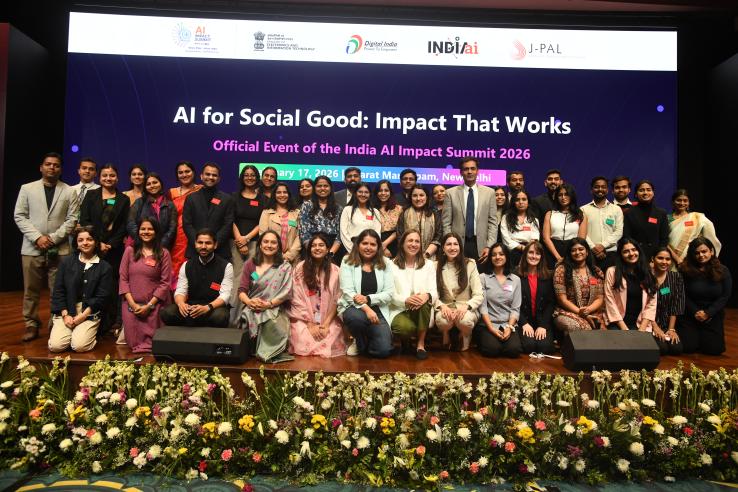
India hosted its flagship international gathering on AI, the India AI Impact Summit 2026, from February 16-20, 2026 at Bharat Mandapam in New Delhi. The J-PAL team had a whirlwind week at the summit, organizing "AI for Social Good: Impact That Works," our official event of the summit, as well as...