

The Impact of Women’s Employment and Control over Income on Family Planning in Rural India
- Job seekers
- Rural population
- Women and girls
- Adults
- Earnings and income
- Employment
- Fertility
- Women’s/girls’ decision-making
- Aspirations
- Gender attitudes and norms
- Fertility/pregnancy
- Health outcomes
- Mental health
- Take-up of program/social service/healthy behavior
- Digital and mobile
- Information
- Training
- Employment




Access to jobs and control over income may enable women to make informed choices about whether and when to have children by increasing their knowledge of family planning methods and empowering them to use these methods if they wish. In rural India, researchers are testing whether helping women access public employment and receive wages through direct deposit into individual bank accounts can increase their chances of being employed, their control over earnings, and ultimately their family planning decisions.
Policy issue
Millions of women around the world are unable to make informed choices about whether and when to have children.1 This reality may stem from a combination of factors, including: a lack of information on family planning methods such as contraceptives and fertility care; the high financial costs of accessing these services; restrictive gender norms that pressure young women into marrying or growing their families against their preferences; and women’s limited influence in household decision-making.
Expanding women’s access to jobs may help address these challenges in several ways. Employment might broaden women’s networks—a possible source of information and support for navigating family planning—and resulting earnings might make family planning methods more affordable. Work opportunities and experience can also shape how women and their families balance family aspirations with women’s education and careers, potentially easing the pressure to have children. Furthermore, income can strengthen women’s influence over household decisions if women control resources, which might extend to decisions regarding contraceptive use and childbearing.
To test these potential links between employment and family planning, researchers are measuring whether helping women enroll in India’s national public employment scheme and receive wages through direct deposit into individual bank accounts can enhance their access to paid work, control over earnings, and, ultimately, their ability to plan their families as they wish.
Context of the evaluation
Launched in 2005, the Mahatma Gandhi National Rural Employment Guarantee Scheme (MGNREGS) offers up to 100 days of paid work per year to residents in rural India who are over 18 years old,2 primarily through public works projects, such as water conservation, irrigation development, and community infrastructure.3
MGNREGS operates in a setting marked by large gender gaps in employment. Nationally, only about 40 percent of women who wanted to work were employed as of 2023–2024, compared to 78 percent of men. In response, the program includes features intended to encourage women’s participation, such as a requirement that at least one-third of beneficiaries be women and childcare provision at some worksites.4 Although all participants are meant to receive payments via direct deposit, enrollment has focused largely on recent workers, excluding many people who previously worked for the program.
In Madhya Pradesh, where this study is taking place, women completed nearly 42 percent of MGNREGS workdays in 2022–2023.5 While one third of women in the study had previously requested work under the program, about three-quarters said they would like to work under MGNREGS if given the chance. Many were unsure how to request MGNREGS work, and those who did often found it challenging to set up direct deposit so that wages could be paid into their own bank accounts. About 72 percent of households in the study relied on agriculture for their main source of income, and most earned less than US$2.15 on average.
Many women were at ages when decisions about childbearing were still ongoing, with 57 percent between 15 and 49 years old. State-level data from Madhya Pradesh show that 48 percent of married women in this age group had not undergone sterilization by 2020 or 2021. Of those, about 28 percent used no contraception, despite wanting fewer children than they had. Specifically, women across the state reported wanting 1.6 children but had 1.99, a gap of 0.39 children; in rural areas, the gap grew to 0.43 children per woman.
Details of the intervention
This study builds on earlier evidence that offering women a bank account, training on how to use it, and direct deposit of MGNREGS wages increased women’s influence in household decision-making and their likelihood of working outside the home. The present study will test a similar intervention implemented at a larger scale in Madhya Pradesh. It will measure the impacts of providing assistance with setting up direct deposits coupled with training on how to access MGNREGS on women’s economic agency and family planning outcomes.
Researchers will randomly assign households across 90 blocks (district sub-divisions) to one of three groups. In groups 2 and 3, they will survey 9,600 households randomly selected from 480 gram panchayats, the lowest governance level in India. Due to budget limitations, they will not survey households in group 1 and will instead use administrative records from MNGREGS to measure impacts on that group.
- Direct deposit help group (30 blocks, no surveyed households) - The Madhya Pradesh State Employment Guarantee Council (MPSEGC) will offer women in these blocks help linking their bank accounts to MGNREGS so they can get paid via direct deposit. MPSEGC will prioritize women who were former MGNREGS employees but have not participated in the program recently.
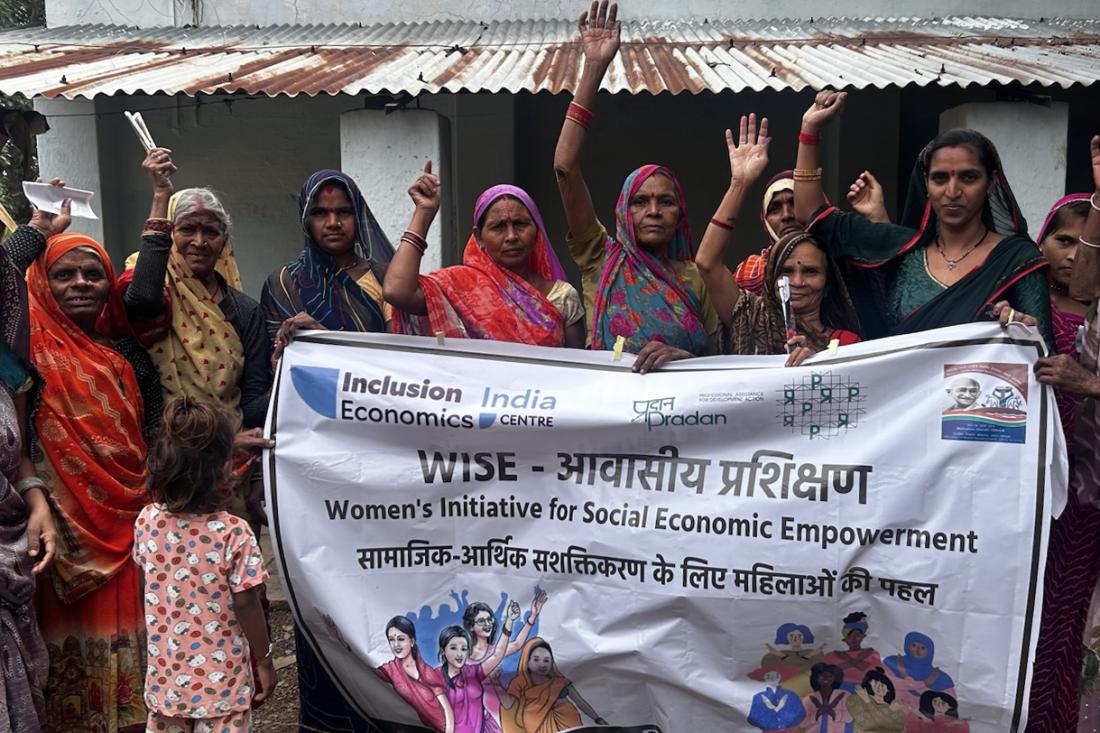
- Direct deposit help and training group (30 blocks, 300 gram panchayats, 6,000 surveyed households) - Women in this group will be offered support with setting up direct deposits along with video-guided training on how to enroll in MGNREGS and navigate the direct deposits. PRADAN, an Indian NGO specialized in rural development and livelihood support, will coordinate the training. Within this group, researchers will randomly vary two conditions: whether women are offered training from PRADAN staff or local government staff overseeing MGNREGS projects, and whether 25 or 75 percent of women in each gram panchayat are offered training.
- Comparison group (30 blocks, 180 gram panchayats, 3,600 surveyed households) - Women in this group will not be offered either direct deposit support or MGNERGS access training.
The interventions will take place from July 2025 to March 2026. Beginning in August 2026, researchers will gather survey and MNGREGS data to assess whether women are working in MGNREGS or private sector jobs, their earnings, the types of private sector jobs they hold, and wages and prices in their local communities. They will also measure women’s influence in household decision-making, spending patterns, mental health, experiences of violence, and how both women and men view women’s roles at home and in the workplace. Finally, researchers will track contraceptive use, whether women’s contraceptive needs are met, the desired number of children and birth timing for women and their spouses, and women’s beliefs of their spouses and in-laws’ views on these matters.
The researchers recognize that encouraging women to take on more visible work roles could lead to community backlash in places where norms limit women’s mobility and paid work. To minimize these risks, the team will train the trainers to explain to local leaders and participants that participation is voluntary, and use simple conflict‑mitigation steps while also tracking community reactions after each session. Additionally, all participants retain full access to MGNREGS and trainings will be open to everyone.
Results and policy lessons
Research ongoing; results forthcoming.
United Nations Population Fund (UNFPA). 2025. State of World Population 2025: The Real Fertility Crisis – The Pursuit of Reproductive Agency in a Changing World. New York: UNFPA. https://www.unfpa.org/swp2025.
State Rural Employment Society, Government of Meghalaya. 2017. “Objective of NREGA.” Meghalaya State Rural Employment Society. Last updated December 15, 2017. Accessed December 1, 2025. https://megsres.nic.in/objective-nrega.
Government of Haryana. 2025. “Mahatma Gandhi National Rural Employment Guarantee Scheme (MGNREGS).” Rural Development Department. Accessed August 15, 2025. https://haryanarural.gov.in/mahatma-gandhi-national-rural-employment-guarantee-scheme-mgnregs/.
Press Information Bureau. 2023. “Participation of Women under Mahatma Gandhi National Rural Employment Guarantee Scheme.” Press Information Bureau, July 25, 2023. https://pib.gov.in/PressReleasePage.aspx?PRID=1942377. [pib.gov.in]
Press Information Bureau. 2023. “Participation of Women under Mahatma Gandhi National Rural Employment Guarantee Scheme.” Press Information Bureau, July 25, 2023. https://pib.gov.in/PressReleasePage.aspx?PRID=1942377.[pib.gov.in]