

Protecting nature, empowering communities:
The PES Delivery Lab
The Payments for Environmental Services (PES) Delivery Lab is a strategic collaboration between The Nature Conservancy (TNC) and J-PAL, designed to support the scale up of high-impact PES models across Latin America and the Caribbean.

BACKGROUND
Over 1,6 billion people (20% of the world population) rely on forests for their livelihoods, yet less than 1 percent of global climate finance reaches forest communities, with only a fraction flowing to them directly. PES offers a powerful vehicle to channel resources to forest communities more directly, efficiently, and equitably while recognizing and valuing their services and ways of life.
Why PES?
Unparalleled opportunity for direct finance. While PES policies have expanded significantly across the tropical forest belt, with over 550 projects disbursing between $36–42 billion in the past decade, community engagement remains limited. Only 40 percent of programs involve community participation, and just 10 percent are designed by communities themselves. This gap undermines uptake and impact. The PES Delivery Lab aims to close this gap by strengthening delivery systems that are inclusive, locally driven, and evidence-based, ensuring that forest communities are not only beneficiaries but co-creators of climate solutions.
Best buys climate solutions. PES can represent one of the most cost-effective climate solutions available in developing countries. Compared to many popular mitigation measures, PES programs can deliver high climate benefits at low cost. In Uganda, for example, evidence shows that the net climate benefits from avoided emissions were two times the program costs. Comparative analyses suggest that PES can outperform by five times the cost of carbon avoidance of energy sector subsidies. By investing in PES, we unlock opportunities to deliver impactful climate action while directly supporting forest communities.
Promising impact for people and planet
PES programs have demonstrated strong results for people and nature. In Uganda, PES reduced tree loss by 54 percent and increased food consumption by 12 percent in Burkina Faso. Evidence also shows that targeting high-risk areas and landholders, combined with satellite monitoring, can enhance compliance and effectiveness. Contract design and incentive structures are also key.
These insights reinforce PES as a vehicle to drive high return on investment, potentially one of the best buys for nature and people outcomes in LAC.
THE PES DELIVERY LAB
The PES Delivery Lab is a strategic collaboration between The Nature Conservancy (TNC) and the Abdul Latif Jameel Poverty Action Lab (J-PAL), designed to scale high-impact PES models across Latin America and the Caribbean (LAC).
The main objective of the Lab is to promote the use of PES schemes for nature conservation and foster the use of evidence to inform the design of PES programs in LAC.
Partners
The PES Delivery Lab brings together two world-class institutions with complementary strengths to close critical gaps in Payments for Ecosystem Services (PES). By aligning policy with practice—and government priorities with community needs—the partnership advances science-led, people-first climate solutions that are both effective and scalable.
Together, J-PAL and TNC combine rigorous evidence, deep policy engagement, and on-the-ground implementation experience to ensure PES programs deliver lasting benefits for communities, governments, and ecosystems.
The Abdul Latif Poverty Action Lab (J-PAL)
J-PAL is a global research center working to reduce poverty by ensuring that policy is informed by scientific evidence. Anchored by a network of more than 1,100 researchers at universities around the world, J-PAL conducts randomized impact evaluations to answer critical questions in the fight against poverty.
J-PAL co-founders Abhijit Banerjee and Esther Duflo, with longtime affiliate Michael Kremer, were awarded the 2019 Nobel Prize in Economics for their pioneering approach to alleviating global poverty.
With over 20 years of experience working alongside governments, J-PAL brings to the partnership a global network of researchers and policy professionals who serve as trusted learning partners and thought leaders in the PES space. J-PAL’s contributions include:
- Sharing existing evidence with policymakers and implementers
- Identifying critical knowledge gaps
- Evaluating PES programs and policy reforms
- Advising on the improvement and scale-up of PES schemes
The Nature Conservancy
TNC is a global environmental nonprofit working to create a world where people and nature can thrive. Founded in the U.S. through grassroots action in 1951, it has grown to become one of the most wide-reaching environmental organizations in the world. Thanks to more than a million members and the dedicated efforts of our diverse staff and over 1,000 scientists, it works on conservation efforts in 83 countries and territories.
TNC brings more than 15 years of experience connecting PES innovation to system-level change. Through the PES Delivery Lab, TNC provides technical support to governments to design and reform inclusive PES policies, while strengthening community capacity to ensure meaningful participation.
Within the PES Delivery Lab, TNC’s role includes:
- Convening and steering coalitions of government, community, and funding partners
- Supporting implementing partners with problem diagnostics and early-stage program design in close collaboration with communities
- Building absorptive capacity and planning clear exit strategies to ensure long-term sustainability
|
Funding
The PES Delivery Lab has received funding from J-PAL’s Innovation for Government Initiative and King Climate Action Initiative, and private donors.
PES DELIVERY LAB ACTIVITIES
The PES Delivery Lab carries out three streams of work:
1. Evidence sharing and cross-pollination to make sure that governments have information for improving their programs.
- Share existing evidence with policymakers and implementers. The Lab disseminates rigorous evidence on PES generated through J-PAL’s extensive network of researchers, alongside relevant findings produced by other organizations.
- Facilitate exchanges between practitioners. Building on more than 25 years of global experience with PES implementation, the PES Delivery Lab convenes governments across the region to share experiences, exchange practical insights, and learn from one another.
- Share lessons from the Lab. In addition to disseminating evidence and fostering cross-learning, the Lab provides technical advice and pilots innovative approaches. The lessons emerging from these activities are systematically documented and shared with the broader community of governments working on PES.
EVIDENCE SHARING AND CROSS-POLLINATION: WORK SO FAR
During 2025, TNC and J-PAL LAC carried out five events to convene academics, practitioners, and experts to discuss evidence and experiences related to Payments for Ecosystem Services (PES). The sessions addressed different topics such as funding, involvement of Indigenous and rural communities, legal aspects. Participants and speakers included academics, government authorities from Argentina, Brazil, Chile, Guatemala, Ecuador, and Mexico, as well as representatives from communities and non-government organizations.
2. Technical advisory support tailored to the specific needs and priorities of each government. The PES Delivery Lab’s advisory offer includes support across the whole spectrum of evidence-informed policy design. As depicted in Figure 1, depending on a program’s stage of development, the Lab offers targeted support ranging from tailored evidence sharing and policy guidance to assistance with program rollout.
Figure 1: The Evidence to Scale (E2S) technical advice spectrum
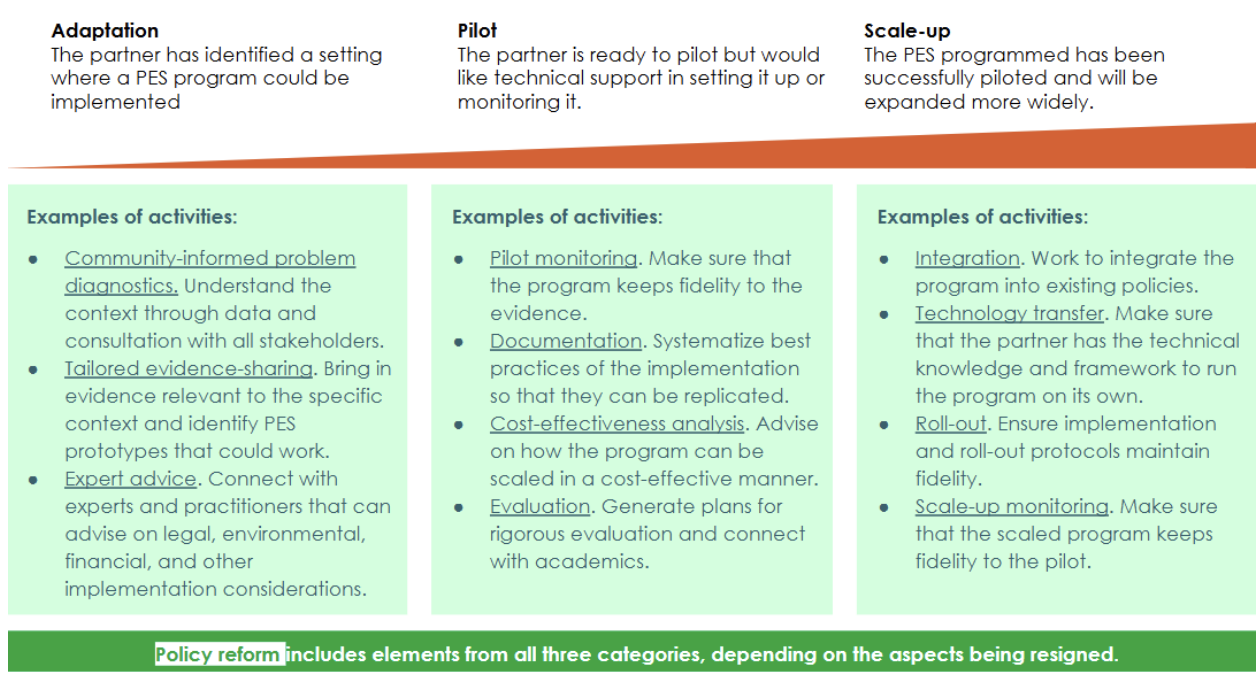
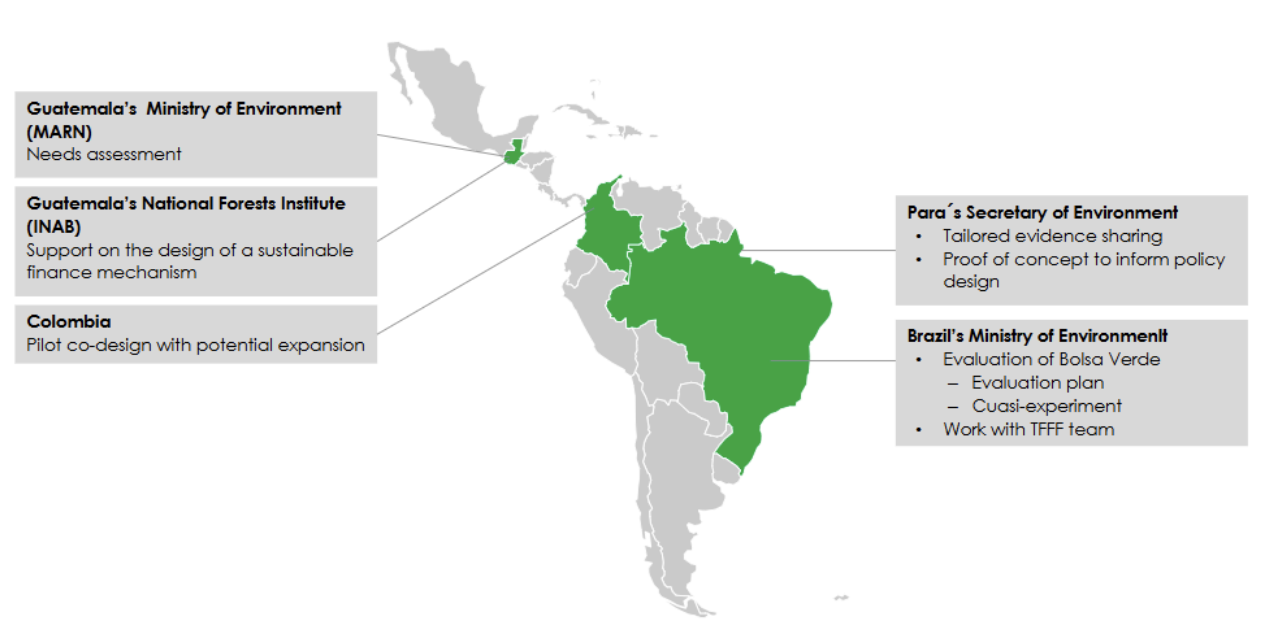
Figure 2: Technical advisory support portfolio
3. Innovation proof of concept to strengthen evidence on effective PES schemes.
To advance what works in PES design and implementation, the Lab will:
- Prototype PES models. While each context is unique, similar conditions often lend themselves to comparable program designs. The Lab will develop PES prototypes based on key design dimensions, such as land tenure and target outcomes. For example, tenure-based prototypes may include schemes for collectively owned land, privately owned land, and mixed-tenure systems. Outcome-based prototypes may focus on goals such as reduced deforestation or reforestation.
- Identify critical knowledge gaps. Despite strong and growing evidence base on the effectiveness of PES programs, important design questions remain—such as optimal contract duration, benefit levels, payment structures, and targeting strategies. The Lab will systematically identify these gaps and prioritize opportunities for generating new insights.
- Co-develop and evaluate innovations with implementers. As implementing partners test new approaches to improve program performance, the Lab will support the rigorous evaluation of these innovations. Leveraging J-PAL’s global research network, the Lab will generate credible evidence on program refinements and share findings widely to inform future PES policy and practice.
ONGOING PES EVALUATIONS BY J-PAL
- Redesigning Payments for Ecosystem Services in Mexico to Increase Cost-effectiveness. This project studied whether a PES program in Mexico cost-effectiveness could be increased by requiring PSA participants to enroll all or most of their eligible forested landholdings (i.e., full enrollment requirement). The study found that a full-enrollment approach led to a substantial decrease in deforestation compared to the traditional contract, resulting in a fourfold increase in the program’s cost-effectiveness. Researchers are currently working with the Mexican government to test this approach on a larger scale, aiming to inform national policy.
- PES to Reduce Deforestation in Communal Forestland in Liberia. With communal property, it is difficult to target and calibrate payments to households: the most scalable and contextually appropriate solution in Liberia relies on local community leadership to allocate payments within communities. Researchers will design and evaluate a PES program to compensate communities in Liberia for conserving collective forestland, including both conservation and governance conditions in the PES contract.