

Displaying 5836 - 5850 of 7216

Blog
Translating research into action in 2019: J-PAL North America’s year in review
As 2019 comes to a close, we reflect back on key accomplishments, lessons learned, and the partnerships that have made it possible to advance J-PAL North America’s mission of reducing poverty in the region. From compelling new evidence and reviews of over 160 rigorous evaluations, to the Evaluation...

Blog
New year, new partnerships to scale life-changing programs
In recent years, the United States Internal Revenue Service (IRS) redesigned the reminder notification letters that now reach more than 360,000 individuals eligible for the earned income tax credit (EITC), giving them millions of dollars in earned benefits. This change was in response to a...
Research resource
Introduction to randomized evaluations
This resource gives an overview and non-technical introduction to randomized evaluations. Randomized evaluations can be used to measure impact in policy research: to date, J-PAL affiliated researchers have conducted more than 1,100 randomized evaluations studying policies in ten thematic sectors in...
Research resource
Resources for researchers new to randomized evaluations
This resource is a brief introduction to conducting field research that distills many years of implementation experience. It is geared towards new PIs (Principal Investigators), such as graduate students or post docs, but may be useful for more seasoned researchers and research staff as well. While...
Research resource
Grant proposals
The first step in embarking on a research project is often writing the grant proposal to fund it. Outside of securing funding for your project, the main purpose of the grant is to lay out your research question and methodology, explain its value to the research and/or policy community, and...
Research resource
Ethical conduct of randomized evaluations
This resource is intended as a practical guide for researchers to use when considering the ethics of a given research project. It draws heavily from J-PAL’s own ethics training for research staff and Rachel Glennerster and Shawn Powers’s chapter in the Oxford Handbook of Professional Economic Ethics...
Research resource
Trial registration
This resource provides guidance for researchers wishing to register their study in a public trial registry. We list common social science registries and registration policies of common funders and economics journals. We additionally describe registration considerations such as the level of detail to...
Research resource
Pre-analysis plans
A pre-analysis plan (PAP) describes how researchers plan to analyze the data from a randomized evaluation. It is distinct from the concept of pre-registration, which in economics is the act of registering a research project in a registry such as the AEA RCT Registry before the intervention begins...
Research resource
Randomization
Randomization for causal inference has a storied history. Controlled randomized experiments were invented by Charles Sanders Peirce and Joseph Jastrow in 1884. Jerzy Neyman introduced stratified sampling in 1934. Ronald A. Fisher expanded on and popularized the idea of randomized experiments and...
Research resource
Power calculations
This section is intended to provide an intuitive discussion of the rationale behind power calculations, as well as practical tips and sample code for conducting power calculations using either built-in commands or simulation. It assumes some knowledge of statistics and hypothesis testing. Readers...
Research resource
Introduction to measurement and indicators
The goal of measurement is to get reliable data with which to answer research questions and assess theories of change. Inaccurate measurement can lead to unreliable data, from which it is difficult to draw valid conclusions. This section covers key measurement concepts, means of data collection...

Blog
African scholars: Refine your randomized evaluation skills through the DigiFI Webinar Series
Local researchers often have a uniquely deep understanding of the context in which they work, which is key to developing well-grounded evaluations. The J-PAL Africa team, including DigiFI Africa led by Tavneet Suri, are committed to providing a mechanism for local African scholars to drive the...
Evaluation
Branchless Banking Agents’ Profile, Limitations, and Potential for Agent Network Expansion and Improvement”
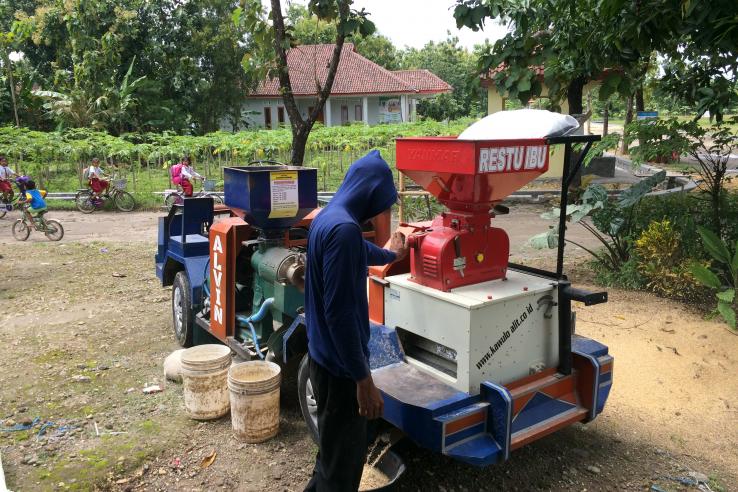
Researchers conducted a randomized evaluation in East Java, Indonesia to investigate the impact of the level and transparency of financial incentives on the take-up of these new banking services. They found that larger incentives caused an increase in take-up, but only when the incentives were not publicized among the community. When incentives are made public, higher incentives instead have no effect on take-up, despite greater agent effort.
Person
Michael Callen
Michael Callen is an Associate Professor at the London School of Economics. His recent work uses experiments to identify ways to address accountability and service delivery failures in the public sector, working primarily in Afghanistan and Pakistan
Person
Alain de Janvry
Alain de Janvry is a Professor of Agricultural and Resource Economics at the University of California, Berkeley.