The Abdul Latif Jameel Poverty Action Lab (J-PAL) is a global research center working to reduce poverty by ensuring that policy is informed by scientific evidence. Anchored by a network of more than 1,100 researchers at universities around the world, J-PAL conducts randomized impact evaluations to answer critical questions in the fight against poverty.
The Abdul Latif Jameel Poverty Action Lab (J-PAL) is a global research center working to reduce poverty by ensuring that policy is informed by scientific evidence. Anchored by a network of more than 1,100 researchers at universities around the world, J-PAL conducts randomized impact evaluations to answer critical questions in the fight against poverty.
Our affiliated professors are based at over 130 universities and conduct randomized evaluations around the world to design, evaluate, and improve programs and policies aimed at reducing poverty. They set their own research agendas, raise funds to support their evaluations, and work with J-PAL staff on research, policy outreach, and training.
Our Board of Directors, which is composed of J-PAL affiliated professors and senior management, provides overall strategic guidance to J-PAL, our sector programs, and regional offices.
We host events around the world and online to share results and policy lessons from randomized evaluations, to build new partnerships between researchers and practitioners, and to train organizations on how to design and conduct randomized evaluations, and use evidence from impact evaluations.
Browse news articles about J-PAL and our affiliated professors, read our press releases and monthly global and research newsletters, and connect with us for media inquiries.
Based at leading universities around the world, our experts are economists who use randomized evaluations to answer critical questions in the fight against poverty. Connect with us for all media inquiries and we'll help you find the right person to shed insight on your story.
J-PAL is based at MIT in Cambridge, MA and has seven regional offices at leading universities in Africa, Europe, Latin America and the Caribbean, Middle East and North Africa, North America, South Asia, and Southeast Asia.
J-PAL is based at MIT in Cambridge, MA and has seven regional offices at leading universities in Africa, Europe, Latin America and the Caribbean, Middle East and North Africa, North America, South Asia, and Southeast Asia.
Our global office is based at the Department of Economics at the Massachusetts Institute of Technology. It serves as the head office for our network of seven independent regional offices.
Led by affiliated professors, J-PAL sectors guide our research and policy work by conducting literature reviews; by managing research initiatives that promote the rigorous evaluation of innovative interventions by affiliates; and by summarizing findings and lessons from randomized evaluations and producing cost-effectiveness analyses to help inform relevant policy debates.
Led by affiliated professors, J-PAL sectors guide our research and policy work by conducting literature reviews; by managing research initiatives that promote the rigorous evaluation of innovative interventions by affiliates; and by summarizing findings and lessons from randomized evaluations and producing cost-effectiveness analyses to help inform relevant policy debates.
How do policies affecting private sector firms impact productivity gaps between higher-income and lower-income countries? How do firms’ own policies impact economic growth and worker welfare?
How can we identify effective policies and programs in low- and middle-income countries that provide financial assistance to low-income families, insuring against shocks and breaking poverty traps?
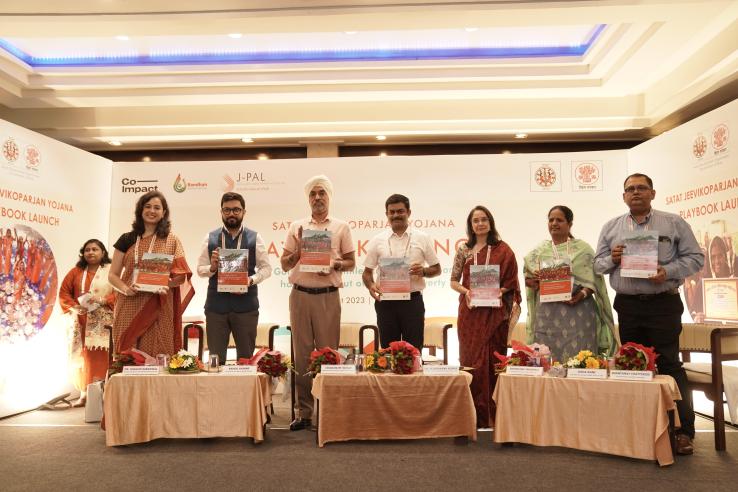
The Bihar Rural Livelihoods Promotion Society (JEEViKA), in collaboration with Bandhan-Konnagar and J-PAL South Asia, hosted the launch of a new playbook capturing five years of learnings from Satat Jeevikoparjan Yojana (SJY)—the world’s first government-led scale-up of the Graduation Approach. The...
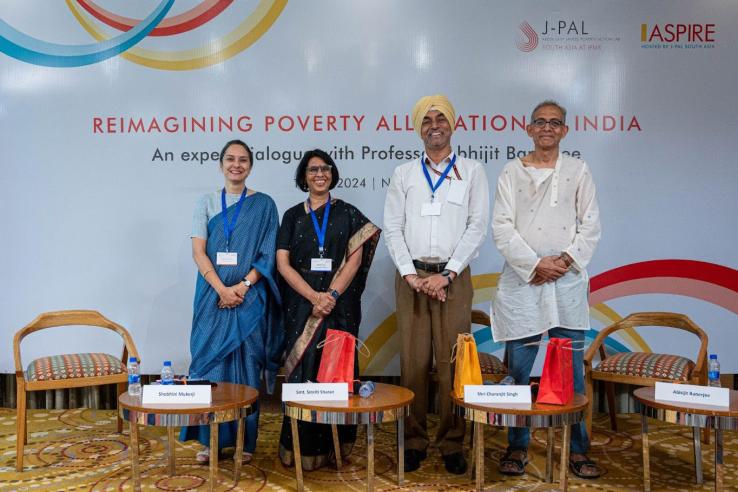
On July 11, 2024, J-PAL South Asia hosted an exclusive roundtable in New Delhi with Nobel Laureate and J-PAL Co-Founder Professor Abhijit Banerjee, bringing together senior leaders from government, philanthropy, and civil society to reimagine how India can tackle extreme poverty through scalable...
Rakean is a Research Associate at J-PAL Southeast Asia, where he currently works on projects related to social protection for poverty reduction and is also assisting the urban transportation project.
Join the course team for a live webinar to explore the Data, Economics, and Design of Policy MicroMasters program. Learn how this flexible, online graduate-level program—taught by MIT faculty—can help you build practical skills in data analysis, economics, and policy design.
J-PAL North America's July newsletter features a new manual for replicating and adapting summer youth employment programming and shares new research results on cash transfers.
J-PAL Latin America and the Caribbean (LAC) promotes J-PAL's campaign The Evidence Effect, celebrates a new Co-Scientific Director, launches a podcast on education and establishes a partnership with UNICEF. Find the latest updates on policy-relevant research, initiatives, courses, events, resources...
ASPIRE’s core mission is to reduce poverty at scale by partnering with governments, civil society, and donors to embed evidence-based solutions into public systems. Through a collaborative and systems-oriented model, ASPIRE helps ensure that every investment achieves outsized and lasting impact.
How can we make climate policy more effective, equitable, and evidence-driven? That was the guiding question of J-PAL Europe’s recent policy roundtable in Bonn, Germany. The roundtable was hosted alongside the Institute of Labour Economics’ (IZA) Climate and Environmental Economics workshop and...
Generating rigorous evidence on the effectiveness of programs designed to reduce poverty is not just the work of lower and middle-income countries. Countries across Europe and North America are also grappling with how to best tackle deep-rooted and pressing social challenges. These include...
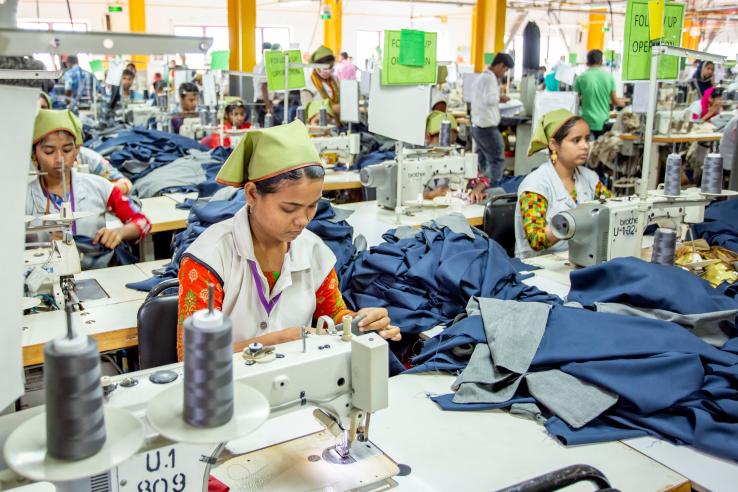
Researchers evaluated how different ways of asking questions in surveys affect workers’ likelihood of reporting harassment at a firm in Bangladesh. A survey technique that gave people plausible deniability led to workers reporting more abuses, allowing the firm to access more accurate data on the extent of harassment at its workplace.
Rhea Daima is a Research Associate at J-PAL South Asia, where she works on the Frontiers of Graduation: Building Resilience and Sustainable Livelihoods in Urban India (SJY Urban) project based in Patna, Bihar.