

J-PAL J-PAL
The Abdul Latif Jameel Poverty Action Lab
  • About
    • Overview
    • People
    • Strengthening Our Work
    • Code of Conduct
    • Initiatives
    • Events
    • Blog
    • News
    • Press Room
  • Offices
    • Overview
    • Global
    • Africa
    • Europe
    • Latin America and the Caribbean
    • Middle East and North Africa
    • North America
    • South Asia
    • Southeast Asia
  • Sectors
    • Overview
    • Agriculture
    • Crime, Violence, and Conflict
    • Education
    • Environment, Energy, and Climate Change
    • Finance
    • Firms
    • Gender
    • Health
    • Labor Markets
    • Political Economy and Governance
    • Social Protection
  • Evaluations
  • Research Resources
    • About Us
    • Our Work
    • Join ASPIRE
    • Newsroom
  • Policy Insights
  • Evidence to Policy
    • Pathways and Case Studies
    • The Evidence Effect
  • Blog
  • Careers
  • Courses
  • For Affiliates
  • Support J-PAL

Utility menu

  • Blog
  • Careers
  • Courses
  • For Affiliates
  • Support J-PAL

Quick links

  • Evaluations
  • Research Resources
  • Policy Insights
  • Evidence to Policy
    • Pathways and Case Studies
    • The Evidence Effect
  • About

    The Abdul Latif Jameel Poverty Action Lab (J-PAL) is a global research center working to reduce poverty by ensuring that policy is informed by scientific evidence. Anchored by a network of more than 1,100 researchers at universities around the world, J-PAL conducts randomized impact evaluations to answer critical questions in the fight against poverty.

    • Overview

      The Abdul Latif Jameel Poverty Action Lab (J-PAL) is a global research center working to reduce poverty by ensuring that policy is informed by scientific evidence. Anchored by a network of more than 1,100 researchers at universities around the world, J-PAL conducts randomized impact evaluations to answer critical questions in the fight against poverty.

      • Affiliated Professors

        Our affiliated professors are based at over 130 universities and conduct randomized evaluations around the world to design, evaluate, and improve programs and policies aimed at reducing poverty. They set their own research agendas, raise funds to support their evaluations, and work with J-PAL staff on research, policy outreach, and training.

      • Invited Researchers
      • J-PAL Scholars
      • Board
        Our Board of Directors, which is composed of J-PAL affiliated professors and senior management, provides overall strategic guidance to J-PAL, our sector programs, and regional offices.
      • Staff
    • Strengthening Our Work

      Our research, policy, and training work is fundamentally better when it is informed by a broad range of perspectives.

    • Code of Conduct
    • Initiatives
      J-PAL initiatives concentrate funding and other resources around priority topics for which rigorous policy-relevant research is urgently needed.
    • Events
      We host events around the world and online to share results and policy lessons from randomized evaluations, to build new partnerships between researchers and practitioners, and to train organizations on how to design and conduct randomized evaluations, and use evidence from impact evaluations.
    • Blog
      News, ideas, and analysis from J-PAL staff and affiliated professors.
    • News
      Browse news articles about J-PAL and our affiliated professors, read our press releases and monthly global and research newsletters, and connect with us for media inquiries.
    • Press Room
      Based at leading universities around the world, our experts are economists who use randomized evaluations to answer critical questions in the fight against poverty. Connect with us for all media inquiries and we'll help you find the right person to shed insight on your story.
  • Offices
    J-PAL is based at MIT in Cambridge, MA and has seven regional offices at leading universities in Africa, Europe, Latin America and the Caribbean, Middle East and North Africa, North America, South Asia, and Southeast Asia.
    • Overview
      J-PAL is based at MIT in Cambridge, MA and has seven regional offices at leading universities in Africa, Europe, Latin America and the Caribbean, Middle East and North Africa, North America, South Asia, and Southeast Asia.
    • Global
      Our global office is based at the Department of Economics at the Massachusetts Institute of Technology. It serves as the head office for our network of seven independent regional offices.
    • Africa
    • Europe
    • Latin America and the Caribbean
    • Middle East and North Africa
      J-PAL MENA is based at the American University in Cairo, Egypt.
    • North America
    • South Asia
    • Southeast Asia
  • Sectors
    Led by affiliated professors, J-PAL sectors guide our research and policy work by conducting literature reviews; by managing research initiatives that promote the rigorous evaluation of innovative interventions by affiliates; and by summarizing findings and lessons from randomized evaluations and producing cost-effectiveness analyses to help inform relevant policy debates.
    • Overview
      Led by affiliated professors, J-PAL sectors guide our research and policy work by conducting literature reviews; by managing research initiatives that promote the rigorous evaluation of innovative interventions by affiliates; and by summarizing findings and lessons from randomized evaluations and producing cost-effectiveness analyses to help inform relevant policy debates.
    • Agriculture
      How can we encourage small farmers to adopt proven agricultural practices and improve their yields and profitability?
    • Crime, Violence, and Conflict
      What are the causes and consequences of crime, violence, and conflict and how can policy responses improve outcomes for those affected?
    • Education
      How can students receive high-quality schooling that will help them, their families, and their communities truly realize the promise of education?
    • Environment, Energy, and Climate Change
      How can we increase access to energy, reduce pollution, and mitigate and build resilience to climate change?
    • Finance
      How can financial products and services be more affordable, appropriate, and accessible to underserved households and businesses?
    • Firms
      How do policies affecting private sector firms impact productivity gaps between higher-income and lower-income countries? How do firms’ own policies impact economic growth and worker welfare?
    • Gender
      How can we reduce gender inequality and ensure that social programs are sensitive to existing gender dynamics?
    • Health
      How can we increase access to and delivery of quality health care services and effectively promote healthy behaviors?
    • Labor Markets
      How can we help people find and keep work, particularly young people entering the workforce?
    • Political Economy and Governance
      What are the causes and consequences of poor governance and how can policy improve public service delivery?
    • Social Protection
      How can we identify effective policies and programs in low- and middle-income countries that provide financial assistance to low-income families, insuring against shocks and breaking poverty traps?
Displaying 8251 - 8265 of 8337
Person

Lesley Harkins
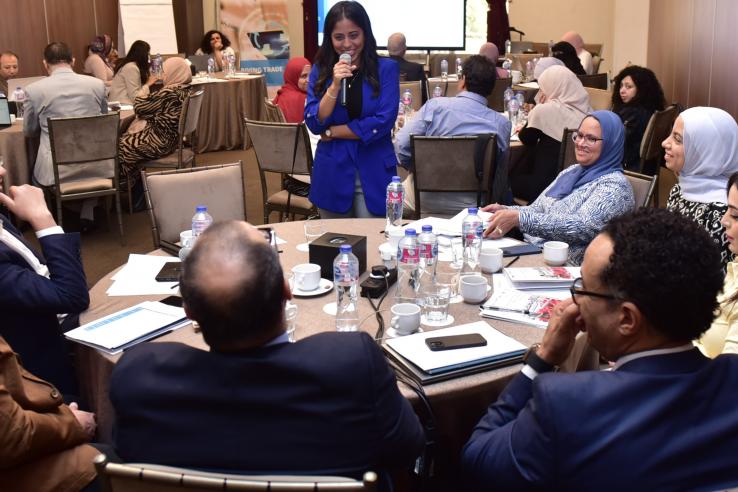
Group roundtable with lady holding mic
Event

Building Evidence Ecosystems in Governmental Digital Inclusion Initiatives through Training

The Egypt Impact Lab (EIL) is collaborating with the German Agency for International Cooperation (GIZ) and the Egyptian Ministry of Communications and Information Technology (MCIT) for two rounds of training for MCIT officers on Government Digital Inclusion Initiatives. This training falls under the...
Person

Oriana Bandiera

Oriana Bandiera is the Sir Anthony Atkinson Professor of Economics at the London School of Economics and Political Science and editor for Microeconomic Insights.
Person

Pascaline Dupas

Pascaline Dupas is a Professor of Economics and Public Affairs at Princeton University and Co-Scientific Director of J-PAL Africa. Pascaline joined the Princeton faculty in July 2023. She was previously the Kleinheinz Family Professor of International Studies at Stanford University, where she spent...
Person

Patrizio Piraino

Patrizio Piraino is a Professor in the Keough School of Global Affairs at the University of Notre Dame. Patrizio’s main fields of interest are labor economics, education, and development. His research focuses broadly on the determinants of socioeconomic disadvantage. He has led a large cross...
Person

Paul Gertler

Paul Gertler is the Li Ka Shing Professor of Economics at the University of California Berkeley where he holds appointments in the Haas School of Business and the School of Public Health. He is also the Director of UC Berkeley’s Graduate Program in Health Management and Scientific Director of the UC...
Person

Paul Glewwe

Paul Glewwe is a Distinguished McKnight University Professor at the University of Minnesota. His interests are economics of education, poverty and inequality in developing countries, and applied econometrics.
Person

Paul Niehaus

Paul Niehaus is an Associate Professor in the Department of Economics at UC San Diego. He is Chancellor's Associates Endowed Chair in Economics at UC San Diego and an affiliate of BREAD, CEGA, J-PAL, and the NBER. His research examines the design, implementation, and impact of anti-poverty programs...
Person

Moussa Blimpo

Moussa P. Blimpo is an Assistant Professor of Economic Inequality and Societies at the University of Toronto’s Munk School of Global Affairs and Public Policy.
Person

Mushfiq Mobarak

Ahmed Mushfiq Mobarak is a Jerome Kasoff ’54 Professor of Management and Economics at Yale University with concurrent appointments in the School of Management and in the Department of Economics. He also leads the Bangladesh Research Program for the International Growth Centre (IGC) at LSE and Oxford...
Person

Namrata Kala

Namrata Kala is an Assistant Professor in Applied Economics at the MIT Sloan School of Management. Her research interests are in environmental and development economics.
Person

Nathan Fiala

Nathan Fiala is an Associate Professor at the University of Connecticut.
Person

Nathaniel (Nathan) Hendren

Nathaniel Hendren is a Professor of Economics at Harvard University and a Faculty Research Fellow at the National Bureau of Economic Research.
Person

Stefano Caria

Stefano Caria is a Professor in Development Economics at the University of Oxford. He uses experimental and structural methods to investigate how to make labor markets work better for the poor.
Person

Sule Alan

Sule Alan is a Professor of Economics and Behavioral Science at Cornell University and Bilkent University, Turkiye. Her research interests include education, education and social policy evaluations, human and social capital formation, and gender.

Pagination

  • First page « First
  • Previous page ‹
  • …
  • Page 549
  • Page 550
  • Current page 551
  • Page 552
  • Page 553
  • …
  • Next page ›
  • Last page Last »
J-PAL

J-PAL

400 Main Street

E19-201

Cambridge, MA 02142

USA

Contact

+1 617 324 6566

[email protected]


Press Room

Stay Informed

Receive our newsletters

Subscribe


Privacy Policy

Accessibility

MIT