J-PAL J-PAL
The Abdul Latif Jameel Poverty Action Lab
  • About
    • Overview
    • People
      • Affiliated Professors
      • Invited Researchers
      • J-PAL Scholars
      • Board
      • Leadership
      • Staff
    • Strengthening Our Work
    • Code of Conduct
    • Initiatives
    • Events
    • Blog
    • News
    • Press Room
  • Offices
    • Overview
    • Global
    • Africa
    • Europe
    • Latin America and the Caribbean
    • Middle East and North Africa
    • North America
    • South Asia
    • Southeast Asia
  • Sectors
    • Overview
    • Agriculture
    • Crime, Violence, and Conflict
    • Education
    • Environment, Energy, and Climate Change
    • Finance
    • Firms
    • Gender
    • Health
    • Labor Markets
    • Political Economy and Governance
    • Social Protection
  • Evaluations
  • Research Resources
    • About Us
    • Our Work
    • Join ASPIRE
    • Newsroom
  • Policy Insights
  • Evidence to Policy
    • Pathways and Case Studies
    • The Evidence Effect
  • Blog
  • Careers
  • Courses
  • For Affiliates
  • Support J-PAL

Utility menu

  • Blog
  • Careers
  • Courses
  • For Affiliates
  • Support J-PAL

Quick links

  • Evaluations
  • Research Resources
  • Policy Insights
  • Evidence to Policy
    • Pathways and Case Studies
    • The Evidence Effect
  • About

    The Abdul Latif Jameel Poverty Action Lab (J-PAL) is a global research center working to reduce poverty by ensuring that policy is informed by scientific evidence. Anchored by a network of more than 1,100 researchers at universities around the world, J-PAL conducts randomized impact evaluations to answer critical questions in the fight against poverty.

    • Overview

      The Abdul Latif Jameel Poverty Action Lab (J-PAL) is a global research center working to reduce poverty by ensuring that policy is informed by scientific evidence. Anchored by a network of more than 1,100 researchers at universities around the world, J-PAL conducts randomized impact evaluations to answer critical questions in the fight against poverty.

      • Affiliated Professors

        Our affiliated professors are based at over 130 universities and conduct randomized evaluations around the world to design, evaluate, and improve programs and policies aimed at reducing poverty. They set their own research agendas, raise funds to support their evaluations, and work with J-PAL staff on research, policy outreach, and training.

      • Invited Researchers
      • J-PAL Scholars
      • Board
        Our Board of Directors, which is composed of J-PAL affiliated professors and senior management, provides overall strategic guidance to J-PAL, our sector programs, and regional offices.
      • Leadership
      • Staff
    • Strengthening Our Work

      Our research, policy, and training work is fundamentally better when it is informed by a broad range of perspectives.

    • Code of Conduct
    • Initiatives
      J-PAL initiatives concentrate funding and other resources around priority topics for which rigorous policy-relevant research is urgently needed.
    • Events
      We host events around the world and online to share results and policy lessons from randomized evaluations, to build new partnerships between researchers and practitioners, and to train organizations on how to design and conduct randomized evaluations, and use evidence from impact evaluations.
    • Blog
      News, ideas, and analysis from J-PAL staff and affiliated professors.
    • News
      Browse news articles about J-PAL and our affiliated professors, read our press releases and monthly global and research newsletters, and connect with us for media inquiries.
    • Press Room
      Based at leading universities around the world, our experts are economists who use randomized evaluations to answer critical questions in the fight against poverty. Connect with us for all media inquiries and we'll help you find the right person to shed insight on your story.
  • Offices
    J-PAL is based at MIT in Cambridge, MA and has seven regional offices at leading universities in Africa, Europe, Latin America and the Caribbean, Middle East and North Africa, North America, South Asia, and Southeast Asia.
    • Overview
      J-PAL is based at MIT in Cambridge, MA and has seven regional offices at leading universities in Africa, Europe, Latin America and the Caribbean, Middle East and North Africa, North America, South Asia, and Southeast Asia.
    • Global
      Our global office is based at the Department of Economics at the Massachusetts Institute of Technology. It serves as the head office for our network of seven independent regional offices.
    • Africa
    • Europe
    • Latin America and the Caribbean
    • Middle East and North Africa
    • North America
    • South Asia
    • Southeast Asia
  • Sectors
    Led by affiliated professors, J-PAL sectors guide our research and policy work by conducting literature reviews; by managing research initiatives that promote the rigorous evaluation of innovative interventions by affiliates; and by summarizing findings and lessons from randomized evaluations and producing cost-effectiveness analyses to help inform relevant policy debates.
    • Overview
      Led by affiliated professors, J-PAL sectors guide our research and policy work by conducting literature reviews; by managing research initiatives that promote the rigorous evaluation of innovative interventions by affiliates; and by summarizing findings and lessons from randomized evaluations and producing cost-effectiveness analyses to help inform relevant policy debates.
    • Agriculture
      How can we encourage small farmers to adopt proven agricultural practices and improve their yields and profitability?
    • Crime, Violence, and Conflict
      What are the causes and consequences of crime, violence, and conflict and how can policy responses improve outcomes for those affected?
    • Education
      How can students receive high-quality schooling that will help them, their families, and their communities truly realize the promise of education?
    • Environment, Energy, and Climate Change
      How can we increase access to energy, reduce pollution, and mitigate and build resilience to climate change?
    • Finance
      How can financial products and services be more affordable, appropriate, and accessible to underserved households and businesses?
    • Firms
      How do policies affecting private sector firms impact productivity gaps between higher-income and lower-income countries? How do firms’ own policies impact economic growth and worker welfare?
    • Gender
      How can we reduce gender inequality and ensure that social programs are sensitive to existing gender dynamics?
    • Health
      How can we increase access to and delivery of quality health care services and effectively promote healthy behaviors?
    • Labor Markets
      How can we help people find and keep work, particularly young people entering the workforce?
    • Political Economy and Governance
      What are the causes and consequences of poor governance and how can policy improve public service delivery?
    • Social Protection
      How can we identify effective policies and programs in low- and middle-income countries that provide financial assistance to low-income families, insuring against shocks and breaking poverty traps?
Displaying 2836 - 2850 of 8566
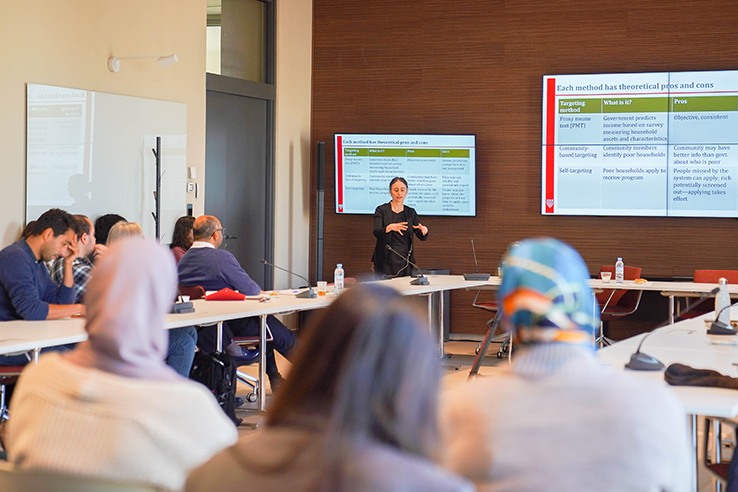
A group of people watching a speaker
Blog

Fostering inclusion in economics: Marianne Bertrand on addressing professional conduct with the American Economics Association

In part one of a series on fostering inclusion in the field of economics, we sat down with Marianne Bertrand (University of Chicago) about addressing professional conduct with the American Economics Association (AEA).
Women speaks in front of room
Blog

Fostering inclusion in economics: Alicia Sasser Modestino on gender and the dynamics of economics seminars

In part two of a series on fostering inclusion in the field of economics, Alicia Sasser-Modestino (Northeastern University) discusses gender dynamics in economics seminars.
Initiative Resource
Initiative projects and documents

Projects

Three people smiling looking at computer screen together
Blog

Fostering inclusion in economics: Matt Notowidigdo on the value (and limitations) of mentorship

In part three of a series on fostering inclusion in the field of economics, Matt Notowidigdo (University of Chicago) discusses the value of mentorship on advancing diversity and inclusion in the field of economics.
Image of voters stopping by political party booths in Honduras.
Evaluation

Impacts of Conditional Cash Transfer Programs on Voting in Honduras

In this randomized evaluation in Honduras, researchers assessed how the national Programa de Asignación Familiar (Family Allowance Program) CCT program, which provided a combination of transfers to households and transfers to support public goods, influenced voting in local and national elections. In municipalities where households received direct transfers, incumbent mayors faced a higher likelihood of re-election (an increase of 39 percent), but there was no impact on presidential election outcomes for any combination of transfers.
FAFSA application on mobile phone
Policy insight

The effect of nudges on federal student aid take-up in the United States

Students must complete the Free Application for Federal Student Aid (FAFSA) annually to receive federal loans and grants to attend college in the United States, a requirement often viewed as a barrier to college access. Informative and timely nudges can increase FAFSA filing rates, but providing...
Person

Sobia Shadbar

Person

Sahreen Shamim

Person

Giordano Frias Martinelli

Combination of Tomas Dulka's, Helena Lima's, and Chuka Ezeoguine’s headshots
Blog

DEDP Alumni Spotlight: Varied paths, one mission toward evidence-based poverty alleviation

We are delighted to share the accomplishments of three alumni from the DEDP Master’s program at MIT. These exceptional individuals represent the growing number of alumni who embark on varied, ambitious careers in a wide range of roles within research, policy, and implementing organizations, but...
Top: An Egyptian man collects grass in his boat. Bottom left: A man walking through air pollution in India. Bottom right: Two people cleaning a polluted river in Cape Town, South Africa
Resource
Basic page

Air and Water Labs

In partnership with Community Jameel, the Air and Water Labs work closely with government partners to co-generate evidence-based solutions for the most pressing air and water challenges in Africa, the Middle East and North Africa, and South Asia.
Student at computer
Blog

Overcoming administrative burdens: Strategies to increase FAFSA filing in the United States

A new J-PAL policy insight highlights evidence from randomized evaluations on interventions to increase FAFSA filing rates. In this post, we situate the insight within the larger context of higher education and barriers to accessing public programs, also known as “administrative burdens.”
A headshot of a man.
Blog

20 for 20: Empowering change in Ghana as an African researcher

As J-PAL celebrates its 20th anniversary, Edward Asiedu shares his experiences as part of the J-PAL network and sheds light on the impactful work he has accomplished in Ghana. In this blog post, he will take you through the journey that led him to this field and share the perspective of an African...
Update
J-PAL Updates

JEEViKA, Bandhan-Konnagar, and J-PAL South Asia Launch the Satat Jeevikoparjan Yojana Playbook to Double Down on the Fight Against Extreme Poverty at Scale

JEEViKA, Bandhan-Konnagar, and J-PAL South Asia launch the Satat Jeevikoparjan Yojana Playbook to double down on the fight against extreme poverty at scale.
Person

Alejandro Noriega

Pagination

  • First page « First
  • Previous page ‹
  • …
  • Page 188
  • Page 189
  • Current page 190
  • Page 191
  • Page 192
  • …
  • Next page ›
  • Last page Last »
J-PAL

J-PAL

400 Main Street

E19-201

Cambridge, MA 02142

USA

Contact

+1 617 324 6566

[email protected]


Press Room

Stay Informed

Receive our newsletters

Subscribe


Privacy Policy

Accessibility

MIT