J-PAL J-PAL
The Abdul Latif Jameel Poverty Action Lab
  • About
    • Overview
    • People
      • Affiliated Professors
      • Invited Researchers
      • J-PAL Scholars
      • Board
      • Leadership
      • Staff
    • Strengthening Our Work
    • Code of Conduct
    • Initiatives
    • Events
    • Blog
    • News
    • Press Room
  • Offices
    • Overview
    • Global
    • Africa
    • Europe
    • Latin America and the Caribbean
      • Growing Futures
    • Middle East and North Africa
    • North America
    • South Asia
    • Southeast Asia
  • Sectors
    • Overview
    • Agriculture
    • Crime, Violence, and Conflict
    • Education
    • Environment, Energy, and Climate Change
    • Finance
    • Firms
    • Gender
    • Health
    • Labor Markets
    • Political Economy and Governance
    • Social Protection
  • Evaluations
  • Research Resources
    • About Us
    • Our Work
    • Join ASPIRE
    • Newsroom
  • Policy Insights
  • Evidence to Policy
    • Pathways and Case Studies
    • The Evidence Effect
  • Blog
  • Careers
  • Courses
  • For Affiliates
  • Support J-PAL

Utility menu

  • Blog
  • Careers
  • Courses
  • For Affiliates
  • Support J-PAL

Quick links

  • Evaluations
  • Research Resources
  • Policy Insights
  • Evidence to Policy
    • Pathways and Case Studies
    • The Evidence Effect
  • About

    The Abdul Latif Jameel Poverty Action Lab (J-PAL) is a global research center working to reduce poverty by ensuring that policy is informed by scientific evidence. Anchored by a network of more than 1,100 researchers at universities around the world, J-PAL conducts randomized impact evaluations to answer critical questions in the fight against poverty.

    • Overview

      The Abdul Latif Jameel Poverty Action Lab (J-PAL) is a global research center working to reduce poverty by ensuring that policy is informed by scientific evidence. Anchored by a network of more than 1,100 researchers at universities around the world, J-PAL conducts randomized impact evaluations to answer critical questions in the fight against poverty.

      • Affiliated Professors

        Our affiliated professors are based at over 130 universities and conduct randomized evaluations around the world to design, evaluate, and improve programs and policies aimed at reducing poverty. They set their own research agendas, raise funds to support their evaluations, and work with J-PAL staff on research, policy outreach, and training.

      • Invited Researchers
      • J-PAL Scholars
      • Board
        Our Board of Directors, which is composed of J-PAL affiliated professors and senior management, provides overall strategic guidance to J-PAL, our sector programs, and regional offices.
      • Leadership
      • Staff
    • Strengthening Our Work

      Our research, policy, and training work is fundamentally better when it is informed by a broad range of perspectives.

    • Code of Conduct
    • Initiatives
      J-PAL initiatives concentrate funding and other resources around priority topics for which rigorous policy-relevant research is urgently needed.
    • Events
      We host events around the world and online to share results and policy lessons from randomized evaluations, to build new partnerships between researchers and practitioners, and to train organizations on how to design and conduct randomized evaluations, and use evidence from impact evaluations.
    • Blog
      News, ideas, and analysis from J-PAL staff and affiliated professors.
    • News
      Browse news articles about J-PAL and our affiliated professors, read our press releases and monthly global and research newsletters, and connect with us for media inquiries.
    • Press Room
      Based at leading universities around the world, our experts are economists who use randomized evaluations to answer critical questions in the fight against poverty. Connect with us for all media inquiries and we'll help you find the right person to shed insight on your story.
  • Offices
    J-PAL is based at MIT in Cambridge, MA and has seven regional offices at leading universities in Africa, Europe, Latin America and the Caribbean, Middle East and North Africa, North America, South Asia, and Southeast Asia.
    • Overview
      J-PAL is based at MIT in Cambridge, MA and has seven regional offices at leading universities in Africa, Europe, Latin America and the Caribbean, Middle East and North Africa, North America, South Asia, and Southeast Asia.
    • Global
      Our global office is based at the Department of Economics at the Massachusetts Institute of Technology. It serves as the head office for our network of seven independent regional offices.
    • Africa
    • Europe
    • Latin America and the Caribbean
    • Middle East and North Africa
    • North America
    • South Asia
    • Southeast Asia
  • Sectors
    Led by affiliated professors, J-PAL sectors guide our research and policy work by conducting literature reviews; by managing research initiatives that promote the rigorous evaluation of innovative interventions by affiliates; and by summarizing findings and lessons from randomized evaluations and producing cost-effectiveness analyses to help inform relevant policy debates.
    • Overview
      Led by affiliated professors, J-PAL sectors guide our research and policy work by conducting literature reviews; by managing research initiatives that promote the rigorous evaluation of innovative interventions by affiliates; and by summarizing findings and lessons from randomized evaluations and producing cost-effectiveness analyses to help inform relevant policy debates.
    • Agriculture
      How can we encourage small farmers to adopt proven agricultural practices and improve their yields and profitability?
    • Crime, Violence, and Conflict
      What are the causes and consequences of crime, violence, and conflict and how can policy responses improve outcomes for those affected?
    • Education
      How can students receive high-quality schooling that will help them, their families, and their communities truly realize the promise of education?
    • Environment, Energy, and Climate Change
      How can we increase access to energy, reduce pollution, and mitigate and build resilience to climate change?
    • Finance
      How can financial products and services be more affordable, appropriate, and accessible to underserved households and businesses?
    • Firms
      How do policies affecting private sector firms impact productivity gaps between higher-income and lower-income countries? How do firms’ own policies impact economic growth and worker welfare?
    • Gender
      How can we reduce gender inequality and ensure that social programs are sensitive to existing gender dynamics?
    • Health
      How can we increase access to and delivery of quality health care services and effectively promote healthy behaviors?
    • Labor Markets
      How can we help people find and keep work, particularly young people entering the workforce?
    • Political Economy and Governance
      What are the causes and consequences of poor governance and how can policy improve public service delivery?
    • Social Protection
      How can we identify effective policies and programs in low- and middle-income countries that provide financial assistance to low-income families, insuring against shocks and breaking poverty traps?
Displaying 2866 - 2880 of 7150
Voter turnout inside election polling site where people are seen in voting booths in the United States
Evaluation

Personality Traits and Responses to Persuasive Appeals among Voters in the United States

Researchers used two randomized evaluations, an online survey and a field experiment, to test how personality traits affect responses to persuasive appeals to vote. They found that individuals with high levels of openness were most responsive to a range of appeals.
Person

Sharon Barnhardt

Sharon Barnhardt is the Director of Research at the Centre for Social and Behavioural Change at Ashoka University. Her research focuses on issues of urban development and rural health in India, through the use of natural and randomized evaluations.
Voter participation with people behind voting booths in the United States with American flag in background
Evaluation

The Effectiveness of Encouraging Voter Participation by Inducing Feelings of Pride or Shame

Researchers evaluated whether disclosure of past voting participation had a stronger impact on turnout when it reminded voters of instances in which they previously voted or of instances in which they failed to vote. The results suggest that mailings disclosing past voting behavior had strong positive effects on voter turnout, and that these effects were stronger when voters were told of a recent election in which they failed to vote.
Candidate campaign mailings sent to voters in the United States
Evaluation

Does Campaign Spending Work in the United States?

In partnership with candidates, researcher Alan Gerber conducted five randomized evaluations in two states to measure the effect of campaign mailings on vote shares. The results suggest that incumbent spending has a negligible effect on vote share, whereas challenger spending was effective.
Image of apartment buildings in New York City
Evaluation

Evaluating the Impact of Moving to Opportunity in the United States

Helping families with young children living in high-poverty housing projects to move to lower-poverty neighborhoods improves the later-life outcomes for the children and may reduce the intergenerational persistence of poverty.
A woman working with her client
Evaluation

Providing Information on the EITC to Increase Amounts Received in the United States

Researchers sought to determine whether providing information on the EITC could increase the amount individuals received by randomizing the information professional tax preparers supplied. They found that providing more information did not increase EITC transfers or annual earnings overall.
Kindergarden students play with their teacher in a classroom in the United States
Evaluation

The Effects of Kindergarten Classroom on Earnings in the United States

Researchers measured the effect of class size, teacher quality, and classroom quality on earnings and other future outcomes for children participating in the Student/Teacher Achievement Ratio (STAR) project in Tennessee. The study found that smaller class sizes raised college attendance, more experienced teachers increased future earnings of their students, and higher quality classrooms improved both college attendance and future earnings. Researchers found that the positive effects of early childhood education on test scores diminish over time, but positive effects on non-cognitive outcomes persist through adulthood.
Doctor measures patient's blood pressure
Evaluation

The Oregon Health Insurance Experiment in the United States

In a series of evaluations, researchers took advantage of a lottery that gave low-income uninsured adults the chance to apply for Medicaid in the United States to examine the impact of health insurance on these outcomes over the first two years.
Evaluation

The RAND Health Insurance Experiment, Three Decades Later

Rema Hanna teaching to a classroom
Resource
Basic page

Morocco Innovation and Evaluation Lab

The Morocco Innovation and Evaluation Lab aims to foster development in Morocco by ensuring that policy is informed by rigorous scientific evidence and research is translated into action.
Primary school students playing in a music class in Germany J-PAL Europe
Evaluation

The Use of Nonbinding Contribution Suggestions for a Charitable Fundraising Scheme in Germany

Researchers randomized the suggested contribution in a fundraising appeal sent to patrons of the Bavaria State Opera (Germany). They found that the suggestions increased the average donation while decreasing the participation rate, resulting in no significant change in the average return per mailing.
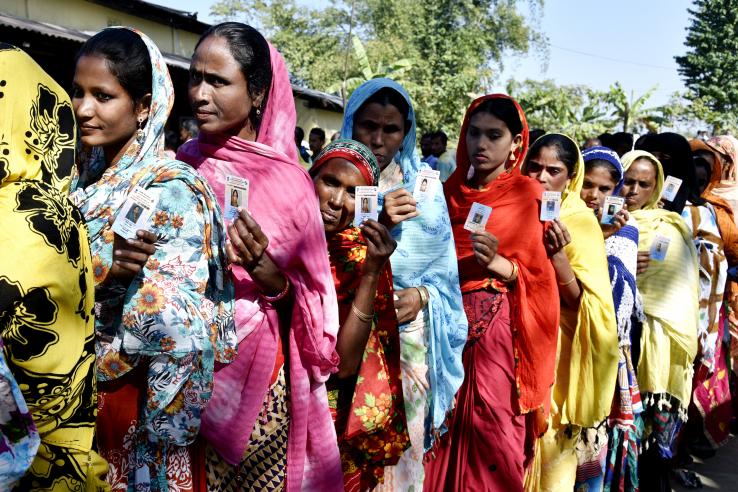
View of voter turnout in the United States with "vote here" sign and american flag
Evaluation

The Effects of Canvassing, Phone Calls, and Direct Mail on Voter Turnout in the United States

Researchers examined the effects of personal canvassing, phone calls, and direct mail on voter turnout shortly before the 1998 general election in the US city of New Haven. Personal canvassing had a far greater influence on voter participation than three pieces of professionally crafted mail delivered within two weeks of Election Day. Calls from professional phone banks were even less effective than direct mail at increasing voter turnout.
Evaluation

Improving Financial Access through Microcredit for Women in Mexico

Researchers expanded microcredit offerings in Sonora, Mexico to evaluate the effect of improved credit access on economic and social outcome. They found that microcredit increased access to formal financial services and enabled some businesses to expand, but did not increase household income or prompt new business creation.
Entrepreneur putting training skills to work
Evaluation

Impacts of Subsidized Entrepreneurship Training in the United States

Subsidizing entrepreneurship training in the United States did not improve access to training services or promoted employment among groups affected by discrimination.
A health worker wearing white gloves doing a finger prick test for HIV
Evaluation

Incentivizing Safe Sex in Rural Tanzania

In Tanzania, researchers examined whether making cash payments conditional on testing negative for sexually transmitted infections (STIs) can improve safe sex practices among young adults. They found that offering cash incentives of US$20 significantly reduced STI rates after one year, although smaller incentives of US$10 had no effect.

Pagination

  • First page « First
  • Previous page ‹
  • …
  • Page 190
  • Page 191
  • Current page 192
  • Page 193
  • Page 194
  • …
  • Next page ›
  • Last page Last »
J-PAL

J-PAL

400 Main Street

E19-201

Cambridge, MA 02142

USA

Contact

+1 617 324 6566

[email protected]


Press Room

Stay Informed

Receive our newsletters

Subscribe


Privacy Policy

Accessibility

MIT