J-PAL J-PAL
The Abdul Latif Jameel Poverty Action Lab
  • About
    • Overview
    • People
      • Affiliated Professors
      • Invited Researchers
      • J-PAL Scholars
      • Board
      • Leadership
      • Staff
    • Strengthening Our Work
    • Code of Conduct
    • Initiatives
    • Events
    • Blog
    • News
    • Press Room
  • Offices
    • Overview
    • Global
    • Africa
    • Europe
    • Latin America and the Caribbean
      • Growing Futures
    • Middle East and North Africa
    • North America
    • South Asia
    • Southeast Asia
  • Sectors
    • Overview
    • Agriculture
    • Crime, Violence, and Conflict
    • Education
    • Environment, Energy, and Climate Change
    • Finance
    • Firms
    • Gender
    • Health
    • Labor Markets
    • Political Economy and Governance
    • Social Protection
  • Evaluations
  • Research Resources
    • About Us
    • Our Work
    • Join ASPIRE
    • Newsroom
  • Policy Insights
  • Evidence to Policy
    • Pathways and Case Studies
    • The Evidence Effect
  • Blog
  • Careers
  • Courses
  • For Affiliates
  • Support J-PAL

Utility menu

  • Blog
  • Careers
  • Courses
  • For Affiliates
  • Support J-PAL

Quick links

  • Evaluations
  • Research Resources
  • Policy Insights
  • Evidence to Policy
    • Pathways and Case Studies
    • The Evidence Effect
  • About

    The Abdul Latif Jameel Poverty Action Lab (J-PAL) is a global research center working to reduce poverty by ensuring that policy is informed by scientific evidence. Anchored by a network of more than 1,100 researchers at universities around the world, J-PAL conducts randomized impact evaluations to answer critical questions in the fight against poverty.

    • Overview

      The Abdul Latif Jameel Poverty Action Lab (J-PAL) is a global research center working to reduce poverty by ensuring that policy is informed by scientific evidence. Anchored by a network of more than 1,100 researchers at universities around the world, J-PAL conducts randomized impact evaluations to answer critical questions in the fight against poverty.

      • Affiliated Professors

        Our affiliated professors are based at over 130 universities and conduct randomized evaluations around the world to design, evaluate, and improve programs and policies aimed at reducing poverty. They set their own research agendas, raise funds to support their evaluations, and work with J-PAL staff on research, policy outreach, and training.

      • Invited Researchers
      • J-PAL Scholars
      • Board
        Our Board of Directors, which is composed of J-PAL affiliated professors and senior management, provides overall strategic guidance to J-PAL, our sector programs, and regional offices.
      • Leadership
      • Staff
    • Strengthening Our Work

      Our research, policy, and training work is fundamentally better when it is informed by a broad range of perspectives.

    • Code of Conduct
    • Initiatives
      J-PAL initiatives concentrate funding and other resources around priority topics for which rigorous policy-relevant research is urgently needed.
    • Events
      We host events around the world and online to share results and policy lessons from randomized evaluations, to build new partnerships between researchers and practitioners, and to train organizations on how to design and conduct randomized evaluations, and use evidence from impact evaluations.
    • Blog
      News, ideas, and analysis from J-PAL staff and affiliated professors.
    • News
      Browse news articles about J-PAL and our affiliated professors, read our press releases and monthly global and research newsletters, and connect with us for media inquiries.
    • Press Room
      Based at leading universities around the world, our experts are economists who use randomized evaluations to answer critical questions in the fight against poverty. Connect with us for all media inquiries and we'll help you find the right person to shed insight on your story.
  • Offices
    J-PAL is based at MIT in Cambridge, MA and has seven regional offices at leading universities in Africa, Europe, Latin America and the Caribbean, Middle East and North Africa, North America, South Asia, and Southeast Asia.
    • Overview
      J-PAL is based at MIT in Cambridge, MA and has seven regional offices at leading universities in Africa, Europe, Latin America and the Caribbean, Middle East and North Africa, North America, South Asia, and Southeast Asia.
    • Global
      Our global office is based at the Department of Economics at the Massachusetts Institute of Technology. It serves as the head office for our network of seven independent regional offices.
    • Africa
    • Europe
    • Latin America and the Caribbean
    • Middle East and North Africa
    • North America
    • South Asia
    • Southeast Asia
  • Sectors
    Led by affiliated professors, J-PAL sectors guide our research and policy work by conducting literature reviews; by managing research initiatives that promote the rigorous evaluation of innovative interventions by affiliates; and by summarizing findings and lessons from randomized evaluations and producing cost-effectiveness analyses to help inform relevant policy debates.
    • Overview
      Led by affiliated professors, J-PAL sectors guide our research and policy work by conducting literature reviews; by managing research initiatives that promote the rigorous evaluation of innovative interventions by affiliates; and by summarizing findings and lessons from randomized evaluations and producing cost-effectiveness analyses to help inform relevant policy debates.
    • Agriculture
      How can we encourage small farmers to adopt proven agricultural practices and improve their yields and profitability?
    • Crime, Violence, and Conflict
      What are the causes and consequences of crime, violence, and conflict and how can policy responses improve outcomes for those affected?
    • Education
      How can students receive high-quality schooling that will help them, their families, and their communities truly realize the promise of education?
    • Environment, Energy, and Climate Change
      How can we increase access to energy, reduce pollution, and mitigate and build resilience to climate change?
    • Finance
      How can financial products and services be more affordable, appropriate, and accessible to underserved households and businesses?
    • Firms
      How do policies affecting private sector firms impact productivity gaps between higher-income and lower-income countries? How do firms’ own policies impact economic growth and worker welfare?
    • Gender
      How can we reduce gender inequality and ensure that social programs are sensitive to existing gender dynamics?
    • Health
      How can we increase access to and delivery of quality health care services and effectively promote healthy behaviors?
    • Labor Markets
      How can we help people find and keep work, particularly young people entering the workforce?
    • Political Economy and Governance
      What are the causes and consequences of poor governance and how can policy improve public service delivery?
    • Social Protection
      How can we identify effective policies and programs in low- and middle-income countries that provide financial assistance to low-income families, insuring against shocks and breaking poverty traps?
Displaying 4606 - 4620 of 7147
A group of people participating in an impact evaluation training discuss lessons while sitting at a table.
Blog

J-PAL South Asia launches Indian Scholars Program to strengthen ties with India-based researchers

J-PAL South Asia’s new Indian Scholars Program (ISP) will provide research funding, training, and networking opportunities for researchers and academics in India to further expand its network of researchers leading rigorous, policy-relevant randomized evaluations in the country.
Person

Clare Hofmeyr

Clare Hofmeyr is Associate Director of Education & Training at J-PAL Africa. She leads J-PAL Africa’s training activities as well as the drive to increase the representation of African researchers within J-PAL’s network and experimental economics.
A young girl wearing headphones sits in front of a laptop with notebooks beside her
Blog

Q&A with affiliate Michela Carlana on an online tutoring program to address Covid-19-induced educational inequalities

Following the shift to online instruction across Italian schools in March 2020, J-PAL affiliates Michela Carlana (Harvard University) and Eliana La Ferrara (Bocconi University) rapidly launched an online tutoring program to help students from disadvantaged backgrounds who were lagging behind during...
Workers in construction helmets stand around a stack of boxes.
Update
J-PAL Updates

June 2021 Newsletter

In the June 2021 Newsletter, we highlight the Jobs and Opportunity Initiative expanding to Brazil, how commitment savings products can help individuals experiencing poverty reach their savings goals, and new trends in randomized evaluations during Covid‑19.
woman reading letter and talking on a cell phone
Evaluation

Personalized Consultations to Increase Uptake of Social Benefits in France

Researchers conducted a randomized evaluation to measure the impact of offering personalized consultations to individuals who were potentially eligible for expanded social benefits on their benefit uptake. Overall, the program led to increases in claims submitted and benefits granted.
A person hands a card to another person operating a card reader
Blog

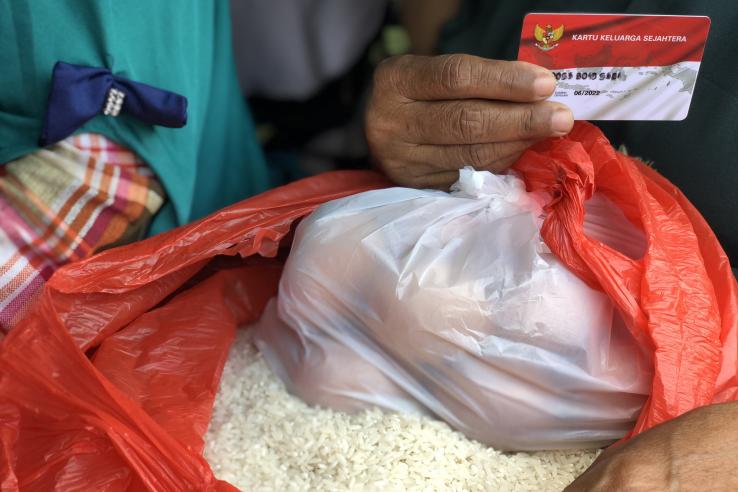
Reforming Indonesia’s largest food assistance program: From Rastra to BPNT

J-PAL Southeast Asia hosted a webinar to disseminate the preliminary findings from a study on the long-awaited transition from Beras Sejahtera or Rastra (previously known as Raskin), Indonesia’s largest food assistance program which covered 15.5 million beneficiaries, to non-cash food assistance or...
People walk through an outdoor market in Chile.
Blog

Data collection, new RCTs, and policy guidance to inform pandemic response and recovery

The past year has been filled with tragedy and sacrifice—but, critically, also innovation, as researchers and policymakers addressed new challenges with creative solutions. Existing and newly generated evidence has informed many policies over the past year, providing a roadmap for incorporating...
Women shopping at an outdoor food market in Matadi, Democratic Republic of the Congo
Event

Building State Capacity for Tax Collection: Emerging Evidence and Implications for Practice

In the Democratic Republic of Congo, tax revenues are equivalent to just 7.5% of GDP , standing in stark contrast to higher-income countries in which tax revenues generate billions of dollars for essential government services. These challenges of domestic resource mobilization are complex and...
Resource
Basic page

Register for the Building State Capacity for Tax Collection: Emerging Evidence and Implications for Practice Webinar

Registration is now closed for the Building State Capacity for Tax Collection: Emerging Evidence and Implications for Practice Webinar.
Two women wear face masks while selling their wares in the tradition markets of Temanggung, Central Java, Indonesia
Event

Emerging Challenges for the Post-Covid Era: Addressing Opportunity, Inequality, and Growth

The economic damage of Covid-19 represents the largest economic shock the world has experienced in decades. In Indonesia, the Covid-19 pandemic has caused significant economic disruption, with adverse impact on jobs and livelihoods, especially among the most vulnerable segments of society. This...
Resource
Basic page

Register for the Emerging challenges for the post-Covid era: Addressing opportunity, inequality, and growth webinar

Registration is now closed for the Emerging challenges for the post-Covid era: Addressing opportunity, inequality, and growth webinar.
A collage of WiEP member headshots
Blog

Breaking the glass ceiling in economics and policy, one conversation at a time

Read our interview with Prerna Kundu and Prashansa Srivastava, Co-Founders of Women in Economics and Policy, and Research Associates at J-PAL South Asia.
Project

Responses to Economic and Security Risks During Covid-19 in Lagos, Nigeria

Researchers studied the economic, social, and security impacts of the Covid-19 crisis on informal market vendors in Lagos, Nigeria through a phone survey. Nearly half of respondents reported that their marketplaces were closed entirely, and only 1.5 percent of respondents reported that their...
Resource
Basic page

Register for the Addressing Education Challenges during Covid-19 webinar

Registration is now closed. The Covid Dialogues: Addressing Education Challenges during Covid-19 webinar was held on Tuesday, June 8, 2021.
Beneficiaries collect rations from a government shop during the covid-19 pandemic
Event

Using Phone Surveys to Improve Public Service Delivery and Guide Crisis Response

In low- and middle-income countries, regular program monitoring for improving public service delivery and the beneficiary experience is often constrained by slow, indirect processes such as periodic government surveys as well as unrepresentative, sporadic data from government dashboards and...

Pagination

  • First page « First
  • Previous page ‹
  • …
  • Page 306
  • Page 307
  • Current page 308
  • Page 309
  • Page 310
  • …
  • Next page ›
  • Last page Last »
J-PAL

J-PAL

400 Main Street

E19-201

Cambridge, MA 02142

USA

Contact

+1 617 324 6566

[email protected]


Press Room

Stay Informed

Receive our newsletters

Subscribe


Privacy Policy

Accessibility

MIT