J-PAL J-PAL
The Abdul Latif Jameel Poverty Action Lab
  • About
    • Overview
    • People
    • Strengthening Our Work
    • Code of Conduct
    • Initiatives
    • Events
    • Blog
    • News
    • Press Room
  • Offices
    • Overview
    • Global
    • Africa
    • Europe
    • Latin America and the Caribbean
    • Middle East and North Africa
    • North America
    • South Asia
    • Southeast Asia
  • Sectors
    • Overview
    • Agriculture
    • Crime, Violence, and Conflict
    • Education
    • Environment, Energy, and Climate Change
    • Finance
    • Firms
    • Gender
    • Health
    • Labor Markets
    • Political Economy and Governance
    • Social Protection
  • Evaluations
  • Research Resources
    • About Us
    • Our Work
    • Join ASPIRE
    • Newsroom
  • Policy Insights
  • Evidence to Policy
    • Pathways and Case Studies
    • The Evidence Effect
  • Blog
  • Careers
  • Courses
  • For Affiliates
  • Support J-PAL

Utility menu

  • Blog
  • Careers
  • Courses
  • For Affiliates
  • Support J-PAL

Quick links

  • Evaluations
  • Research Resources
  • Policy Insights
  • Evidence to Policy
    • Pathways and Case Studies
    • The Evidence Effect
  • About

    The Abdul Latif Jameel Poverty Action Lab (J-PAL) is a global research center working to reduce poverty by ensuring that policy is informed by scientific evidence. Anchored by a network of more than 1,100 researchers at universities around the world, J-PAL conducts randomized impact evaluations to answer critical questions in the fight against poverty.

    • Overview

      The Abdul Latif Jameel Poverty Action Lab (J-PAL) is a global research center working to reduce poverty by ensuring that policy is informed by scientific evidence. Anchored by a network of more than 1,100 researchers at universities around the world, J-PAL conducts randomized impact evaluations to answer critical questions in the fight against poverty.

      • Affiliated Professors

        Our affiliated professors are based at over 130 universities and conduct randomized evaluations around the world to design, evaluate, and improve programs and policies aimed at reducing poverty. They set their own research agendas, raise funds to support their evaluations, and work with J-PAL staff on research, policy outreach, and training.

      • Invited Researchers
      • J-PAL Scholars
      • Board
        Our Board of Directors, which is composed of J-PAL affiliated professors and senior management, provides overall strategic guidance to J-PAL, our sector programs, and regional offices.
      • Staff
    • Strengthening Our Work

      Our research, policy, and training work is fundamentally better when it is informed by a broad range of perspectives.

    • Code of Conduct
    • Initiatives
      J-PAL initiatives concentrate funding and other resources around priority topics for which rigorous policy-relevant research is urgently needed.
    • Events
      We host events around the world and online to share results and policy lessons from randomized evaluations, to build new partnerships between researchers and practitioners, and to train organizations on how to design and conduct randomized evaluations, and use evidence from impact evaluations.
    • Blog
      News, ideas, and analysis from J-PAL staff and affiliated professors.
    • News
      Browse news articles about J-PAL and our affiliated professors, read our press releases and monthly global and research newsletters, and connect with us for media inquiries.
    • Press Room
      Based at leading universities around the world, our experts are economists who use randomized evaluations to answer critical questions in the fight against poverty. Connect with us for all media inquiries and we'll help you find the right person to shed insight on your story.
  • Offices
    J-PAL is based at MIT in Cambridge, MA and has seven regional offices at leading universities in Africa, Europe, Latin America and the Caribbean, Middle East and North Africa, North America, South Asia, and Southeast Asia.
    • Overview
      J-PAL is based at MIT in Cambridge, MA and has seven regional offices at leading universities in Africa, Europe, Latin America and the Caribbean, Middle East and North Africa, North America, South Asia, and Southeast Asia.
    • Global
      Our global office is based at the Department of Economics at the Massachusetts Institute of Technology. It serves as the head office for our network of seven independent regional offices.
    • Africa
    • Europe
    • Latin America and the Caribbean
    • Middle East and North Africa
      J-PAL MENA is based at the American University in Cairo, Egypt.
    • North America
    • South Asia
    • Southeast Asia
  • Sectors
    Led by affiliated professors, J-PAL sectors guide our research and policy work by conducting literature reviews; by managing research initiatives that promote the rigorous evaluation of innovative interventions by affiliates; and by summarizing findings and lessons from randomized evaluations and producing cost-effectiveness analyses to help inform relevant policy debates.
    • Overview
      Led by affiliated professors, J-PAL sectors guide our research and policy work by conducting literature reviews; by managing research initiatives that promote the rigorous evaluation of innovative interventions by affiliates; and by summarizing findings and lessons from randomized evaluations and producing cost-effectiveness analyses to help inform relevant policy debates.
    • Agriculture
      How can we encourage small farmers to adopt proven agricultural practices and improve their yields and profitability?
    • Crime, Violence, and Conflict
      What are the causes and consequences of crime, violence, and conflict and how can policy responses improve outcomes for those affected?
    • Education
      How can students receive high-quality schooling that will help them, their families, and their communities truly realize the promise of education?
    • Environment, Energy, and Climate Change
      How can we increase access to energy, reduce pollution, and mitigate and build resilience to climate change?
    • Finance
      How can financial products and services be more affordable, appropriate, and accessible to underserved households and businesses?
    • Firms
      How do policies affecting private sector firms impact productivity gaps between higher-income and lower-income countries? How do firms’ own policies impact economic growth and worker welfare?
    • Gender
      How can we reduce gender inequality and ensure that social programs are sensitive to existing gender dynamics?
    • Health
      How can we increase access to and delivery of quality health care services and effectively promote healthy behaviors?
    • Labor Markets
      How can we help people find and keep work, particularly young people entering the workforce?
    • Political Economy and Governance
      What are the causes and consequences of poor governance and how can policy improve public service delivery?
    • Social Protection
      How can we identify effective policies and programs in low- and middle-income countries that provide financial assistance to low-income families, insuring against shocks and breaking poverty traps?
Displaying 1231 - 1245 of 1283
close up of woman reading letter
Evaluation

The Effectiveness of Financial Disclosure in the United Kingdom

Researchers partnered with financial providers in the United Kingdom to evaluate the effectiveness of various disclosure designs aimed at supporting consumers’ financial decisions across savings products. Although most disclosures increased the number of consumers that switched to higher-yielding savings account, the effects were relatively modest, even among those who received the most effectively designed disclosure and those with substantial financial incentives to switch. These findings suggest that low attention limits the potential of financial disclosures and that disclosures need to be more explicitly designed to better capture consumers' attention.
Young children in classroom going through computer-assisted learning in Russia
Evaluation

Does EdTech Substitute for Traditional Learning? The Impact of Computer-Assisted Learning in Russia

Researchers conducted a randomized evaluation to evaluate the impact of computer-assisted learning (CAL) on student test scores. The CAL program improved students’ math and language test scores, but increasing the time students spent on CAL did not lead to additional gains.
Young woman holding cash in DRC
Evaluation

A Multifaceted Approach to Increase Women’s Empowerment in the Democratic Republic of Congo

Researchers evaluated a multifaceted program for women experiencing extreme poverty in the Democratic Republic of Congo, a region facing protracted conflict. The intervention had positive and enduring effects on women’s consumption, employment, finances, and empowerment, and small positive impacts on health outcomes.
Evaluation

Reducing Formalization Costs for Small Businesses in Colombia

In the context of a recent government policy that reduced costs of formalization, researchers provided information on the formal entry process through workshops and personalized visits to determine the impacts of information on firms’ decision to formalize.
Filipino family eating outside
Evaluation

Social Integration Effects of Pre-Migration Information Sessions in the Philippines

Researchers conducted a randomized evaluation to investigate whether an expanded and more thorough version of an orientation program in the Philippines improved socioeconomic outcomes and facilitated settlement for migrants upon moving to the United States. The research team found that though the program did not have many sizable impacts, migrants who received the new orientation program acquired fewer social network connections in the United States.
Child sits and reads while woman looks on
Evaluation

Can Informational Campaigns Raise Awareness and Local Participation in Primary Education in India?

Researchers examined whether increasing community oversight and participation could improve education outcomes in Uttar Pradesh, India. Mobilizing community members to monitor local schools through Village Education Committees did not increase participation in school governance or improve education outcomes, but training local volunteers to teach basic reading outside school had a positive impact on student learning.
Evaluation

Slum Housing Upgrading in El Salvador, Mexico, and Uruguay

Researchers measured the impact of improving the quality of slum housing on household wellbeing in El Salvador, Mexico, and Uruguay. Residents were selected to receive housing upgrades by lottery. Results show that slum upgrading significantly improved satisfaction with quality of life. In two countries positive and significant effects are detected in child health. In El Salvador, significant and positive effects are observed in the perception of safety. Finally, no effects are detected in labor market variables and in the accumulation of durable goods.
Man carries buckets of water to house in dry landscape
Evaluation

Harvesting Rainfall: Experimental Evidence from Cistern Deployment in Northeast Brazil

Distributing water cisterns in northeast Brazil led to fewer requests for private benefits from local politicians and fewer votes for incumbent mayors, who typically have more resources to engage in clientelism. Researchers and J-PAL's Latin America & Caribbean office are now working with the Climate Policy Initiative to support the Ministry of Social Development to design and implement an evaluation of the second deployment of cisterns.
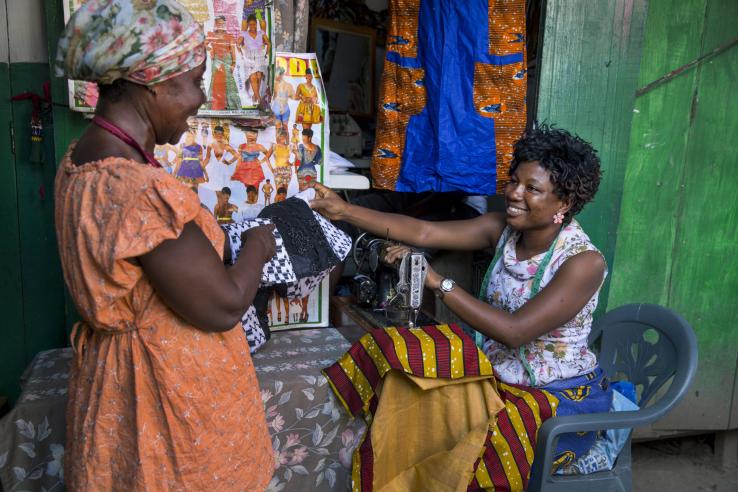
Woman pushing fabric through a sewing machine
Evaluation

Improving Rug Firm Performance through Exporting in Egypt

Researchers partnered with Aid to Artisans (ATA), a US-based nonprofit, and Hamis Carpets, an Egypt-based distributor, to provide small-scale rug manufacturers the opportunity to export to high-income countries. Offering small firms the opportunity to export rugs to high-income markets increased firm profits through improvements in firm’s technical knowledge, efficiency, and product quality.
A patient with their leg wrapped in gauze.
Evaluation

The Effects of a Nationwide Medicare Bundled Payment Reform Program in the United States

Researchers examined the impact of bundled payments on Medicare spending, utilization, and quality of care for knee and hip replacements, two common and expensive medical procedures. Evidence from the first year of implementation of a five-year mandatory bundled payment model showed a reduction in health care utilization, but no evidence of an impact on health care quality, the volume of patients treated, or the mix of patients treated.
Children outside their school
Evaluation

Vouchers for Private Schooling in Colombia

Colombia used lotteries to distribute vouchers which partially covered the cost of private secondary school for students who maintained satisfactory academic progress. Three years after the lotteries, winners were about 10 percentage points more likely to have finished 8th grade, primarily because they were less likely to repeat grades, and scored 0.2 standard deviations higher on achievement tests. In the long-run, the PACES program increased secondary school completion rates by 15 to 20 percent.
Man walking in corn field
Evaluation

Innovative Finance for Technology Adoption in Western Kenya

Researchers randomly evaluated whether well-timed access to credit would allow maize farmers in Kenya to make better use of storage and sell their output at higher prices. The loan offers allowed farmers to store more maize and earn higher revenues, with larger revenue impacts for farmers granted loans immediately following harvest and in areas where a smaller share of farmers was offered loans.
A nurse vaccinates a woman with grey hair.
Evaluation

Providing Financial Incentives and Behavioral Nudges to Encourage Covid-19 Vaccine Uptake in the United States

Researchers evaluated the impact of financial incentives, public health video messages, and access to a vaccine scheduling link on Covid-19 vaccination intentions and vaccine take-up in the United States. None of the interventions led to increases in vaccine take-up after thirty days. In a subsequent study, researchers found that personal reminder messages led to increases in booster vaccination rates while monetary incentives had no additional impact.
 Local farmer works in the countryside near Banani village
Evaluation

The Effects of Varying Input Market Timing and Access to Credit on Farmers’ Agricultural Investment in Mali

In Mali, researchers conducted a randomized evaluation to test how the design and timing of a physical market for inputs (village input fairs) with varying levels of credit access affected farmers’ investment decisions. They found that farmers with access to credit from VIFs organized after harvest increased their demand for inputs while farmers offered VIFs at planting without access to credit did not.
A boy washes his hands while other students are waiting in line for their turn
Evaluation

The Impact of Sanitation and Hand-Washing Promotion Campaigns on Child Health in Tanzania

Researchers conducted a randomized evaluation to measure the impact of sanitation and hand-washing promotion campaigns, alone and in combination, on household knowledge, behavior, and child health (diarrhea prevalence, stunting, wasting, and anemia). While the program improved hygiene and sanitation behavior, it had no impact on child health outcomes.

Pagination

  • First page « First
  • Previous page ‹
  • …
  • Page 81
  • Page 82
  • Current page 83
  • Page 84
  • Page 85
  • …
  • Next page ›
  • Last page Last »
J-PAL

J-PAL

400 Main Street

E19-201

Cambridge, MA 02142

USA

Contact

+1 617 324 6566

[email protected]


Press Room

Stay Informed

Receive our newsletters

Subscribe


Privacy Policy

Accessibility

MIT