J-PAL J-PAL
The Abdul Latif Jameel Poverty Action Lab
  • About
    • Overview
    • People
    • Strengthening Our Work
    • Code of Conduct
    • Initiatives
    • Events
    • Blog
    • News
    • Press Room
  • Offices
    • Overview
    • Global
    • Africa
    • Europe
    • Latin America and the Caribbean
    • Middle East and North Africa
    • North America
    • South Asia
    • Southeast Asia
  • Sectors
    • Overview
    • Agriculture
    • Crime, Violence, and Conflict
    • Education
    • Environment, Energy, and Climate Change
    • Finance
    • Firms
    • Gender
    • Health
    • Labor Markets
    • Political Economy and Governance
    • Social Protection
  • Evaluations
  • Research Resources
    • About Us
    • Our Work
    • Join ASPIRE
    • Newsroom
  • Policy Insights
  • Evidence to Policy
    • Pathways and Case Studies
    • The Evidence Effect
  • Blog
  • Careers
  • Courses
  • For Affiliates
  • Support J-PAL

Utility menu

  • Blog
  • Careers
  • Courses
  • For Affiliates
  • Support J-PAL

Quick links

  • Evaluations
  • Research Resources
  • Policy Insights
  • Evidence to Policy
    • Pathways and Case Studies
    • The Evidence Effect
  • About

    The Abdul Latif Jameel Poverty Action Lab (J-PAL) is a global research center working to reduce poverty by ensuring that policy is informed by scientific evidence. Anchored by a network of more than 1,100 researchers at universities around the world, J-PAL conducts randomized impact evaluations to answer critical questions in the fight against poverty.

    • Overview

      The Abdul Latif Jameel Poverty Action Lab (J-PAL) is a global research center working to reduce poverty by ensuring that policy is informed by scientific evidence. Anchored by a network of more than 1,100 researchers at universities around the world, J-PAL conducts randomized impact evaluations to answer critical questions in the fight against poverty.

      • Affiliated Professors

        Our affiliated professors are based at over 130 universities and conduct randomized evaluations around the world to design, evaluate, and improve programs and policies aimed at reducing poverty. They set their own research agendas, raise funds to support their evaluations, and work with J-PAL staff on research, policy outreach, and training.

      • Invited Researchers
      • J-PAL Scholars
      • Board
        Our Board of Directors, which is composed of J-PAL affiliated professors and senior management, provides overall strategic guidance to J-PAL, our sector programs, and regional offices.
      • Staff
    • Strengthening Our Work

      Our research, policy, and training work is fundamentally better when it is informed by a broad range of perspectives.

    • Code of Conduct
    • Initiatives
      J-PAL initiatives concentrate funding and other resources around priority topics for which rigorous policy-relevant research is urgently needed.
    • Events
      We host events around the world and online to share results and policy lessons from randomized evaluations, to build new partnerships between researchers and practitioners, and to train organizations on how to design and conduct randomized evaluations, and use evidence from impact evaluations.
    • Blog
      News, ideas, and analysis from J-PAL staff and affiliated professors.
    • News
      Browse news articles about J-PAL and our affiliated professors, read our press releases and monthly global and research newsletters, and connect with us for media inquiries.
    • Press Room
      Based at leading universities around the world, our experts are economists who use randomized evaluations to answer critical questions in the fight against poverty. Connect with us for all media inquiries and we'll help you find the right person to shed insight on your story.
  • Offices
    J-PAL is based at MIT in Cambridge, MA and has seven regional offices at leading universities in Africa, Europe, Latin America and the Caribbean, Middle East and North Africa, North America, South Asia, and Southeast Asia.
    • Overview
      J-PAL is based at MIT in Cambridge, MA and has seven regional offices at leading universities in Africa, Europe, Latin America and the Caribbean, Middle East and North Africa, North America, South Asia, and Southeast Asia.
    • Global
      Our global office is based at the Department of Economics at the Massachusetts Institute of Technology. It serves as the head office for our network of seven independent regional offices.
    • Africa
    • Europe
    • Latin America and the Caribbean
    • Middle East and North Africa
      J-PAL MENA is based at the American University in Cairo, Egypt.
    • North America
    • South Asia
    • Southeast Asia
  • Sectors
    Led by affiliated professors, J-PAL sectors guide our research and policy work by conducting literature reviews; by managing research initiatives that promote the rigorous evaluation of innovative interventions by affiliates; and by summarizing findings and lessons from randomized evaluations and producing cost-effectiveness analyses to help inform relevant policy debates.
    • Overview
      Led by affiliated professors, J-PAL sectors guide our research and policy work by conducting literature reviews; by managing research initiatives that promote the rigorous evaluation of innovative interventions by affiliates; and by summarizing findings and lessons from randomized evaluations and producing cost-effectiveness analyses to help inform relevant policy debates.
    • Agriculture
      How can we encourage small farmers to adopt proven agricultural practices and improve their yields and profitability?
    • Crime, Violence, and Conflict
      What are the causes and consequences of crime, violence, and conflict and how can policy responses improve outcomes for those affected?
    • Education
      How can students receive high-quality schooling that will help them, their families, and their communities truly realize the promise of education?
    • Environment, Energy, and Climate Change
      How can we increase access to energy, reduce pollution, and mitigate and build resilience to climate change?
    • Finance
      How can financial products and services be more affordable, appropriate, and accessible to underserved households and businesses?
    • Firms
      How do policies affecting private sector firms impact productivity gaps between higher-income and lower-income countries? How do firms’ own policies impact economic growth and worker welfare?
    • Gender
      How can we reduce gender inequality and ensure that social programs are sensitive to existing gender dynamics?
    • Health
      How can we increase access to and delivery of quality health care services and effectively promote healthy behaviors?
    • Labor Markets
      How can we help people find and keep work, particularly young people entering the workforce?
    • Political Economy and Governance
      What are the causes and consequences of poor governance and how can policy improve public service delivery?
    • Social Protection
      How can we identify effective policies and programs in low- and middle-income countries that provide financial assistance to low-income families, insuring against shocks and breaking poverty traps?
Displaying 6016 - 6030 of 8335
Surveyors share a joke in Mexico
Evaluation

The Price Effects of Cash Versus In-Kind Transfers in Mexico

When making transfers to poor families, many governments choose to transfer goods rather than cash, often in order to encourage the consumption of specific goods. In southern Mexico, researchers studied the effects of both cash and in-kind transfers on the demand and supply of food. They found that both cash and in-kind transfers increased the demand for food, but only in-kind transfers also increased supply. As a result, in-kind transfers led to lower food prices than cash transfers, which can be seen as an indirect benefit for households who did not receive the transfers.
Young boy stands in doorway of house
Evaluation

Influences on Investments in Preventative Health Products in Kenya

In Kenya, researchers studied whether information or price subsidies influenced demand for a simple health product which could be effective in preventing soil-transmitted helminths (STHs). While providing liquidity and targeting women can increase demand for preventative health products, price has the greatest impact on people's decision to purchase.
Screening of a video during agricultural extension session.
Evaluation

Video-Based and In-person Extension Services to Increase Agricultural Technology Adoption in Ethiopia

Researchers randomly evaluated the effects of a decentralized extension program and an additional video-based information campaign on farmers’ adoption of a package of integrated soil fertility management (ISFM) technologies as well as individual practices in Ethiopia. They found that both in-person extension services and extension services combined with a video campaign increased the adoption of the package and some practices of ISFM. This increase was driven by improvements in awareness and knowledge of practices.
A group of female plumbers enter a school to fix a water tank in Jordan.
Evaluation

Job Search Assistance for Syrian Refugees in Jordan

Researchers conducted a randomized evaluation that introduced an adaptive targeted treatment assignment methodology to measure the impact of providing different types of job search assistance on job search rates and labor outcomes for Syrian refugees and local jobseekers in Jordan. While none of the interventions had an impact on whether participants were in wage employment after six weeks, a small cash transfer had large impacts on refugee employment and earnings two and four months after the intervention.
Shanty town
Evaluation

Valuing Trust in Shantytowns in Peru

In collaboration with PRISMA, a Peruvian NGO offering credit through village banks, researchers designed and implemented a new loan product, which required new clients to be sponsored by existing clients, to measure the relative importance of social networks and prices for borrowing in shantytowns near Lima. Results demonstrated that borrowers were more likely to obtain sponsorship from friends. Non-friends were more likely to sponsor higher quality borrowers.
Evaluation

The Impact of Distributing School Uniforms on Children's Education in Kenya

An officer conducting document verification for check distribution.
Evaluation

Using Cell Phones to Monitor the Delivery of Government Payments to Farmers in India

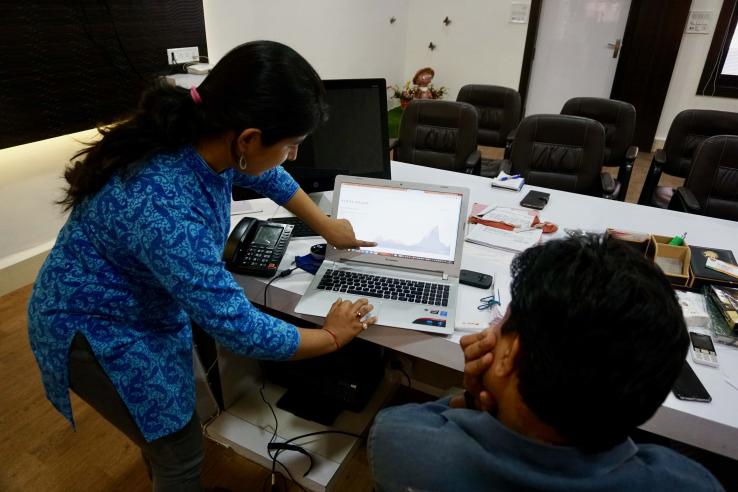
Researchers conducted a randomized evaluation to test the impact of a cell phone-based monitoring system on the delivery of government-issued payments for farmers in Telangana, India. The system significantly improved the likelihood of farmers ever receiving their payments as well as receiving them on time, indicating improved performance by on-the-ground service providers in delivering payments to farmers.
Teacher with student in classroom
Evaluation

High Hopes: Saving for High School with a Mobile-Money Lock-Box in Kenya

In Kenya, researchers partnered with a telecom operator to evaluate the impact of a commitment savings account, called the “High Hopes” Lock-Savings Account, on account usage, savings and loans, and school enrollment. The study found that many parents used the accounts–usage rates increased by about 25 percentage points–and that among those who took up the account, total financial savings increased by three to four times. Parents who saved were also 18-24 percentage points more likely to enroll their children in high school. However, the results were nearly the same for a more conventional mobile savings account that did not offer the commitment bonus, suggesting that easy access to a means of saving, even absent behavioral incentives, was enough to affect parents’ decisions.
Woman using ATM in the Philippines
Evaluation

Commitment Savings Products in the Philippines

Researchers designed and implemented a commitment savings product called a SEED (Save, Earn, Enjoy Deposits) account, which restricted access to savings, thus potentially helping with either self-control or family-control issues. After one year, the commitment savings product led to increased savings and more decision making power in the household for women.
Line of people showing voter turnout against brick building in the United States.
Evaluation

Do Phone Calls Increase Voter Turnout in the United States?

Researchers measured the impact of receiving phone calls on registered voters’ likelihood of voting in general elections in the United States. The study found that non-partisan, get-out-the-vote (GOTV) phone calls had no effect on voter turnout.
A young boy gets his hemoglobin measured in Udaipur, India
Evaluation

Reducing Anemia Through Iron Fortification of Grain in Udaipur, India

Researchers in Udaipur, India, evaluated the impact of a village-level iron fortification program on the physical health of local families in 134 villages. Despite high take-up rates at the beginning of the study, overall take-up rates fell by the end of the evaluation. Results showed a significant difference in anemia rate and physical health between the treatment and comparison group when program take-up was high, but no difference when it was low.
Young, pregnant women in the waiting area of a health clinic.
Evaluation

Free Distribution or Cost Sharing? Evidence from a Malaria Prevention Experiment in Kenya

Researchers investigated the impact of the price of insecticide-treated bed nets (ITNs) on usage and demand in Kenya. Researchers found that cost-sharing considerably dampened demand, and those who were left out under a cost-sharing scheme had very high usage rates when they could access the product for free. Because there are social health benefits from achieving a certain ITN coverage rate, the results suggest that free distribution of ITNs is both more effective and cost-effective than cost-sharing.
Liberian students on a playground
Evaluation

Partnership Schools for Liberia (PSL)

Researchers worked with Innovations for Poverty Action, the Liberian Ministry of Education, and the group of eight private operators to conduct a randomized evaluation to assess the effects of outsourcing management of public schools after one and three years.
High school students in career mentoring program in France
Evaluation

Career Mentoring for Secondary Students in France (Actenses)

Researchers examined the impact of a mentoring program on high school students' academic achievement, job market knowledge, and career-related goals. The program changed students' academic ambitions, but had no impact on their professional plans, knowledge about the professional world, or motivation for schoolwork.
A family shop in Nicaragua.
Evaluation

The Impact of Social Interactions on a Household's Aspirations and Investments in Nicaragua

In Nicaragua, researchers examined the impact of interacting with motivated community leaders on aspirations, household investment, and long-term living standards. They found that social interactions with these motivated community leaders increased households’ investments in education, nutrition, and income-generating activities, and improved households’ attitudes towards the future.

Pagination

  • First page « First
  • Previous page ‹
  • …
  • Page 400
  • Page 401
  • Current page 402
  • Page 403
  • Page 404
  • …
  • Next page ›
  • Last page Last »
J-PAL

J-PAL

400 Main Street

E19-201

Cambridge, MA 02142

USA

Contact

+1 617 324 6566

[email protected]


Press Room

Stay Informed

Receive our newsletters

Subscribe


Privacy Policy

Accessibility

MIT