Guiding investments in long-term human capital development in Egypt: A recap from the Global Evidence for Egypt Spotlight Seminar on early childhood development
Despite substantial progress, approximately 40 percent of children under five in Egypt are at risk of not meeting their full development potential due to malnutrition, poor health, and lack of adequate access to home-based and center-based care and education. Encouraging cross-sectoral investments in early childhood development (ECD) is essential to generating long-term benefits for children, promoting socio-economic growth, and disrupting the intergenerational transmission of poverty in Egypt.
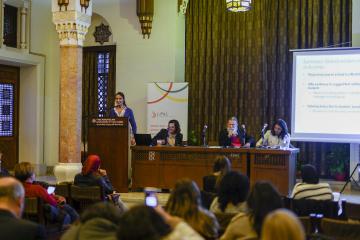
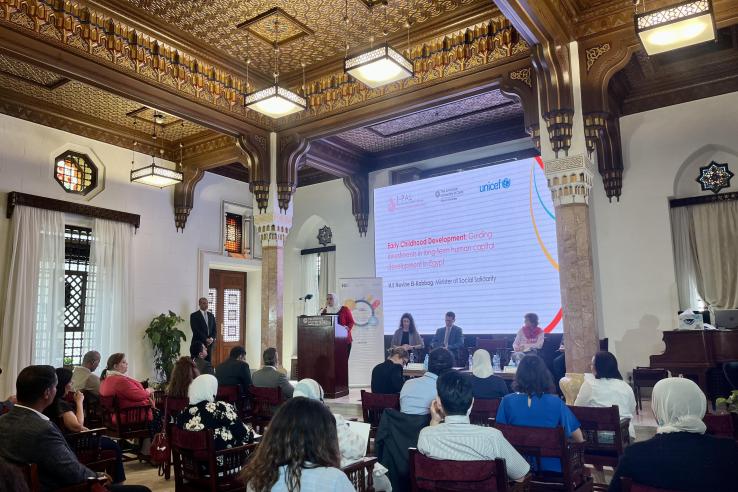
J-PAL Middle East and North Africa (J-PAL MENA) at The American University in Cairo (AUC) co-hosted a seminar (recording here) with UNICEF Egypt on May 19, 2022 to share global evidence on early childhood development to guide investments in long-term human capital development in Egypt.
This seminar was the sixth in a broader Global Evidence for Egypt Spotlight Seminar Series that aims to foster a discussion between Egyptian policymakers, development practitioners, and J-PAL affiliated professors using rigorous evidence relevant to timely policy priorities in Egypt.
The seminar featured H. E. Nevine El-Kabbag, Minister of Social Solidarity; Dr. Wael Abdel-Razek, Head of the Primary Healthcare and Nursing Sector at the Ministry of Health and Population; Dr. Karen Macours, Professor at Paris School of Economics and Co-Chair of the Health sector at J-PAL Global; Dr. Inas Hegazy, Early Childhood Development Manager at UNICEF Egypt; and Jeremy Hopkins, UNICEF Representative in Egypt; and was moderated by Alison Fahey, Executive Director of J-PAL MENA at AUC.
Dr. Macours began the discussion with a presentation on takeaways from J-PAL’s global evidence base on effective domains of investment in early childhood development.
Dr. Hegazy brought a development practitioner’s perspective into the discussion, focusing on the role of integration and efficient coordination mechanisms among key players to maximize benefits for children.
Dr. Abdel-Razek followed with an overview of the Ministry of Health and Population’s efforts to increase coverage of preventive health services among children as well as persisting challenges.
H. E. El-Kabbag then concluded the panel with a discussion of the Ministry of Social Solidarity’s approach to tackling ECD from a social protection and justice angle.
Ongoing efforts to encourage early childhood development in Egypt
The Government of Egypt perceives ECD as a fundamental right for all children and incorporates investments in ECD in its strategy to address multidimensional poverty across Egyptian governorates.
In her remarks, H. E. Minister El-Kabbag emphasized the importance of establishing new nurseries and improving the quality of existing ones to increase the number of children aged 0–4 enrolled in center-based care across Egypt from 8 percent to 60 percent. The Ministry of Social Solidarity (MoSS) is collaborating with the Ministry of Education to develop a curriculum for children that focuses on personality development, nutrition, and health to improve children’s early cognitive development. MoSS is additionally implementing programs focused on awareness raising to correct misperceptions about enrolling children in nurseries and encourage caregivers to pursue early care and education for their children.
The Ministry is also rolling out programs to educate mothers and encourage investments in children’s first 1,000 days. H. E. El-Kabbag indicated that MoSS is keen on incorporating evaluation in its programs to measure their impact on intended outcomes and children’s early development.
Similarly, Dr. Abdel-Razek illustrated that the Ministry of Health and Population (MoHP) strives towards improving coverage of healthcare services, particularly nutritional services for children. The MoHP is using digital transformation to institutionalize a comprehensive approach and ensure reaching different socioeconomic groups in Egypt to fulfill all needs of early childhood, especially at the age of vaccinations. He further elaborated that capacity building for service providers, health education, and awareness raising for parents and caregivers regarding early detection of illnesses are among the MoHP’s priorities.
Finally, Dr. Hegazy highlighted in her remarks that early childhood development requires integrated packages of interventions, explaining UNICEF Egypt’s outlook that multiple factors impact children’s early development, and that interventions should accordingly incorporate cross-sectoral elements to lead to better impacts. As such, UNICEF believes in bringing together the efforts of key ECD stakeholders and has supported the Government of Egypt in developing a national strategy and an action plan for promoting ECD.
In their dialogue, all panelists pointed to the importance of efforts to improve the availability and quality of childcare services to help children reach their full potential and facilitate sustainable development in Egypt.
Key lessons from evidence on early childhood development
Evidence from randomized evaluations suggests that interventions to encourage early childhood stimulation, promote a healthy home environment, improve nutrition, scale preventive health interventions for mothers and children, and provide cash transfers conditional on health and nutrition behaviors can have positive impacts on early childhood development and long-term human capital development. Dr. Macours shared the following key takeaways from the evidence:
i. Encouraging early childhood stimulation (ECS) from parents and caregivers can improve children’s cognitive development
Evidence from 17 evaluations conducted in 11 low- and middle-income countries, including Jamaica, Bangladesh, Columbia, and China, finds that early childhood stimulation programs targeting children aged 0–3 can lead to improvements in cognitive development, especially for children who are most disadvantaged. An evaluation in Jamaica finds that ECS impacts persist into adulthood, leading to improved long-term outcomes in schooling, employment, and earnings.
ii. Targeting nutritional practices or supplementation can have positive impacts on ECD outcomes, although the evidence is mixed
Evidence suggests that reminders and nudges can help shift feeding behavior, but more evidence is needed. In Zambia, reminders around feeding children four to five times per day and the importance of protein intake reduced stunting among children. In contrast, three health education campaigns for parents in rural China had no effect on children’s hemoglobin levels or anemia. Research in Columbia, Bangladesh, and China indicates that interventions narrowly targeting a specific micronutrient deficiency can have limited effects, as there are often multiple drivers of undernutrition.
iii. Improving coverage of preventive health services can reduce illnesses that hinder children’s development
Interventions to improve the supply and demand of preventive health can have positive impacts on early childhood development, as communicable diseases, vaccine-preventable illnesses, and poor health can hinder children’s growth into their full potential. In Kenya and Malawi, researchers found that subsidizing user fees for key preventive health products and eliminating cost-sharing when possible can help increase caregivers’ take-up and in turn have positive impacts on ECD. In India, researchers similarly found that incentives and nudges to promote health behaviors can increase caregivers’ take-up of preventive healthcare services and have positive impacts on children.
iv. Conditional cash transfers (CCTs) can cut across multiple domains to increase healthy behaviors for children in the short-run and improve their health and education outcomes in the long-run
Evidence from thirteen low- and middle-income countries, including Nigeria, Indonesia, Tanzania, Mexico, and Honduras, shows that cash transfer programs conditional on the use of health products and services generally increase uptake of targeted health behaviors and improve child health outcomes in the short term and can improve cognition and educational outcomes in the longer term. In Nicaragua, researchers found that the timings of CCTs matter, as transfers to poor rural households were more effective for boys who received transfers starting in utero relative to boys who received the transfer starting at age 2–5.
While global evidence on ECD is overall promising, evaluating ongoing programs in Egypt is essential to grounding the evidence in Egyptian context and answering questions about delivering ECD programs at scale to sustain long-term human capital development.
J-PAL MENA at AUC will continue to engage policymakers, development practitioners, and J-PAL affiliates in discussions on priority issues and development challenges in Egypt as part of its Global Evidence for Egypt Spotlight Seminar Series with UNICEF Egypt. Register for email updates and follow J-PAL MENA’s accounts on Twitter, Facebook, and LinkedIn to find out about future events and seminars.
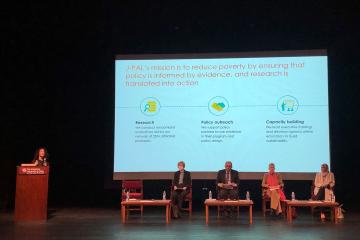
The J-PAL Middle East and North Africa (MENA) Initiative, housed within the American University in Cairo (AUC) School of Business, hosted a seminar on “Strengthening the Egyptian Education System to Better Reach Marginalized Children and Youth: What We Can Learn from Randomized Evaluations” at AUC. The event took place as part of the broader Global Evidence for Egypt Spotlight Seminar Series, which brings together Egyptian policymakers and leading J-PAL affiliated researchers to discuss pertinent policy issues in Egypt.
In Egypt, more children are in school today than ever before. Primary school net enrollment rates have increased from 87 percent in 2000 to 97 percent in 2018, and secondary school net enrollment rates have risen from 77 percent in 2014 to 83 percent in 2018. Yet despite these improvements, when the number of years of schooling in the MENA region is adjusted for the level of learning, the World Bank estimates that students miss out on roughly three years of education.
Egypt is in the early stages of overhauling its education system (known as Education 2.0) as part of its national sustainable development agenda (known as Egypt’s Vision 2030). Education 2.0 includes a number of policy changes, including changing curricula to ensure that educational content is up to date and relevant, adjusting teaching methods to enable the adoption of more learner-centered approaches, and building the capacities of students by teaching them how to think critically, negotiate, and problem solve, among other priorities.
In alignment with these recent efforts, on Sunday, February 23, 2020, the J-PAL Middle East and North Africa (MENA) Initiative, housed within the American University in Cairo (AUC) School of Business, hosted a seminar on “Strengthening the Egyptian Education System to Better Reach Marginalized Children and Youth: What We Can Learn from Randomized Evaluations” at AUC. The event took place as part of the broader Global Evidence for Egypt Spotlight Seminar Series, which brings together Egyptian policymakers and leading J-PAL affiliated researchers to discuss pertinent policy issues in Egypt.
The recent seminar on education featured one of the co-authors of this blog, Sule Alan, Professor of Economics at the European University Institute and J-PAL affiliated professor, alongside Ray Langsten, Research Associate Professor at AUC, and Yasmin Helal, Founder and Executive Director of the Educate Me Foundation.
Alan opened the panel by sharing key lessons emerging from J-PAL’s global evidence in education. Langsten followed up by highlighting key educational challenges prevalent in the Egyptian context. Helal discussed how Educate Me’s work within local communities responds to these issues and can continue drawing from the rigorous global evidence to strengthen its programming efforts.
The panelists and audience members, consisting of national policymakers, intergovernmental officials, education practitioners, and development researchers, engaged in a conversation covering a number of themes relevant for strengthening the Egyption education system.
Reaching Egyptian children and youth located in remote communities
In Egypt, school access can be limited in certain regions and among specific populations. For example, in Egypt’s rural areas, such as Upper Egypt, families live in small, rural hamlets which are generally located far from central village primary schools. Parents, as a result, are often reluctant to allow their daughters to walk long distances to attend local village schools.
Two studies in Afghanistan and Pakistan demonstrated improvements in enrollment, attendance, and learning by reducing travel time by creating local schools using existing resources. The studies suggested that creating schools, when the alternative is no school at all, may be particularly beneficial in underserved areas or areas with security concerns.
In the case of Afghanistan, during the time of the evaluation in 2007, distances between villages were great and traveling between them dangerous—especially for young children and girls. As such, Burde and Linden (2013) evaluated a five-year USAID-funded program that created schools directly in children’s villages. Communities provided space for the schools, while USAID provided the educational materials and teacher trainings.
As a result of the program, overall formal school enrollment increased and test scores improved among both boys and girls. Researchers found that distance played a large role on student outcomes, with school enrollment rates falling by 16 percentage points and test scores dropping by 0.19 standard deviations for each additional mile a child had to otherwise walk to school.
Reducing teaching to the test to better educate Egyptian students
The Egyptian education system has traditionally prioritized passive learning and rote memorization over active learning, critical thinking, and creative expression among students. This largely results from the education system’s heavy emphasis on end-of-session examinations as a means for continued education, which, in turn, drives educators to often teach to the test rather than focus on overall learning outcomes. As a result, students are often taught at the standardized grade level and may in the process miss out on learning valuable practical skills.
One particularly effective and cost-effective pedagogy, evaluated through thirteen studies in Chile, India, Kenya, and the United States, tailors instruction to students’ learning levels and has led to increased student learning outcomes. This is especially beneficial in classroom settings where there can be large variations in learning levels within grades, and in which teachers are often incentivized to teach grade-level curriculum to the top of the class without having flexibility to support students who may be falling behind. This form of tailored instruction can be delivered effectively through multiple channels: during or after school; by tutors, volunteers, or government teachers; or through education technology.
Promoting non-cognitive skills in Egypt to improve students’ cognitive outcomes
There is emerging evidence on the importance of developing students’ non-cognitive skills to improve learning outcomes. For instance, Alan has been working with public elementary schools in Istanbul to evaluate the impact of an innovative educational intervention aiming at improving learning outcomes by fostering students’ grit and patience. This research program was motivated by studies that document that non-cognitive skills, such as patience, self-control, and grit, affect educational as well as other socio-economically significant outcomes, such as criminal activity and health. The research program involved first developing scientifically informed toolkits for teachers, and then offering extensive training on how to use the toolkit and how to nurture these skills in the classroom.
Alan has found that as a result of the program, students exhibit higher patience, higher resilience to negative feedback, greater willingness to engage in challenging tasks, and more openness to skill-building productive activities. These enhanced skills naturally led to substantial increases in students’ math and verbal test scores.
The recent spotlight seminar on education is an example of how global evidence can speak to critical policy issues in countries around the world. Researchers shared a global research perspective and offered evidence-informed recommendations for tackling challenges in the Egyptian education system. Local leaders helped ground the evidence in the Egyptian context while exploring possible policy solutions.
The J-PAL MENA Initiative plans to continue this type of dialogue through additional seminars on related development topics as part of the Global Evidence for Egypt Spotlight Seminar Series. To stay tuned for future seminars, please visit the J-PAL MENA Initiative page or contact [email protected] for more information.
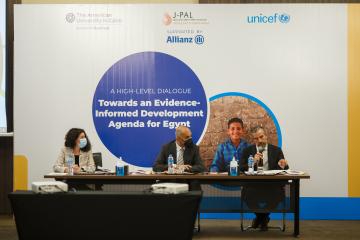
On November 15, 2021, J-PAL MENA at AUC co-hosted a roundtable discussion with UNICEF Egypt titled, "Towards an evidence-informed development agenda for Egypt: Fostering government-research partnerships."
Egypt’s Vision 2030 outlines the government’s top policy priorities. Applying lessons from rigorous global evidence can help improve the effectiveness of policies to reduce poverty and achieve these ambitious development goals in Egypt.
Over the past two years, J-PAL Middle East and North Africa (J-PAL MENA) at The American University in Cairo (AUC) and UNICEF Egypt held four Global Evidence for Egypt seminars to foster dialogue on how lessons from randomized evaluations can help inform decisions around overcoming youth unemployment, strengthening the education system, designing adaptive social assistance programs, and shifting social and gender norms in Egypt. As our partnership with UNICEF Egypt continues, future seminars will focus on emerging questions that matter most for the Government of Egypt.
On November 15, 2021, J-PAL MENA at AUC co-hosted a roundtable discussion with UNICEF Egypt titled “Towards an evidence-informed development agenda for Egypt: Fostering government-research partnerships.” The roundtable aimed to identify key development priorities across the Government of Egypt and hone in on areas where evidence can add the most value in meeting national development goals. This roundtable (watch here) launched the new phase of the Global Evidence Series partnership and will shape the direction of the next set of seminars that J-PAL MENA at AUC and UNICEF Egypt will co-host over the coming year.
The roundtable featured presentations and discussion from H. E. Dr. Nevine El-Kabbag, Minister of Social Solidarity in Egypt; Rema Hanna, Jeffrey Cheah Professor of South-East Asia Studies at Harvard University and J-PAL Southeast Asia Co-Scientific Director; Jeremy Hopkins, UNICEF Representative in Egypt; Samer Atallah, Associate Dean of AUC School of Business; and was moderated by Alison Fahey, Executive Director of J-PAL MENA at AUC.
The discussion also featured key officials representing entities across the Government of Egypt, international development agencies, and academia. Participants were invited to highlight their organizations’ development priorities and their reflections on areas where global evidence from randomized evaluations would be most useful to inform decision-making processes.
Using evidence to address priorities in labor markets, gender, health, education, and climate change
Partnering with the Government of Egypt to build links between research and policy and promote a culture of evidence use can play a role in directing the future of investments in social development, ultimately helping Egypt achieve its development goals. Panelists as well as participants in the roundtable emphasized the need for sustainable partnerships that bring researchers and policymakers together to bridge the gap between data, evidence, and government decisions.
In her remarks, H. E. El-Kabbag highlighted that the Ministry of Social Solidarity incorporates evidence at various stages of its decision making processes, from setting an agenda to its implementation, emphasizing that evaluation helps measure the real impact of social assistance programs on the lives of individuals. She added that with national developmental initiatives such as “Haya Karima” (Decent Life), poverty figures across governorates will change on a daily basis, creating a need for developing a rigorous mechanism to gather and analyze data to understand the impact of invested resources.
Panelists and participants representing ministries, development agencies, and academia agreed on the importance of timely data collection and analysis as well as the accessibility of reliable data in order to improve services and social policy. Investing in human capital and creating an enabling environment for research and data collection and translating this research to action is thus a priority to help Egypt achieve its development goals.
The discussion among panelists and participants identified priority topics that will guide the direction of the next seminars. Measuring and addressing the learning losses that have resulted from the pandemic is a top priority for Egypt’s policymakers. Egypt is also on a fast digitization track; learning from global best practices is vital to ensure that this process is inclusive and beneficial to the poor. Equally important, investing in family planning and development to curb the rising population rate in Egypt will continue to be a national priority. Water scarcity, usage, and management was also highlighted as a major challenge facing Egypt today, underscoring the need for encouraging dialogue around climate change in the region.
Other development priorities for Egypt highlighted in the discussion included revisualizing social safety nets, improving female labor force participation, promoting early childhood development, addressing norms to encourage behavior change, and protecting the rights of people with disabilities.
The goal of the next round of seminars will be to bring these priorities together with existing evidence that can help inform the design of innovative programs spearheaded by the Government of Egypt.
Influencing large-scale policy decisions with evidence
Programs that were rigorously evaluated and which have proven to be effective in reducing poverty have been scaled up to reach over 540 million individuals worldwide, and evidence has influenced policy thinking on important questions in development. To illustrate how working with the government to co-design evaluations of major poverty reduction programs can lead to useful insights that inform government decisions, J-PAL affiliated professor Rema Hanna shared several compelling examples from her work in Indonesia.
J-PAL affiliates worked with Raskin, Indonesia’s biggest food subsidy program, to evaluate the impact of providing identification cards with information on program benefits. They found that cards increased the total benefits eligible households received, and adding price information increased card effectiveness. In 2013, the Government of Indonesia leveraged the results of this evaluation to expand social protection identification cards, reaching 66 million individuals and improving access to social assistance.
Within the same framework, J-PAL affiliates worked with the Government of Indonesia to evaluate the impact of transforming a targeted social assistance program that reaches 15 million individuals through in-kind transfers to a non-cash food assistance program. Researchers found that vouchers reduced poverty among the poorest households by 20 percent and reduced administrative costs to deliver benefits. The results of the evaluation encouraged the Government of Indonesia to continue digitizing the program, reaching 18.8 million households.
Similarly, researchers partnered with the Government of Indonesia to evaluate the impact of information campaigns and incentives on informal sector workers’ enrollment into a national health insurance scheme. The results of the study indicate that providing full subsidies increased enrollment by 11.6 percent and attracted healthier households. The government incorporated these results in its decisions by rolling back its plans to increase premiums in 2016.
Overall, through partnerships with J-PAL and our affiliates, the Indonesian government has obtained immediately useful and contextually appropriate guidance on how to adapt and scale programs to improve outcomes and use scarce resources well.
J-PAL MENA at AUC is committed to engaging with the Government of Egypt, international development agencies, and non-governmental organizations to produce timely research on knowledge gaps and to use evidence to guide solutions to Egypt’s development challenges. In doing so, J-PAL MENA at AUC and UNICEF Egypt will continue to bring policymakers together with J-PAL affiliated professors in constructive dialogues that contribute to the government’s policy agenda.
Subscribe to J-PAL MENA’s newsletter and follow us on Twitter, Facebook, and LinkedIn to learn about future events and seminars.
J-PAL MENA at AUC co-hosted a seminar with UNICEF Egypt on February 22, 2022 to share global evidence on fertility and family planning to promote healthy behaviors and curb population growth in Egypt. This seminar was the fifth in a broader Global Evidence for Egypt Spotlight Seminar Series.
Since the 2000s, Egypt has seen rapid population growth. High population growth and limited access to family planning resources can have an adverse impact on maternal and child health outcomes, as well as educational and economic opportunities. Promoting family planning is thus integral to facilitating human development, and ultimately reducing poverty in Egypt.
J-PAL Middle East and North Africa (J-PAL MENA) at The American University in Cairo (AUC) co-hosted a seminar with UNICEF Egypt on February 22, 2022 to share global evidence on family planning to promote healthy behaviors in Egypt. This seminar was the fifth in a broader Global Evidence for Egypt Spotlight Seminar Series that aims to foster a discussion between Egyptian policymakers, development practitioners, and J-PAL affiliated researchers using rigorous evidence relevant to timely policy priorities.
The seminar featured Dr. Caroline Krafft, J-PAL MENA Invited Researcher and Associate Professor in the Department of Economics and Political Science at St. Catherine University; Dr. Tarek Tawfik, Deputy Minister of Health and Population for Population; Frederika Meijer, UNFPA Representative in Egypt; Dina Heikal, Social and Behavioral Change Officer at UNICEF Egypt; Dr. Fazlul Haque, Deputy Representative of UNICEF Egypt; and was moderated by Alison Fahey, Executive Director of J-PAL MENA at AUC.
Dr. Krafft opened the panel with an overview of global evidence focused on improving women’s access to family planning. Dr. Tawfik followed with an overview of national efforts to promote family planning and a perspective on persisting challenges. Ms. Meijer then discussed UNFPA’s efforts to support national policies and programs to ensure widespread access to reproductive health services and to improve maternal and child health outcomes. Ms. Heikal concluded with insights on addressing gender norms and empowering girls, women, and families as a way to address desired fertility and family planning decisions, focusing on social and behavioral change dimensions.
Ongoing efforts to improve family planning in Egypt
The Government of Egypt is working with donors and implementers to roll out programs that aim to to raise awareness and increase access to family planning services across Egyptian governorates.
In his remarks, Dr. Tawfik highlighted that the family planning sector at the Ministry of Health and Population (MoHP) is working to increase the prevalence of contraceptive use in Egypt. MoHP is using mobile units to reach remote areas and providing capacity building and counseling to health care providers to improve the quality of available services across Egyptian governorates. The MoHP is also increasing the number of female physicians in Upper Egypt to overcome stigma and better reach girls and women in governorates with high levels of poverty.
Dr. Tawfik highlighted the Ministry of Planning and Economic Development’s newly launched National Family Development Program and its plans to target women aged 20 to 45 with free distribution of contraceptives, economic empowerment efforts, and financial incentives, with efforts to customize interventions to local and district needs. The program also includes launching mass media campaigns to raise population awareness about family planning as well as the adverse effects of population growth.
Similarly, UNFPA works to fulfill demand side and supply side needs related to addressing family planning in Egypt through multiple programs, including the Your Right to Plan Campaign launched in collaboration with the MoHP. With a mission to promote rights-based family planning, the campaign provides contraceptives, improves access to reproductive health services, and engages in awareness messaging. UNFPA is also working to expand women’s choices, integrate reproductive health messaging in education, and address social norms in collaboration with faith-based organizations and community leaders.
Recognizing the importance of creating enabling environments for girls and improving women’s agency, UNICEF and UNFPA are working together to target girls aged 12 to 13 to reduce dropout rates in schools and equip adolescents with life skills to expand their opportunities beyond marriage and help them transition into the labor force. Overall, panelists agreed that multiple dimensions feed into women’s family planning preferences, emphasizing the need for cross-sectoral interventions that address background and proximate determinants of fertility in Egypt.
Dr. Krafft’s five lessons on family planning
Evidence from randomized evaluations conducted by J-PAL affiliated professors globally in low- and middle-income countries suggests that family planning services may have a positive impact on economic and social outcomes as well as poverty reduction. Dr. Krafft shared her five key takeaways from rigorous global research on the links between family planning services and economic and social outcomes:
i. Increasing educational and economic opportunities for girls and young women may reduce early childbearing
Researchers in Kenya found that reducing school costs through education subsidies helped girls stay in school and in turn delayed childbearing among adolescents. In India and the Dominican Republic, researchers found that programs which strengthen beliefs about girls’ and young women’s abilities and future economic opportunities can encourage them to delay childbearing and reduce desired fertility. In contexts where parents and others influence childbearing outcomes, Dr. Krafft noted that programs should also consider involving these decision-makers.
ii. Awareness messaging can help shift attitudes towards family planning and childbearing
In Zambia, researchers found that providing information to men on risks of maternal mortality can increase male acceptance of family planning, as husbands who received the information had lower fertility preferences than husbands who did not and reported more accurate knowledge of their wives’ fertility preferences. Similarly in Burkina Faso, a mass media campaign corrected misinformation, changed beliefs, and improved attitudes about family planning. Dr. Krafft suggested that this research indicates the media can be a powerful tool to encourage behavioral change.
iii. Providing women with private access to family planning services may lead to increased take-up
In contexts in which women have less bargaining power, providing private access to contraceptives may be an effective means of enabling women to achieve their fertility goals. In Zambia, researchers found that women who received private access to vouchers for contraceptives without their husbands were more likely to take up and use contraception. Dr. Krafft pointed out that this implies that private access to contraception can enable women to make family planning decisions that they otherwise might not be able to make.
iv. More evidence is needed on whether tailoring programs to consumers’ preferences can lead to increased contraceptive take-up
Researchers found that linking microcredit and family planning programs together did not increase contraceptive use and was ineffective at changing reproductive behavior and preferences in Ethiopia, possibly due to a discrepancy between methods offered in the program and consumers’ preferences. Similarly in Jordan, researchers did not detect significant impacts of an evidence-based medicine program on changing family planning providers’ biases against injectable contraceptives. Dr. Krafft noted that this highlights the potential need to add a component addressing consumers’ misconceptions and biases as well as health care providers’ biases to related interventions.
v. Providing targeted training to health care providers may be effective in improving family planning service delivery
In Nigeria, researchers found that training targeted to health care providers increased the quantity of contraceptive methods offered and the quality of family counseling provided at private health care facilities. However, the program had no impact on the range of methods covered, technical competence, or continuity. Dr. Krafft highlighted that this may indicate that important issues still lacked coverage in counseling sessions.
This evidence has the potential to inform policy decisions around addressing demand for family planning resources in Egypt, although evaluating national family planning programs is crucial to generating research that further grounds lessons on what approaches are most effective in the Egyptian context.
J-PAL MENA at AUC will continue to engage policymakers, development practitioners, and J-PAL affiliates in discussions on priority issues and development challenges in Egypt as part of its Global Evidence for Egypt Spotlight Seminar Series with UNICEF Egypt. Register for email updates and follow J-PAL MENA’s accounts on Twitter, Facebook, and LinkedIn to find out about future events and seminars.