

Evidence for Export Growth

View of an industrial harbor in Cape Town, South Africa
Photo credit: Ingrid Rousseau, Shutterstock.com
Reaching global markets can help firms in low- and middle-income countries grow, create more and better jobs, and raise incomes. J-PAL's Firms sector supports innovative strategies by working with policymakers, partner organizations, and researchers.
Strong growth has lifted more than a billion people out of poverty, and fast-growing, job-rich export sectors have powered such growth in many low- and middle-income countries (LMICs). But breaking into higher-value products or high-income markets remains hard. Africa, for example, needs roughly 25 million new jobs a year for young people, yet makes up less than 3 percent of global trade.
In theory, helping firms in these countries grow through access to high-income markets such as the United States, Europe, and Japan can drive job creation, productivity, and learning. In practice, the “plumbing” of these efforts matters. How are programs targeted, designed, implemented, and refined to be most effective?
Governments and businesses understand their own contexts and set their own priorities—evidence and data are powerful tools to help test and strengthen the strategies they choose to pursue. In this portfolio, we start with what our partners want to learn, and collaborate across our research network to build projects focused on actionable evidence.
What We Do
We work with policy leaders, partner organizations, researchers, and funders to:
- Identify high-potential export projects with governments, exporters, buyers, and implementing organizations—partner organizations may range from trade ministries and investment promotion agencies to global e-commerce platforms and multinational companies sourcing worldwide
- Deliver technical assistance grounded in rigorous, independent evidence; bring credible, evidence-backed ideas to the table
- Adapt proven program designs, and pilot new innovative features tailored to local context before they move to full rollout
- Conduct research along the way to clarify which programs work best, for whom, and why
For partners and researchers: While we are interested in a range of policies intended to boost ambitious growth, our initial focus is on export and firm growth. This means we will prioritize opportunities in export promotion policies, trade incentives, global supply chain practices, export-oriented market development, industrial policy, and related approaches. In addition, we are interested in interventions for broader trade, investment, and technology links between high-income economies and LMICs.
We are open to working in any region, especially sub-Saharan Africa and South Asia.
Have a problem worth exploring? We'd love to be in touch. Reach out to share more and explore a project together.
Key Facts
- Office(s): J-PAL Global, J-PAL Africa, J-PAL South Asia
- Academic Lead: David Atkin
- Funder(s): Coefficient Giving
- Portfolio Team Contact:
- Ying Gao, Senior Policy Manager (J-PAL Global)
- Namitha Sadanand, Senior Policy and Training Manager (J-PAL South Asia)
- Julia Kaufman, Policy Manager (J-PAL Africa)
- Soumya Singhal, Policy Associate (J-PAL Global)
Our Evidence Briefs

Policy insight
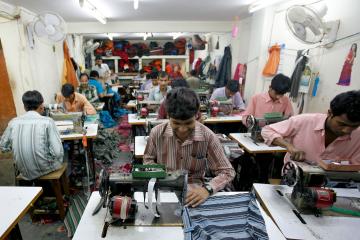
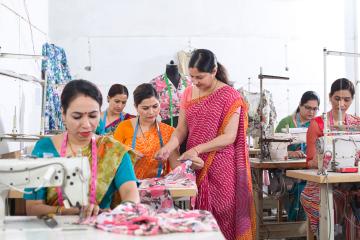
Workplace interventions to improve worker well-being

The Evidence Effect
Finding and financing businesses that are ready to grow

The Evidence Effect
Making markets work for small businesses
The Evidence Effect
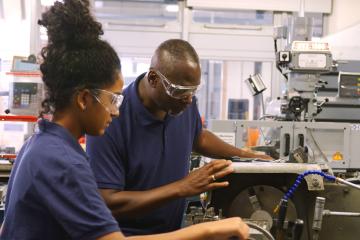
Targeted job training can open doors

The Evidence Effect
Making markets work for farmers

The Evidence Effect
Effective and fair taxation

The Evidence Effect
A market to clean up air pollution
Evaluations of Economic Growth Strategies
Export and Market Access
- In Argentina, Juan Carlos Hallak and coauthors identified 20 “good exporting practices”. Promoting these via an export consulting program by Argentina’s National Export Promotion Agency across 200 food and beverage firms, their randomized study found targeting the truly export-ready firm was key: only motivated firms already making suitable products ventured into exporting.
- In Brazil, Cristine Pinto and coauthors are testing ways to improve Brazil’s export promotion by targeting firms better, building on an earlier project funded by J-PAL Jobs and Opportunity Initiative Brazil.
- In Egypt, David Atkin, Amit Khandelwal, and Adam Osman partnered with an NGO experimentally offering small firms opportunity to export rugs to high-income markets; this raised the firms’ profits substantially by increasing technical knowledge, efficiency, and product quality in a clear evidence of learning by exporting.
- In Rwanda, Lauren Falcao Bergquist, Jie Bai, Vittorio Bassi, and coauthors are working with the Ministry of Trade and Industry (MINICOM), Rwanda Development Board (RDB), and Export Growth Fund (EGF) for a series of projects testing export-oriented growth programs ranging from quality certification to trade incentives.
- In South Africa, J-PAL Africa is engaging with the national Department of Trade, Industry and Competition (DTIC) to review and provide insights on a slew of firm incentives including the ones focused on export industries.
- In Tunisia, Eric Verhoogen and coauthors tested the question: Do government export promotion schemes work? Randomizing US$14 million of the budget for Tasdir+, Tunisia’s export matching-grant scheme, their evaluation found the program generated large export expansion (US$60 more exports per dollar spent) though it did not meet the goal of diversifying Tunisia’s exports.
- In Vietnam, randomized evaluations found that export training programs were more effective when they involved large firms and when they helped producers forge sales contracts rather than just provide information.
- Globally, Achyuta Adhvaryu, Shawn Cole, Rocco Macchiavello, Anant Nyshadham, and many others in J-PAL network are partnering with international buyers and global companies to understand how companies' practices affect growth and productivity.
- Across 19 studies globally, J-PAL’s Policy Insights evidence brief found market access improvements often spurred business and job growth via a variety of policy tools.
Financing Firm Growth
- In China, Jing Cai and Adam Szeidl measured both direct and spillover effects of credit expansion to firms across markets in a welfare evaluation going beyond just effects on the supported firms, which may be offset by losses at rival firms. If firms sell to non-local markets (by exporting), the potential harm to rival firms may be less worrying.
- In Egypt, Bruno Crépon, Adam Osman and coauthor partnered with three microfinance institutions to study providing loans vs. grants and found the types of financing did not matter as much as targeting the growth-ready firms.
- Also in Egypt, J-PAL researchers helped pilot a borrower screening tool using psychology and machine learning to identify businesses who could truly benefit from larger financing.
- In Nigeria, a nationwide business plan competition that awarded large grants boosted job creation, sales, and profits, showing a new tool like this can identify growth-ready firms using information traditional screening methods might not capture.
Improving Regulation and Policy Coordination
- In Bangladesh, Laura Boudreau partnered with a private sector consortium to find out when and how compliance to local labor regulations, which international buyers wanted, could be achieved to benefit factory workers.
- In India, an evidence-based industrial emissions trading market was first piloted and then scaled up to reach more than ten million people through the works of Esther Duflo, Michael Greenstone, Rohini Pande, Nicholas Ryan, and Anant Sudarshan .
- In Indonesia, Andreas Stegmann and Adam Szeidl, through J-PAL Southeast Asia, are partnering with local and national government to identify services small businesses want from the government and test how to design the right services.
- In Vietnam, Edmund Malesky and coauthor collaborated with the Vietnamese Chamber of Commerce and Industry (VCCI) and the Ministry of Labor, Invalids, and Social Affairs (MOLISA) to evaluate whether participating in the law-making process improved factory regulations compliance by small and medium-sized firms.
Technology Upgrading
- In Bangladesh, Eric Verhoogen, Ritam Chaurey and coauthors, funded by J-PAL K-CAI, measured social learning among clusters of firms geographically located together and how it drove the adoption of an energy-saving technology.
- In Ghana, Morgan Hardy and Jamie McCasland measured the impact of demand shock (order from buyer), which jump-started technology diffusion by making firms far more willing to share know-how.
- In India, Namrata Kala and Julieta Caunedo ran a randomized evaluation on access to agricultural equipment rental markets, finding that mechanization raised productivity and shifted household labor toward higher-value, non-agricultural work.
- In Pakistan, David Atkin, Azam Chaudhry, Amit Khandelwal, Eric Verhoogen and coauthor identified organizational bottleneck for profitable technology adoption across a cluster of export-oriented soccer ball manufacturers.
Training and Management Consulting
- In Colombia, long-run research implemented by Innovations for Poverty Action (IPA) found a group-based management consulting for auto parts firms was highly cost-effective as treated firms’ sales and profits rose and remained high thanks to decade-long business practice improvements and exports.
- In Tanzania and Vietnam, working with the Japan International Cooperation Agency (JICA), Yuki Higuchi, Tetsushi Sonobe, and coauthors tested a series of consulting programs tailored to manufacturing for improving business practices and value added (a measure of income) at firms.
- In Turkey, David Atkin and Banu Demir are partnering with the European Bank for Reconstruction and Development (EBRD) with support from J-PAL K-CAI to test the effectiveness of training and credit programs on carbon mitigation and growth for small and mid-sized companies facing the European Union (EU) market.
Workforce Development
- In Brazil, David Atkin, Emanuele Colonnelli, and Tommaso Porzio are investigating the spillover effects of encouraging young graduates to work in entrepreneurship on local economies, supported by J-PAL Jobs and Opportunity Initiative Brazil.
- In China, J-PAL Jobs and Opportunity Initiative is funding a collaboration with New Balance, a U.S. footwear and apparel company, by Laura Boudreau and Jing Cai to identify ways of tailoring training and worker voice institutions to help improve global manufacturing workplaces.
- In Kenya, David Atkin, Antoinette Schoar, and coauthors partnered with a company to measure the impact of their skills and job placement program designed for sectors with labor demand, the growing AI-linked industry serving overseas markets in this case.
Other Research Priorities
- Micro to macro bridging evidence to inform policy: Research should prioritize more in filling urgent policy-relevant micro to macro evidence gaps. For example, strategies for where to focus growth resources can be informed by evidence on the size of spillovers or externalities and distortions across firms of different sectors, sizes, trade orientation, regions, and more.
- Identifying broader effects of growth: Clarifying when and how exports translate into broader impact on people’s lives can help inform policy and investments. For example, RCT and quasi-experimental research including studies by J-PAL researchers shows that growth of garment export industry predominantly employing women in Bangladesh, Myanmar, and Ethiopia probably shaped women’s educational attainment and decisions about marriage age, fertility, and empowerment.
- Technology and innovation for long-run growth: How ideas are discovered and spread ultimately improves people’s lives by spurring growth and beneficial technologies. J-PAL’s Science for Progress Initiative (SfPI) has been supporting a set of randomized studies on scientific process.
News and Other Writing



Review Paper
File: Initiative publication
Increasing Market Access for MSME: The role of e-commerce and transportation infrastructure
Media

Discover more from other sources
- International Growth Center (IGC) evidence paper: IGC Firms, trade, and productivity Evidence paper
- ILO Employment Seminar series presentation: Does providing digital skills and improving digital jobs lead to better labour market outcomes in low- and medium-income countries?
- J-PAL and Innovations for Poverty Action (IPA) for the United
Kingdom's Foreign, Commonwealth and Development Office (FCDO): Growth
Learning Agenda for the Strategic Impact Evaluation and Learning (SIEL) Programme - Nobel Symposia in Africa: Microdevelopment research in the last 20 years - Session 6 lecture - Firms
- VoxDev literature review: International Trade: Issue 2
- VoxDev podcast: How connecting firms to markets can promote economic development