


Learn how to evaluate your program with JOI Brazil
The Covid-19 crisis has exacerbated labor market challenges in Brazil, where over the last decades productivity has stagnated, unemployment has risen, and labor force participation has reached an historic low.
With support from Arymax Foundation, B3 Social, Potencia Ventures, Inter-American Development Bank, and Insper, J-PAL Latin America and the Caribbean (LAC) launched the Jobs and Opportunity Initiative (JOI) in Brazil to evaluate innovative strategies that address the country’s most pressing employment challenges.
JOI Brazil builds off the work of J-PAL’s global Jobs and Opportunity Initiative, driving rigorous research into priority questions in the labor markets space, including: What policies are most effective at improving labor market conditions? Under what circumstances does firm growth lead to job creation? Which design features of skills training programs have the most impact? How can economies best prepare high-skilled and lower-skilled workers for changing labor demands?
Over the next five years, JOI Brazil will fund new research that builds rigorous evidence on creating quality employment opportunities in Brazil, and will work with Brazilian governments, civil society, private sector organizations, and foundations to ensure that the evidence is used to inform future policymaking. Research anchored in scientific evidence will help identify effective interventions and scale-up the mechanisms that consistently impact people's lives.
How does it work?
JOI Brazil maps the trends of labor market challenges in Brazil and those actors who have been working to find innovative solutions for them. The initiative works on two fronts: social incubation, a three-stage process focused on capacity building for policymakers and program implementers; and technical and funding support to Brazilian researchers on priority JOI Brazil topics via research assistants sponsored through our direct research incubation support (DRIS) program and competitive funding to implement impact evaluations.
The social incubation process
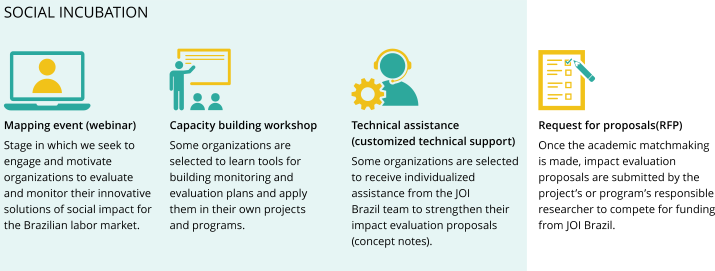
JOI Brazil’s social incubation process aims to support organizations in developing an evaluation proposal that can be funded through JOI. In three free-of-charge phases, the process offers information, capacity building, and personalized technical assistance to policy and program implementers in governments, international agencies, foundations, civil society, and the private sector.
The process began with a webinar to announce the initiative’s launch and engage Brazilian actors interested in developing and evaluating innovative labor market solutions (a recording is available here), and will continue through mid-February. Read on to learn about each phase and how to get involved:
- On November 4, 2021, JOI Brazil hosted a webinar on “Consistent Evidence and Best Practices in Evaluation: Meet JOI Brazil and be part of the J-PAL evaluation process,” where we were pleased to have the contributions of Diana Coutinho (Vice-Rector and Director of Advanced Studies, ENAP), Livia Gouvêa Gomes (Labor Market Specialist, IDB), Luis Junqueira (Co-founder, Letrus), and Bruno Ferman (Professor of Economics, FGV EESP) in conversation with Paula Pedro (Executive Director, J-PAL LAC) and Edivaldo Constantino (Manager, JOI Brazil). Three hundred representatives from academia, civil society, government, and the private sector attended, many of whom had no experience conducting randomized evaluations and sought guidance on how to build them into their work—an indication of the high demand for rigorous evidence in the labor sector.
- In the second stage of the incubation process, JOI Brazil will hold a capacity building workshop on January 17-21, 2022. Through a combination of classes and exercises, participants will learn how to design and implement rigorous impact assessments and make progress on developing their evaluation proposals. Interested organizations may fill out the registration form, which is open until January 12, 2022.
- In February, JOI Brazil will provide personalized technical assistance to finalize impact evaluation proposals from selected organizations, with the aim to maximize the chances of success of receiving funding from JOI Brazil. Interested organizations can fill out the application form, which will be open from January 24 to February 8, 2022. Results will be published on February 10, 2021.
We will also accept applications from organizations that did not take part in all three stages. The 2021 cycle is the first of at least five, and JOI Brazil’s social incubation process is open to any organization interested in conducting impact evaluations of its policies, programs, and projects whose themes align with JOI Brazil’s priority issues. We look forward to connecting with organizations interested in generating rigorous evidence through impact evaluations.
Please reach out to JOI Brazil’s Manager Edivaldo Constantino ([email protected]) to connect with the initiative.
Por favor, entre em contato com Edivaldo Constantino ([email protected]), Gerente da JOI Brasil, para se conectar com a iniciativa.

The Covid-19 crisis has exacerbated labor market challenges in Brazil. More so than ever, we need evidence-based solutions. With support from Fundação Arymax, B3 Social, Potencia Ventures, and the Inter-American Development Bank, J-PAL is bringing the Jobs and Opportunity Initiative (JOI Brazil) to Brazil to evaluate innovative strategies that address the country’s most pressing employment challenges.
Leia este artigo em português aqui.
The Covid-19 crisis has exacerbated labor market challenges in Brazil. More so than ever, we need evidence-based solutions. With support from Fundação Arymax, B3 Social, Potencia Ventures, and the Inter-American Development Bank, J-PAL is bringing the Jobs and Opportunity Initiative (JOI Brazil) to Brazil to evaluate innovative strategies that address the country’s most pressing employment challenges.
The jobs challenge (and opportunity) in Brazil
The Brazilian labor market faces a variety of challenges to achieve inclusive access to productive work. Productivity has stagnated in recent decades despite the average level of education almost doubling from 1981 to 2014. People of color in Brazil are more likely to be unemployed, underemployed, and in informal work. Brazil will also need to adjust to changing labor market dynamics such as an aging population, the digital transformation of services, a push for greater flexibility in labor regulations, and increasing automation.
In 2019, Brazil was in the midst of a slow economic recovery from a financial crisis, in which the country saw a sharp increase in unemployment. The Covid-19 crisis has only exacerbated Brazil’s labor market challenges.
The IMF projects that the unemployment rate will reach 14.5 percent in 2021. Many Brazilians left the labor force entirely last year—the labor force participation rate, which averaged 62 percent in 2019, hit a historic low of 55.1 percent in the third quarter of 2020. Groups that were already underrepresented in the workforce, such as women and youth, were especially hard hit.
These dynamics affect millions of workers. The interruptions in women's careers may negatively impact their labor market performance in the future. Likewise, the transition period from school to the labor market is a decisive time for youth, and economic downturns can be particularly disruptive to their work trajectories. These are just a small sample of the many effects—both temporary and lasting—that we can anticipate in the years to come. More than ever, we need to respond to these challenges with informed solutions.
Applying a global lens
Impact evaluations from around the world have identified innovative labor market programs that increased employment rates.
However, more research is needed to understand the mechanisms that drive positive impacts of employment programs and adapt and scale them in other contexts. More research is also necessary to know how to grow the number of jobs in an economy and how private sector firms can expand opportunities for job creation.
In Brazil, we believe that these strategies could help governments, NGOs, and foundations, who face difficult budgetary decisions, make better and long-lasting decisions to support vulnerable families.
Launching J-PAL's Jobs and Opportunity Initiative in Brazil
Last year, with support from Google.org, J-PAL launched the Jobs and Opportunity Initiative (JOI) to answer some of the most pressing questions related to employment facing policymakers, employers, and job seekers. Google.org’s anchoring investment focuses in sub-Saharan Africa. JOI had a busy first year, funding more than twenty projects that seek to answer important questions in labor markets policy.
With generous support from Fundação Arymax, B3 Social, Potencia Ventures, and the Inter-American Development Bank, we are thrilled to bring the Jobs and Opportunity Initiative to Brazil this year. Our work will be implemented in collaboration with our host university in Brazil, Insper.
We seek to fund policy-relevant research that will help inform the policy debate on important economic opportunity issues and inform the decisions of project implementing partners, donors, and other stakeholders working in this space. Our ultimate goal is that through these efforts, the quality of labor programs increases and that livelihoods of Brazilians are improved.
Over the course of five years, JOI Brazil will:
- Host social innovation incubators that crowdsource innovative policies and programs in the Initiative’s priority topics.
- Provide technical assistance to the most promising innovations to help them design impact evaluations of their programs.
- Connect Brazilian NGOs, government agencies, and researchers to partner in piloting and testing innovations.
- Host calls for proposals with dedicated funding for pilot studies and randomized evaluations in Brazil.
- Share research results with Brazilian NGOs, government agencies, and donors to ensure that the evidence generated through JOI Brazil is used to inform future policymaking in Brazil.
The goals of JOI Brazil are to improve our understanding of how to best promote quality employment and disseminate this knowledge to governments, civil society, the private sector, and foundations in Brazil so that policies and programs can be informed by scientific evidence.
Looking forward
We are excited to share this news and look forward to collaborating with researchers, partners, and practitioners in Brazil to advance this ambitious agenda. In the coming months, we will share more details about JOI Brazil and the different ways to be part of it through a launch event and a dedicated webpage.
In the meantime, we are currently hiring an Initiative Manager, based in São Paulo, to help us launch the activities in Brazil. Please help us spread the word about this exciting job opportunity! J-PAL will also seek to hire two more positions, also based in Brazil, to be announced on our careers page.
Stay tuned!
COVID-19 has disrupted and altered labor markets across the globe. Through the Jobs and Opportunity Initiative, we are supporting urgent research that helps us understand how vulnerable workers around the world are being impacted by COVID-19, and how to design effective policy responses to protect these workers.
More than 188 million people were unemployed globally in 2019. High unemployment is particularly challenging in low-income settings, where there are often few jobs to begin with. Despite the wide array of policies and programs designed to address these challenges, many questions remain unanswered to guide policymakers toward the most effective solutions.
Certain subsets of the population are especially vulnerable to unemployment. For example, youth have an unemployment rate around three times higher than that of adults, totaling an estimated 70.9 million unemployed youth in 2017.
And just because someone has a job, that doesn’t guarantee them a decent livelihood to maintain their family. In low- and middle-income countries, over 25 percent of people who have jobs still live in extreme or moderate poverty. Many workers remain trapped in low-quality jobs with low pay, unsafe conditions, and no benefits.
Existing research suggests several key drivers behind these employment challenges, including job search and matching frictions and economies that do not create enough quality jobs. Randomized evaluations can help us identify practical solutions to these challenges.
J-PAL’s Jobs and Opportunity Initiative
J-PAL’s new Jobs and Opportunity Initiative was created with support from Google.org to answer some of the most pressing questions facing policymakers, employers, and job seekers: For example, how can we help job-seekers gain marketable skills, and find jobs that are the best fit for them? How can we best prepare workers for the changing demands of the labor market and leverage technology to improve their employment prospects? How can we support entrepreneurs to help them grow their businesses and employ other people who need work?
The Jobs and Opportunity Initiative funds innovative randomized evaluations that tackle these questions and many more. The initiative is led by labor economists and J-PAL affiliates Marianne Bertrand (University of Chicago) and Bruno Crepon (ENSAE and École Polytechnique). It focuses on three key thematic areas: job training and matching, job creation, and the future of jobs.
The initiative doesn’t stop at funding research. We will also synthesize key lessons we are learning from the research, and work to get that research into the hands of policymakers who can use it as an input as they’re making difficult decisions about how to design their employment policies.
Google.org’s anchoring investment of $4M in this initiative focuses in sub-Saharan Africa, with some funding flexible for evaluations in other low- and middle-income countries. Through this effort, Google.org seeks to strengthen the innovation and learning ecosystem in sub-Saharan Africa through rigorous research partnerships. Especially as we consider sub-Saharan African economies in light of COVID-19, we hope to deepen partnerships across the public sector, private industry, civil society, and philanthropy to tackle critical labor market challenges together.
Rapidly responding to job implications of the COVID-19 pandemic
COVID-19 has disrupted and altered labor markets across the globe. Through the Jobs and Opportunity Initiative, we are supporting urgent research that helps us understand how vulnerable workers around the world are being impacted by COVID-19, and how to design effective policy responses to protect these workers.
For example, in Dandora, Kenya, a dense urban slum outside of Nairobi, many people lack the savings to sustain them for weeks or months without working. Researchers are testing the effectiveness of delivering cash grants to female microenterprise owners during the COVID-19 outbreak. In addition to measuring the impact of these cash grants on economic outcomes before and after the crisis, they will collect information about the impact of potential government policy responses on these microenterprises.
And with millions of migrants returning from cities to rural villages across India in the wake of COVID-19 outbreak and a nationwide shutdown, this JOI project works with a state government’s COVID-19 Response Team to support a rapid policy response. Specifically, they will conduct high-frequency surveys of return migrants in rural villages to better understand the challenges they face. They will be regularly providing key insights to the government partners to inform their COVID-19 response.
Looking forward
Already, the Jobs and Opportunity Initiative has received dozens of high-quality proposals. This signals to us the extent of excitement from implementers and researchers to rigorously evaluate innovations in the jobs and opportunity space.
There are still a lot of unknowns around the pandemic's long term impacts. However, what’s clear is that effective solutions that support people to access good jobs will be critical. We are excited to support rigorous research that can help inform these solutions.
For more information, visit www.povertyactionlab.org/JOI.
Quality employment is one of the many ways people can graduate from poverty. Yet, unemployment remains is a problem that has only become more salient through the COVID-19 pandemic. Over the course of 2020, the Jobs and Opportunity Initiativehas funded more than twenty projects that seek to answer important questions in labor markets policy.
J-PAL’s Jobs and Opportunity Initiative (JOI) has hosted three funding rounds and funded more than twenty projects in its first year.
Quality employment is one of the many ways people can graduate from poverty. Yet, in 2019, more than 188 million people were unemployed globally. Many more remained trapped in low-quality jobs with low pay, unsafe working conditions, and no benefits. Policymakers have designed a wide array of programs to address these challenges, but many open questions remain about how best to improve employment.
In 2020, the problem of unemployment has only become more salient as the COVID-19 pandemic disrupted and altered labor markets and livelihoods across the globe. The International Labour Organization estimates that global working hours decreased by up to 14 percent in the second quarter of 2020, equal to roughly 400 million full-time jobs.
In early March 2020, J-PAL launched JOI, with support from Google.org, to answer some of the most pressing questions related to employment facing policymakers, employers, and job seekers.
Shortly after JOI’s launch, the World Health Organization characterized COVID-19 as a pandemic, and governments around the world began enacting lockdowns to restrict movement and curb the spread of COVID-19. Production shutdowns, economic slowdowns, and a global recession followed, breaking valuable work relationships and inducing job loss.
Leveraging J-PAL’s network to fund policy-relevant research and rapidly respond to the COVID-19 pandemic
JOI was set up to host two regular competitive funding rounds for labor markets research in 2020. But given the existing infrastructure of the initiative, the commitment of our academic co-chairs Marianne Bertrand (University of Chicago) and Bruno Crépon (ENSAE and École Polytechnique), and the support of Google.org, we were able to quickly pivot and open a third COVID-19 response funding round that ran from mid-March through September.
During this time, implementing partners and researchers in our network came together to submit 24 creative proposals responding to COVID-19-induced labor market disruptions around the world, seeking answers to pressing policy-relevant questions. We were able to provide teams with rapid decisions, funding a total of nine projects over a period of about six months.
A snapshot of JOI-funded projects
Over the course of 2020, JOI has funded more than twenty projects that seek to answer important questions in labor markets policy.
For example, production shutdowns due to the COVID-19 pandemic have severed valuable ties between employers and workers across labor markets around the world. Protecting work relationships, especially for positions where workers tend to learn on the job and develop job- or firm-specific skills, may mitigate COVID-19’s longer-term economic impacts as the economy recovers and firms look to re-hire workers. In Myanmar, researchers are conducting a randomized evaluation to test the impact of providing wage vouchers—which pay for part of a worker’s salary and may encourage firms to hire more workers or keep on existing workers—on the employment, earnings, and productivity of laid-off garment factory workers.
In low- and middle-income countries, labor markets are often inefficient, with relatively long search durations for job seekers, low-quality matches between firms’ needs and job seekers’ skills, and high turnover. Researchers are partnering with Harambee Youth Employment Accelerator to evaluate how matching on different types of information about job seekers changes the quality of worker-firm matches in South Africa.
Forming business networks can be important for business growth through information sharing and building business partnerships, yet in many contexts, women tend to have smaller professional networks than men. Researchers are exploring whether online professional networking groups, combined with access to legal information and advisory services, can foster interfirm collaboration among female entrepreneurs and improve their business performance in Ghana.
Looking forward
In JOI’s first year, we received 63 proposals for projects based in thirty countries. These numbers signal the extent of excitement from implementers and researchers to rigorously evaluate innovations in the jobs and opportunity space. With our current resources, JOI will host four more regular funding rounds over the spring and fall of 2021 and 2022.
In the future, J-PAL aims to expand JOI regionally and thematically, securing more resources to fund policy-relevant research and to expand the questions we address related to job creation and firm growth. If you’re interested in exploring a partnership, please reach out to [email protected]. For future updates on JOI and our broader work at J-PAL, sign up for the J-PAL newsletter and note your interest in labor markets.