Affiliate Spotlight: Seema Jayachandran
To read the full profile, please download the PDF.
Seema Jayachandran is a Professor of Economics at Northwestern University. Seema currently serves on J-PAL's board of directors and is the chair of J-PAL's gender sector. Her research focuses on economic issues in low- and middle-income countries that persist in spite of overall economic growth, including environmental degradation and gender inequality. Her work also spans the breadth of labor markets, health, and education.
Seema Jayachandran and her research partners aim to uncover solutions to chronic social and environmental problems, ranging from deforestation to systemic gender inequality, that persist in spite of overall economic growth.
“Absent policy, gender inequality might get worse over time rather than better,” Seema explains. “The same could be said of many aspects of environmental degradation; we can’t rely on economic growth to solve them.”
Seema’s research on gender inequality focuses on widespread social practices in low- and middle-income countries that perpetuate discrimination against women and girls. These practices—from families’ preferential treatment of sons over daughters and sex-selective abortions to societal expectations that restrict women from working outside the home—take the form of deeply entrenched social norms that have far-reaching consequences for the lives of women and girls.
To address these often invisible societal forces, Seema’s work targets inequality at its root: by engaging with processes like attitude- and stereotype-formation that underlie prevailing gender norms.
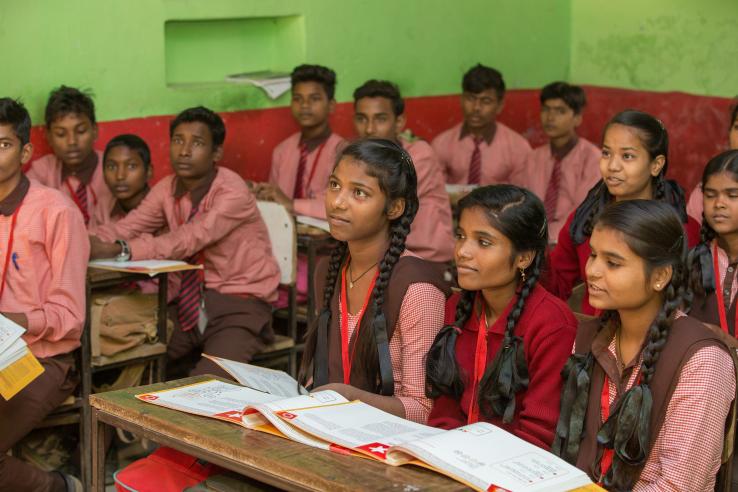
In 2013, Seema and co-authors partnered with the NGO Breakthrough to evaluate the impact of a school-based gender equity curriculum on adolescents’ gender attitudes in Haryana, India. The randomized evaluation included interactive classroom discussions on gender equality that challenged both adolescent girls’ and boys’ biased perceptions regarding girls’ education and women’s work. Held over two and a half years, the curriculum succeeded in leading students to express more progressive gender attitudes. The program also led to behavioral changes, particularly among boys, who reported performing more household chores.
The study in Haryana showed that adolescents’ attitudes towards gender equality can be changed, especially when targeted at an age when they are still forming opinions. In early 2021, the curriculum was adopted by public schools across Punjab, India in response to these results and will be rolled out to 600,000 students in Grades 6 to 8 in the state.
A self-described “latecomer” to the field of economics, Seema began her journey in an unexpected way: as a theoretical physicist. After realizing that her interests lay at the intersection of quantitative analysis and issues closer to earth that impact society and people, she made the switch to economics. Her pivot to development economics, however, came later.
“I started out my graduate studies expecting to become a labor economist, focused on the United States. My interest in development economics was sparked by taking a development economics course in my first year, taught by Abhijit Banerjee, Esther Duflo, and Michael Kremer.”
Looking back, she finds valuable insight from her early career dilemma.
“A distinction I’ve since come to appreciate is between how much you like consuming knowledge in a field versus producing it,” she says. “It turns out that I enjoy doing research in economics more than in physics.”
To students faced with similar career decisions, she emphasizes that a practical view is often more telling than grand, existential questions: “Think about how you like spending your days—what kind of job is going to energize your day-to-day life?”
Michela Carlana is an assistant professor of public policy at the Harvard Kennedy School. From researching the subtle role of bias and motivation in student outcomes to rapidly launching and evaluating scalable programs to combat learning loss, Michela’s work reflects a commitment to reducing inequality through focusing on education, gender, and migration.
To read the full profile, please download the PDF.
Michela Carlana is an assistant professor of public policy at the Harvard Kennedy School. From researching the subtle role of bias and motivation in student outcomes to rapidly launching and evaluating scalable programs to combat learning loss, Michela’s work reflects a commitment to reducing inequality through focusing on education, gender, and migration.
Michela’s work is driven by a long-held conviction in the power of education and its ability to help individuals actualize skills and opportunities for a better future. Yet, “many children are left behind when they are induced into early educational choices that do not allow them to achieve their full potential,” she notes. Holding this idea that “opportunity begets opportunity,” her research focuses on identifying inequities in education and programs that may help close the gaps.
“I go after deep economic issues and think about concrete policy interventions that may help address those challenges,” Michela explains. Recognizing that stereotypes and cultural norms are often a subtle but widespread barrier to equality, Michela's research has explored the impacts of revealing teachers' implicit biases. In her home country of Italy, Michela and co-authors evaluated the impact of informing teachers of their implicit stereotypes towards immigrant students on end-of-year grading, finding that teachers unaware of their biases gave better grades once they were made aware.
To generate evidence on policy-relevant issues, Michela grounds her research in discussions with the populations she hopes to serve.
“A key component of my work is observing and talking with individuals, especially students, teachers, and parents, to shape my research questions,” she describes.
A conversation with a teacher while on a data collection visit inspired Michela to focus on implicit bias as a constraint to opportunity: “One of the teachers told me she recommended the vocational track to a high-performing immigrant student because ‘you never know whether immigrant children can get the necessary family support to do well during high school.’”
During the Covid-19 pandemic, Michela saw governments’ focus on increasing access to technology to address learning losses as insufficient to tackle the deep challenges students were facing, including a sense of isolation that affected not only their learning, but also their psychological well-being. In 2020, she, along with frequent co-author Eliana La Ferrara, pioneered the Tutoring Online Project (TOP), a virtual program aiming to close the education gap for disadvantaged students during the pandemic.
They were able to leverage extensive past experience in conducting educational interventions in Italian schools to rapidly launch and evaluate this intervention amidst the pandemic. Their results provided crucial insight into a scalable program that could be implemented across countries lagging behind with school reopenings. “There are few interventions in economics of education that have proven as effective as tutoring in helping student achievements,” Michela notes.
Michela’s relentless dedication to studying constraints to equality of opportunities in education is evident in her work. She continues to create and evaluate programs that help close educational gaps.
Michela Carlana has been a J-PAL affiliate since 2020.
Karthik Muralidharan is the Tata Chancellor’s Professor of Economics at the University of California, San Diego and also serves as a J-PAL Board member and co-chair of the Education sector. A pioneering researcher in education and service delivery, Karthik has profoundly influenced social service delivery in developing countries (especially India) through research and policy partnerships with governments and a body of work spanning over twenty years.
To read the full profile, please download the PDF version here.
Karthik Muralidharan is the Tata Chancellor’s Professor of Economics at the University of California, San Diego and also serves as a J-PAL Board member and co-chair of the Education sector. A pioneering researcher in education and service delivery, Karthik has profoundly influenced social service delivery in developing countries (especially India) through research and policy partnerships with governments and a body of work spanning over twenty years.
Growing up in India in the 1980s, and observing changes induced by economic liberalization in the 1990s, J-PAL affiliate Karthik Muralidharan developed an interest in the transformative power of public policy at a young age. This focus, along with a passion for education, launched Karthik on a path that would soon become his life’s work.
As a development economist, Karthik studies how scarce resources should be allocated to maximize impact. This research is particularly important to governments seeking to design and implement cost-effective programs on a large scale, where mistakes can be costly and potentially difficult to revert. “Over the past twenty years I’ve seen how there is stunning variation in the cost-effectiveness of policies that sound equally sensible sitting in a conference room,” he observes. “The job of the researcher is to bring objective evidence into the discussion.”
In his role as Co-Chair of the Education sector at J-PAL, Karthik guides the synthesis and dissemination of lessons from hundreds of randomized evaluations on education topics. He also chairs J-PAL’s Post-Primary Education Initiative, which funds randomized evaluations that develop and test innovative solutions for improving access and quality of post-primary education in low- and middle-income countries. Through his leadership at J-PAL, Karthik plays a direct role in shaping the field of education research and policy.
Karthik leads many evaluations related to education and social service delivery, with a focus on helping governments identify the most cost-effective approaches to improving outcomes on a fixed budget. For instance, his work has shown that in low- and middle-income country settings, an unconditional doubling of teacher salaries may have no impact on learning outcomes, while even modest amounts of performance-linked pay to teachers can have large positive impacts. School grants on their own may have no impact on learning, while combining them with performance-based pay for teachers can sharply increase the effectiveness of the grants. Finally, simply providing computer hardware may have no impacts on learning, whereas using technology to personalize instruction may have large gains.
These studies and Karthik’s broader body of research illustrate the wide contrast in cost-effectiveness of public policies and the importance of evaluation as a tool for decision-making.
Working in partnership with central and state governments has underpinned much of Karthik’s most ambitious and influential research. “There is an incredible appetite for good analytical inputs among policymakers,” he notes. Although it can take years to evaluate the impact of some programs, Karthik emphasizes the importance of seeking out this knowledge across programs and contexts. He notes that the impact of research is not usually that of a single study, but rather a body of work that can be synthesized to reveal robust patterns in the evidence and be used to guide policy.
A unifying principle of Karthik’s career is his relentless dedication to improving lives. “One of the best pieces of advice I got from my advisor [Nobel Prize-winning economist and longtime J-PAL affiliate] Michael Kremer, was, ‘Never apologize for the fact that your fundamental motivation is to make sure 200 million kids in India have a better education, and that economics is a tool to get you there.’ It's a very powerful tool, but it's not an end in itself.” In his commitment to ensuring that research has policy relevance, Karthik’s work at J-PAL and longterm partnerships with governments have been instrumental to policy change on a large scale.
Karthik Muralidharan has been a J-PAL affiliate since 2009. For more information about J-PAL and to read about Karthik’s research, visit povertyactionlab.org. You can learn more about Karthik’s journey in education research and policy, in the following conversation.
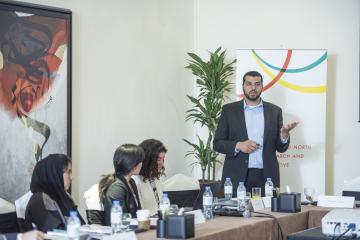
Adam Osman is an Assistant Professor of Economics at the University of Illinois at Urbana-Champaign and Co-Scientific Director at J-PAL Middle East and North Africa (MENA). Adam’s work using randomized evaluations to test theories about improving the lives of the poor serves to fill the gap in research on the unique economic landscape of the Middle East and provide the foundations for evidence-driven policy.
To read the full profile, please download the PDF version here.
Adam Osman is an Assistant Professor of Economics at the University of Illinois at Urbana-Champaign and Co-Scientific Director at J-PAL Middle East and North Africa (MENA). Adam’s work using randomized evaluations to test theories about improving the lives of the poor serves to fill the gap in research on the unique economic landscape of the Middle East and provide the foundations for evidence-driven policy.
Born to immigrant parents in the United States, Adam spent many childhood summers in his parents’ home country of Egypt, where he recognized early on that many of the opportunities he enjoyed in New York were not available to young Egyptian students. When he was introduced to the field of development economics as a graduate student, he decided to dedicate his studies to addressing these striking inequalities.
“There is no difference in the quality of people who live in low-income countries versus high-income countries, but there is a big difference in their outcomes,” he says. “That stark difference always just sticks with me; the tremendous chasm between what we take for granted in everyday life and what many people lack.”
Adam uses randomized evaluations, also known as randomized controlled trials (RCTs), to examine the effectiveness of poverty alleviation solutions in the Middle East and North Africa. He focuses on themes of finance and labor markets, such as youth employment, market access, and financial inclusion. “MENA is one of the most understudied regions in the world, especially when we consider the relatively low number of RCTs,” Adam explains. He goes on to point out that despite strong local efforts and philanthropic interest in poverty alleviation programs, “The region is still in the early days of taking seriously the need for evidence-based policies.”
While Adam has been helping set up J-PAL’s presence in the region since 2014, J-PAL MENA, located at the American University in Cairo, officially opened in 2020 as J-PAL’s newest regional office. J-PAL MENA leads research projects, builds policy partnerships, and assists partners with scale-ups in the region. Adam serves as Co-Scientific Director of the office along with Bruno Crépon (ENSAE and École Polytechnique). Adam oversees randomized evaluations covering a wide range of topics including social protection, education, transportation, and gender, among others.
As Scientific Director, Adam encourages the research staff at J-PAL MENA to take charge of evaluations and develop their skills as independent researchers. “What I am particularly proud of,” he says, “is that we have gone from a situation where every evaluation required really heavy guidance from affiliates to now being able to implement complicated RCTs with minimal input from affiliates because staff capacity has grown so much.”
He hopes that J-PAL MENA will open up new opportunities for researchers to run their own evaluations and use their work for positive change. “Right now, we’re able to open the doors to outside researchers who want to implement high-quality RCTs in the region and have developed the infrastructure to let them hit the ground running. But, my ten-year goal is to help train and support the next generation of local researchers in the region so that they can generate high-quality evidence and answer policy-relevant questions themselves using RCTs,” he says. He also hopes that broadening the existing J-PAL research infrastructure and continuing to build appreciation for the importance of generating high-quality evidence about public policies will encourage prospective scientists, particularly women, from countries in MENA to enter the field of development economics by providing clear avenues for career success.
Adam firmly believes that evidence is necessary for building effective poverty reduction policies. To him, one of the most exciting parts of his work is finding evidence that is sometimes counterintuitive, but he notes that surprising results often provide insight into aspects of the world that we were overlooking. “If we knew the answers, we wouldn’t have to do the research,” he says. “The open questions are what makes this work really exciting.”