J-PAL J-PAL
The Abdul Latif Jameel Poverty Action Lab
  • About
    • Overview
    • People
      • Affiliated Professors
      • Invited Researchers
      • J-PAL Scholars
      • Board
      • Leadership
      • Staff
    • Strengthening Our Work
    • Code of Conduct
    • Initiatives
    • Events
    • Blog
    • News
    • Press Room
  • Offices
    • Overview
    • Global
    • Africa
    • Europe
    • Latin America and the Caribbean
      • Growing Futures
    • Middle East and North Africa
    • North America
    • South Asia
    • Southeast Asia
  • Sectors
    • Overview
    • Agriculture
    • Crime, Violence, and Conflict
    • Education
    • Environment, Energy, and Climate Change
    • Finance
    • Firms
    • Gender
    • Health
    • Labor Markets
    • Political Economy and Governance
    • Social Protection
  • Evaluations
  • Research Resources
    • About Us
    • Our Work
    • Join ASPIRE
    • Newsroom
  • Policy Insights
  • Evidence to Policy
    • Pathways and Case Studies
    • The Evidence Effect
  • Blog
  • Careers
  • Courses
  • For Affiliates
  • Support J-PAL

Utility menu

  • Blog
  • Careers
  • Courses
  • For Affiliates
  • Support J-PAL

Quick links

  • Evaluations
  • Research Resources
  • Policy Insights
  • Evidence to Policy
    • Pathways and Case Studies
    • The Evidence Effect
  • About

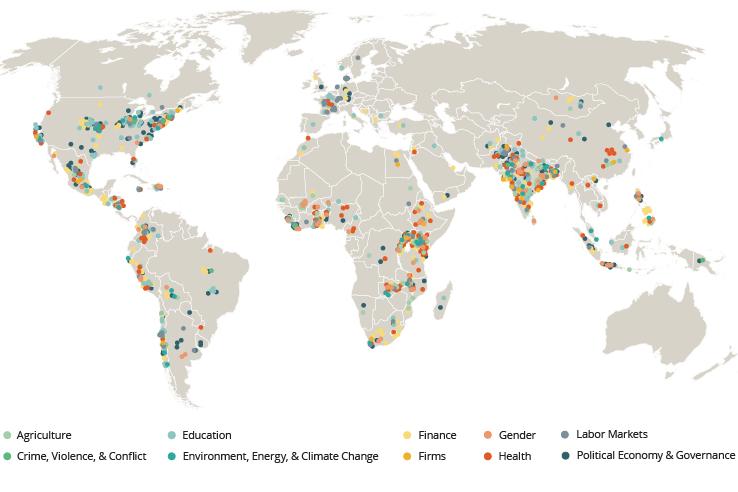
    The Abdul Latif Jameel Poverty Action Lab (J-PAL) is a global research center working to reduce poverty by ensuring that policy is informed by scientific evidence. Anchored by a network of more than 1,100 researchers at universities around the world, J-PAL conducts randomized impact evaluations to answer critical questions in the fight against poverty.

    • Overview

      The Abdul Latif Jameel Poverty Action Lab (J-PAL) is a global research center working to reduce poverty by ensuring that policy is informed by scientific evidence. Anchored by a network of more than 1,100 researchers at universities around the world, J-PAL conducts randomized impact evaluations to answer critical questions in the fight against poverty.

      • Affiliated Professors

        Our affiliated professors are based at over 130 universities and conduct randomized evaluations around the world to design, evaluate, and improve programs and policies aimed at reducing poverty. They set their own research agendas, raise funds to support their evaluations, and work with J-PAL staff on research, policy outreach, and training.

      • Invited Researchers
      • J-PAL Scholars
      • Board
        Our Board of Directors, which is composed of J-PAL affiliated professors and senior management, provides overall strategic guidance to J-PAL, our sector programs, and regional offices.
      • Leadership
      • Staff
    • Strengthening Our Work

      Our research, policy, and training work is fundamentally better when it is informed by a broad range of perspectives.

    • Code of Conduct
    • Initiatives
      J-PAL initiatives concentrate funding and other resources around priority topics for which rigorous policy-relevant research is urgently needed.
    • Events
      We host events around the world and online to share results and policy lessons from randomized evaluations, to build new partnerships between researchers and practitioners, and to train organizations on how to design and conduct randomized evaluations, and use evidence from impact evaluations.
    • Blog
      News, ideas, and analysis from J-PAL staff and affiliated professors.
    • News
      Browse news articles about J-PAL and our affiliated professors, read our press releases and monthly global and research newsletters, and connect with us for media inquiries.
    • Press Room
      Based at leading universities around the world, our experts are economists who use randomized evaluations to answer critical questions in the fight against poverty. Connect with us for all media inquiries and we'll help you find the right person to shed insight on your story.
  • Offices
    J-PAL is based at MIT in Cambridge, MA and has seven regional offices at leading universities in Africa, Europe, Latin America and the Caribbean, Middle East and North Africa, North America, South Asia, and Southeast Asia.
    • Overview
      J-PAL is based at MIT in Cambridge, MA and has seven regional offices at leading universities in Africa, Europe, Latin America and the Caribbean, Middle East and North Africa, North America, South Asia, and Southeast Asia.
    • Global
      Our global office is based at the Department of Economics at the Massachusetts Institute of Technology. It serves as the head office for our network of seven independent regional offices.
    • Africa
    • Europe
    • Latin America and the Caribbean
    • Middle East and North Africa
    • North America
    • South Asia
    • Southeast Asia
  • Sectors
    Led by affiliated professors, J-PAL sectors guide our research and policy work by conducting literature reviews; by managing research initiatives that promote the rigorous evaluation of innovative interventions by affiliates; and by summarizing findings and lessons from randomized evaluations and producing cost-effectiveness analyses to help inform relevant policy debates.
    • Overview
      Led by affiliated professors, J-PAL sectors guide our research and policy work by conducting literature reviews; by managing research initiatives that promote the rigorous evaluation of innovative interventions by affiliates; and by summarizing findings and lessons from randomized evaluations and producing cost-effectiveness analyses to help inform relevant policy debates.
    • Agriculture
      How can we encourage small farmers to adopt proven agricultural practices and improve their yields and profitability?
    • Crime, Violence, and Conflict
      What are the causes and consequences of crime, violence, and conflict and how can policy responses improve outcomes for those affected?
    • Education
      How can students receive high-quality schooling that will help them, their families, and their communities truly realize the promise of education?
    • Environment, Energy, and Climate Change
      How can we increase access to energy, reduce pollution, and mitigate and build resilience to climate change?
    • Finance
      How can financial products and services be more affordable, appropriate, and accessible to underserved households and businesses?
    • Firms
      How do policies affecting private sector firms impact productivity gaps between higher-income and lower-income countries? How do firms’ own policies impact economic growth and worker welfare?
    • Gender
      How can we reduce gender inequality and ensure that social programs are sensitive to existing gender dynamics?
    • Health
      How can we increase access to and delivery of quality health care services and effectively promote healthy behaviors?
    • Labor Markets
      How can we help people find and keep work, particularly young people entering the workforce?
    • Political Economy and Governance
      What are the causes and consequences of poor governance and how can policy improve public service delivery?
    • Social Protection
      How can we identify effective policies and programs in low- and middle-income countries that provide financial assistance to low-income families, insuring against shocks and breaking poverty traps?
Displaying 2911 - 2925 of 7150
Children outside their school
Evaluation

Vouchers for Private Schooling in Colombia

Colombia used lotteries to distribute vouchers which partially covered the cost of private secondary school for students who maintained satisfactory academic progress. Three years after the lotteries, winners were about 10 percentage points more likely to have finished 8th grade, primarily because they were less likely to repeat grades, and scored 0.2 standard deviations higher on achievement tests. In the long-run, the PACES program increased secondary school completion rates by 15 to 20 percent.
Books and pen
Evaluation

Peer Effects, Alcohol, and College Roommates in the United States

Researchers conducted a randomized evaluation to measure the impact of having a roommate who drank alcohol frequently before college on college students' grade point averages (GPAs). Results show that, while female students' GPAs were not affected by their roommate's drinking prior to college, male students' GPAs were significantly reduced by being assigned to a roommate who drank frequently before college.
College students studying together
Evaluation

Peer Effects, Diversity, and College Roommates in the United States

Researchers in the United States assessed the impact on college students of having a roommate from a different race. White students assigned to a black roommate were more likely to endorse affirmative action policies than those assigned to a white roommate. Other factors, such as having roommates from high-income or low-income backgrounds, also influenced students' behavior and attitudes towards social issues.
students in a classroom in Kenya
Evaluation

Teacher Incentives Based on Students' Test Scores in Kenya

In partnership with International Child Support, researchers designed and evaluated an incentives program that provided salary bonuses to teachers in Kenya based on the performance of their school as a whole on annual district exams. While results show that the incentives program led to an increase in student test scores, researchers believe that this increase was due to improved test-taking strategies and "cramming," rather than an increase in overall knowledge. The program did not have an impact on test scores in the long-run.
Women stand in line waiting to cast their vote at a polling station in in Barpeta, Assam, India.
Blog

Can information lead to better voting decisions? Evidence from information campaigns in India

Out of 539 winners in India’s 2019 general election for the lower house of Parliament, 29 percent have, at some point, been charged with serious criminal cases, including cases related to rape, murder, attempt to murder, kidnapping, and crimes against women. Why do voters elect criminal politicians...
Person

Mary Pietrusko

Water point in Malawi
Evaluation

The Roles of Water Treatment Subsidies and Community Health Workers in Improving Child Health and Chlorine Usage in Malawi

Researchers partnered with Partners in Health (PIH) to conduct a randomized evaluation to test the impact of monthly coupons and different CHW delivery methods on chlorine usage and child health outcomes in Southern Malawi. They find that the coupon program had stronger impacts on both outcomes and was more cost-effective than having CHWs distribute free chlorine to households during routine monthly visits.
A close-up of a man smiling at the camera
Blog

Adrien Bouguen, J-PAL ‘12, on his path from research assistant to assistant professor

Adrien Bouguen joined J-PAL Europe as a research assistant in 2009, where he played a central role in establishing our then-fledgling European office. Now an assistant professor of economics at Santa Clara University, his research focuses on the economics of education and child development.
TaRL activities taking place in a classroom in Gujarat, India
Evidence to Policy Case Study
Case study

Teaching at the Right Level to improve learning

Reorienting instruction has improved learning opportunities for over 60 million students in India and Africa.
Kenya’s National School-Based Deworming Programme rolls out in Kwale province, Kenya.
Evidence to Policy Case Study
Case study

Deworming to increase school attendance

After research found that school-based distribution of deworming pills in areas with high infection rates boosted health and school attendance, the approach has been scaled to reach over 280 million children in 2019.
A woman receives a free insecticide-treated bednet at a health clinic in Kakamega County, Kenya.
Evidence to Policy Case Study
Case study

Free bednets to fight malaria

Evidence from randomized evaluations played a role in shifting global opinion to support free distribution of key preventive health products.
Police training improves public perception and police morale.
Evidence to Policy Case Study
Case study

Skills training to strengthen police performance

Training in soft skills for police in Rajasthan, India improved public perceptions of their performance.
Indonesians participate in their community block grants meetings and decision-making process as part of Generasi, 2007
Evidence to Policy Case Study
Case study

Incentivized community grants for aid effectiveness

A performance-incentivized community grant program shown to accelerate improvements in health reached about 4.9 million people from 2010 to 2018 and generated important lessons for future programs to reduce childhood stunting in Indonesia.
TNP2K commercial about the social protection identification card.
Evidence to Policy Case Study
Case study

Targeted information to improve social assistance

A government scale-up has improved access to targeted social programs for 65 million people.
Woman patient with bandage compression knee brace to support injury on hospital bed.
Evaluation

The Spillover Effects of a Nationwide Medicare Bundled Payment Reform

Researchers evaluated the spillover effects of a nationwide Medicare bundled payment reform on privately insured Medicare Advantage (MA) patients who were not targeted by the reform. They found that the bundled payment reform’s spillover effect on non-targeted MA patients was similar to the bundled payment reform’s direct effect on targeted Traditional Medicare patients.

Pagination

  • First page « First
  • Previous page ‹
  • …
  • Page 193
  • Page 194
  • Current page 195
  • Page 196
  • Page 197
  • …
  • Next page ›
  • Last page Last »
J-PAL

J-PAL

400 Main Street

E19-201

Cambridge, MA 02142

USA

Contact

+1 617 324 6566

[email protected]


Press Room

Stay Informed

Receive our newsletters

Subscribe


Privacy Policy

Accessibility

MIT